Welcome
Congratulations on your new appointment as Commissioner to the Board of the Housing Authority of the County of Merced (Authority).
The Authority is excited to have you join its team.
Enclosed you will find information that will be very useful to you in your new role.
- Authority's Mission Statement
- Listing of All Authority Projects
- Organizational Chart
- Board of Commissioners By-lays
- The Commissioners Handbook by Herb Small
- The Brown Act Handbook
Mission Statement
The Housing Authority of the County of Merced offers affordable housing opportunities to our community by providing access to a variety of services and programs to promote self-sufficiency and to enhance the quality of life for those we serve.
We strive to provide housing assistance, training, education, and homeownership opportunities by participation in the acquisition, development and operation of affordable housing through the utilization of various funding sources and partnerships that builds pride and responsibility in our residents.
We are committed to giving our clients and each other courtesy, respect and quality customer care. We will ethically apply the laws, rules and regulations that govern this Agency, and further affirm the value and dignity of each person we serve and with whom we work.
↑ Back to topBoard of Commissioners & Organizational Chart
The Housing Authority is governed by a seven-member Board of Commissioners, with daily operations led by the Executive Director and a team of department directors. The chart below reflects the staffing structure as of the original handbook (revised January 2022); the current Board roster is shown on the Board of Commissioners page.
Organizational structure — revised January 2022
Evelyne Dorsey · Jose Resendez
Authority Property Inventory
The Housing Authority owns, operates, and maintains the following housing communities and programs:
| Program / Community | Units |
|---|---|
| Housing Choice Voucher | 2,950 |
| Public Housing | 421 |
| Valley View Homes | 73 |
| Merced Commons I/II | 147 |
| Oak Terrace | 65 |
| Migrant Farmworker | 228 |
| Year Round Farm Labor | 50 |
| Total Units | 3,934 |
About the Authority
Since 1942 the Housing Authority of the County of Merced has provided affordable housing to low and very-low income families throughout the county. The Authority operates under the auspice of a seven-member Board of Commissioners — five members from the community at large and two members who are residents of the Authority.
Funding for the various programs is provided by the federal Department of Housing and Urban Development (HUD), the federal Rural and Economic Development Administration, and through the State Department of Housing and Community Development.
↑ Back to topAuthority Properties & Communities
The Housing Authority owns, operates, and maintains the housing communities listed below across Merced County. The information here was current at the time of the original handbook (2022) and may not reflect recent renovations or changes.
Service Area

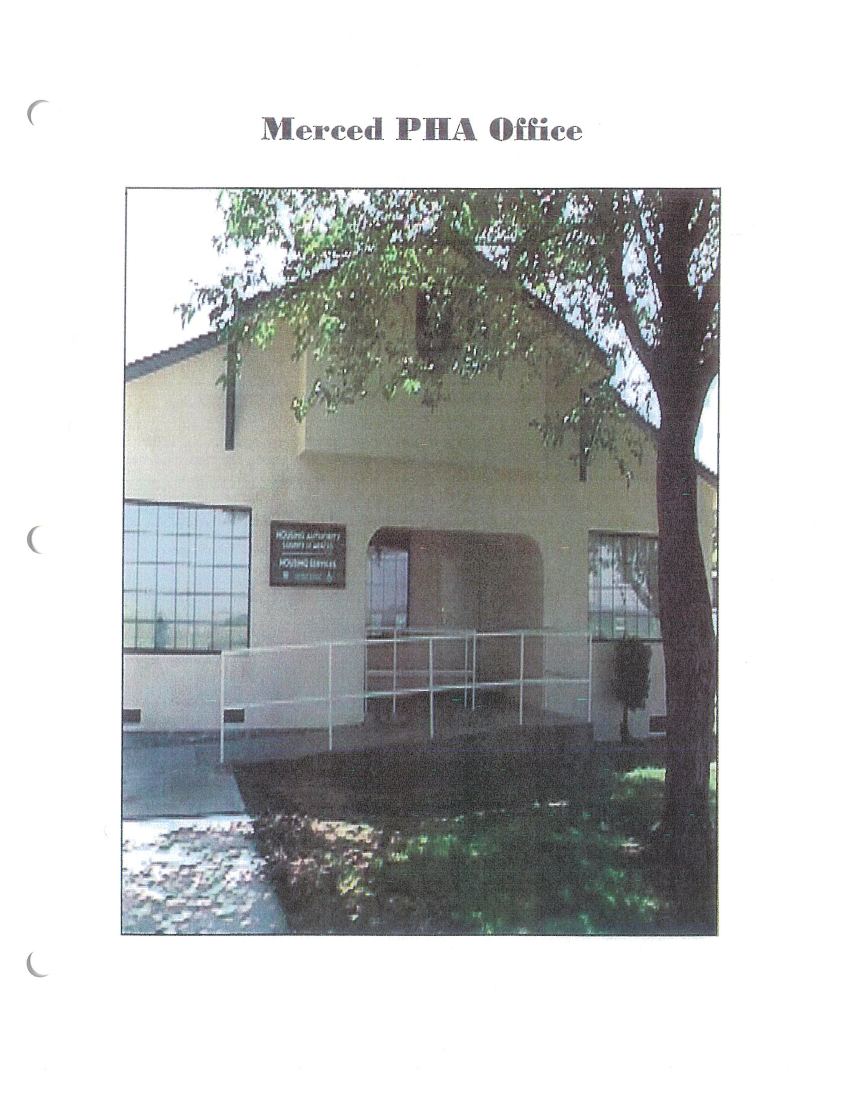
Authority Offices


Public Housing Communities
Conventional public housing communities owned and operated by the Authority. Click View site / floor plan on any card to see the property layout.
Merced
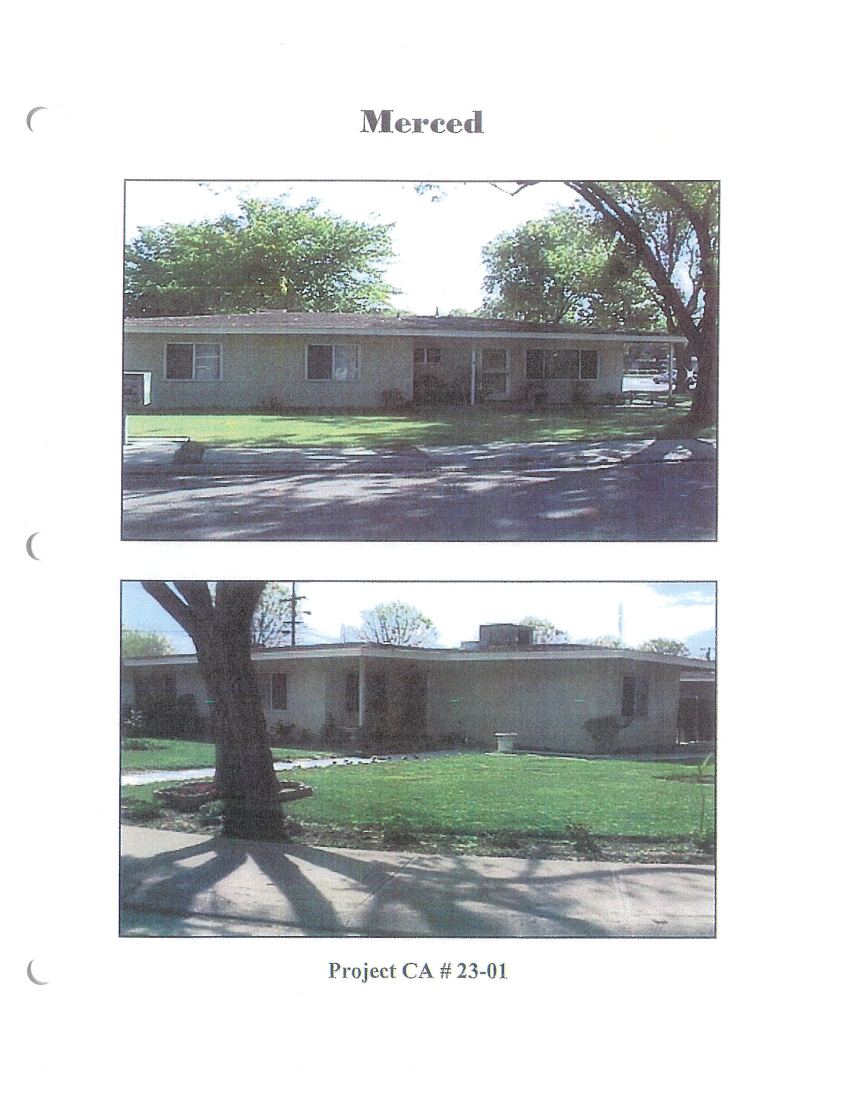
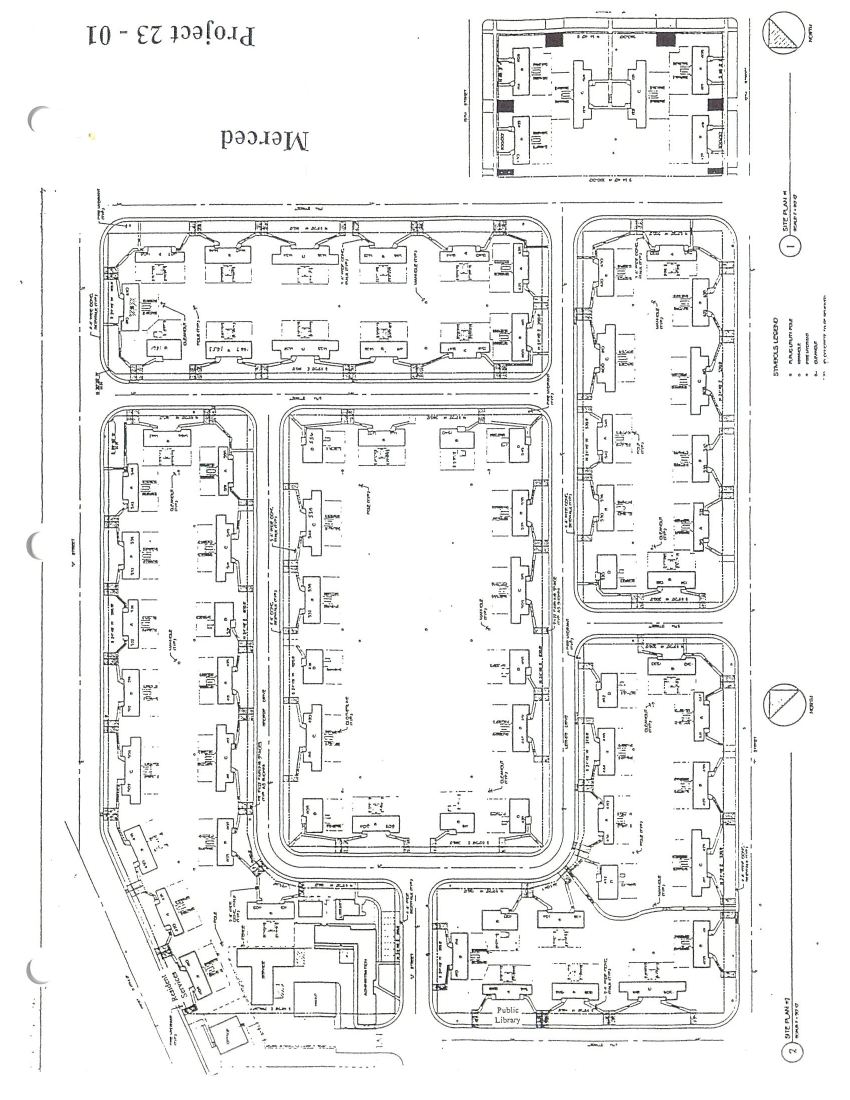
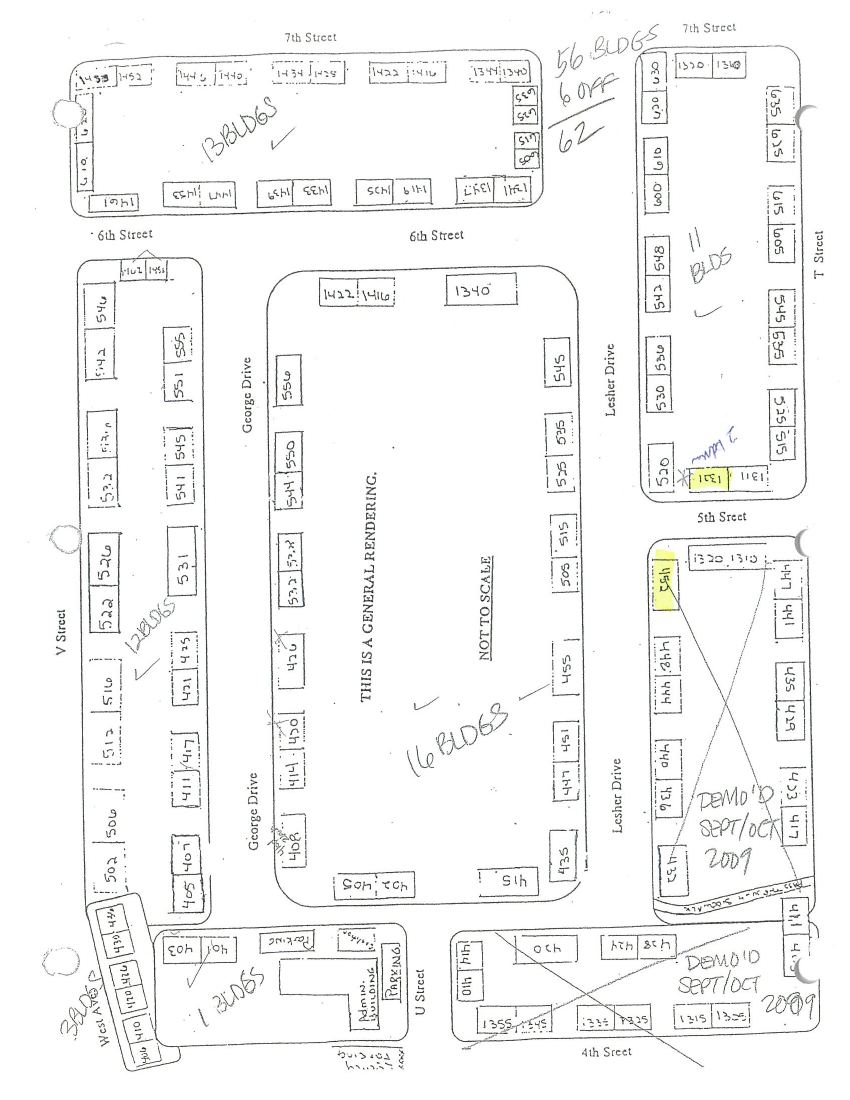
Located in south Merced between "V," "T," and 8th Streets these duplex units offer yards along with fenced in back yards. There are many trees through out for summer shade with a large park area in the center of the project. Included in this project is a Resident Services Center, offering programs for adults and children, plus a public library. This complex was originally built in 1951, modernized in 1992 and again starting in 1998.
Building Data
- Total # of Buildings
- 64
- 1 Bedroom
- 22
- Total # of Units
- 101
- 2 Bedroom
- 48
- Designated Elderly
- 0
- 3 Bedroom
- 20
- Handicap Units
- 0
- *4 Bedroom
- 11
Unit Amenities: central heat and AC, gas stoves, refrigerators, fenced backyards, private parking pads, storage buildings.
Nearby Schools: Sheehy Elementary and Tenaya Jr. High.
Nearby Services: Housing Authority Offices, Resident Center, day care center, public library, medical facilities, and business district, close to industrial park.
View site / floor plan
Merced
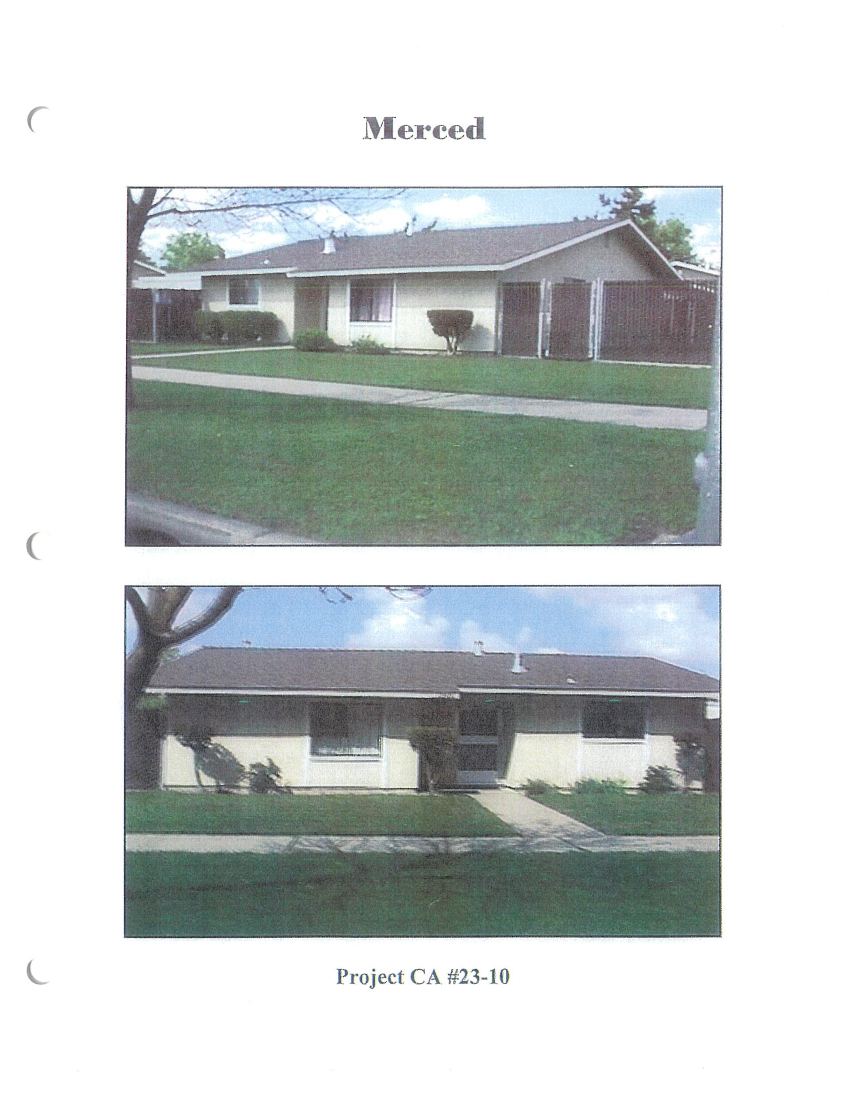
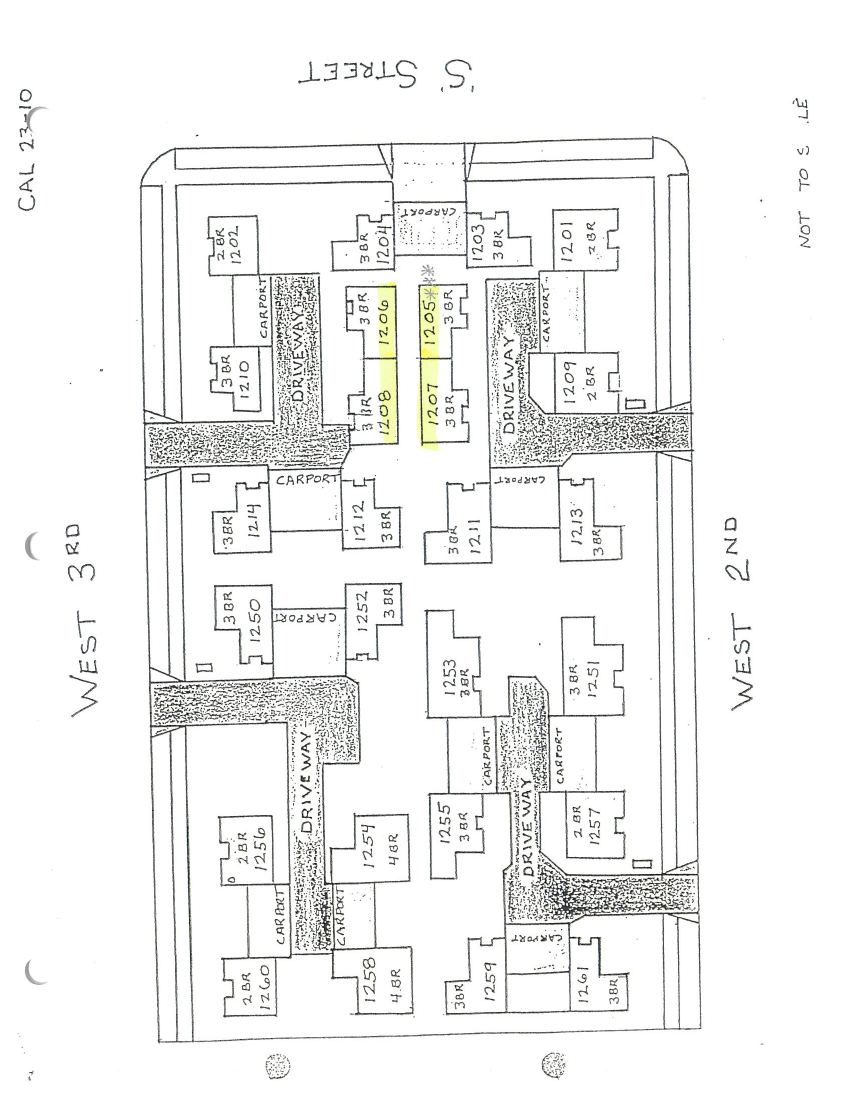
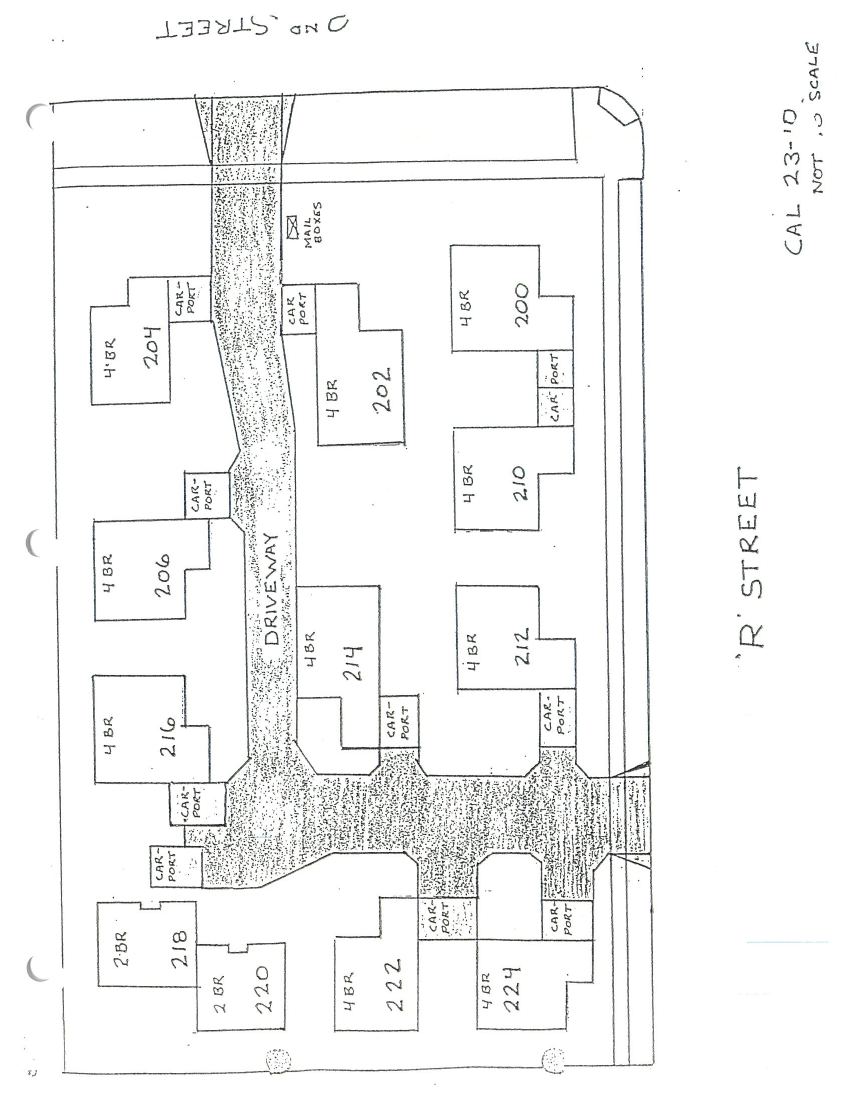
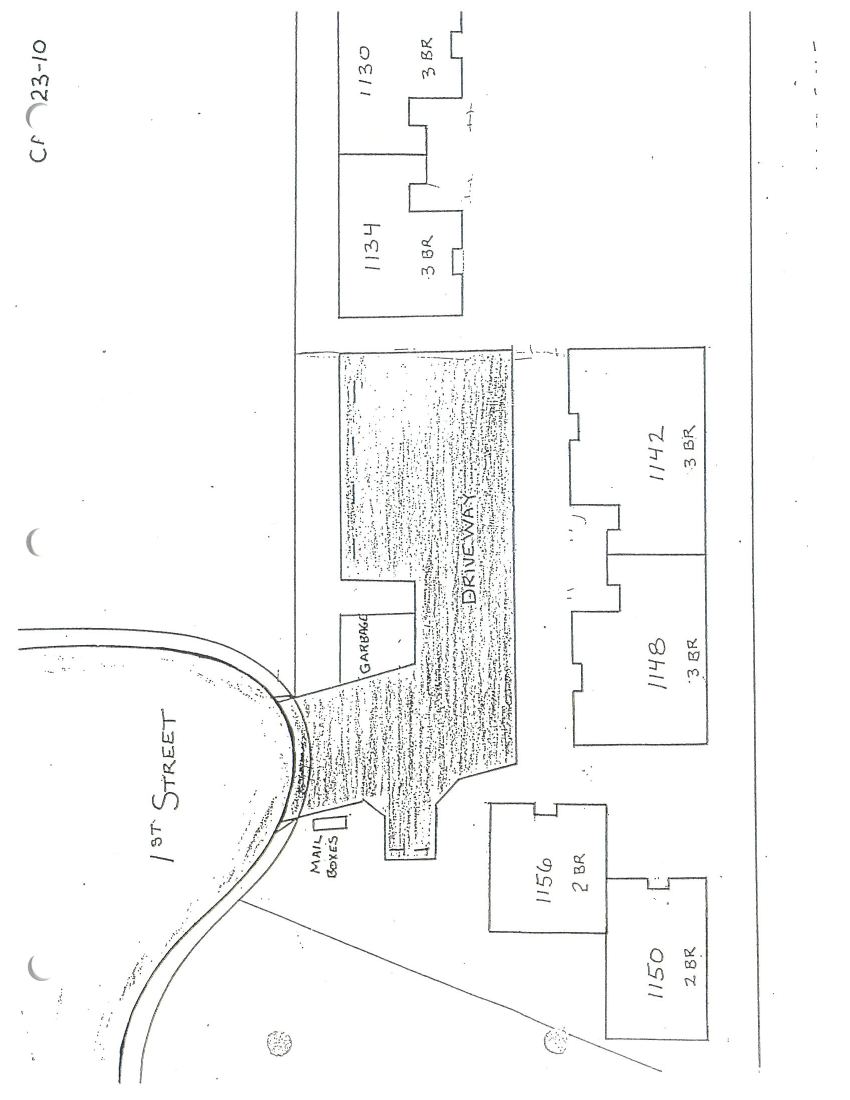
This project, located in south Merced, is built on three separate parcels. The first location is on 2", 3", and "S" Streets, the next is located at "S" and 1st Street, and the final at "R" and 2™ Street. These single and duplex units come with front yards, fenced backyards, and carports. All areas are within walking distance to the Housing Authority offices, Resident Services Center with its programs for adults and children and the learning center with medical facility and library. First built in 1980 this project was modernized in 1994.
Building Data
- Total # of Buildings
- 38
- 1 Bedroom
- 0 Units N/A
- Total # of Units
- 44
- 2 Bedroom
- 10 Units 1024 square feet
- Designated Elderly
- 0
- 3 Bedroom
- 22 Units 1180 square feet
- Handicap Units
- 4
- 4 Bedroom
- 12 Units 1304 square feet
Unit Amenities: central heat and AC, private patios and backyards, off- street carport parking, gas stoves, and refrigerators.
Nearby Schools: Sheehy Elementary and Tenaya Jr. High.
Nearby Services: close to industrial park, Housing Authority offices, public library, downtown Merced and medical facilities.
View site / floor plans
Merced Senior Complex
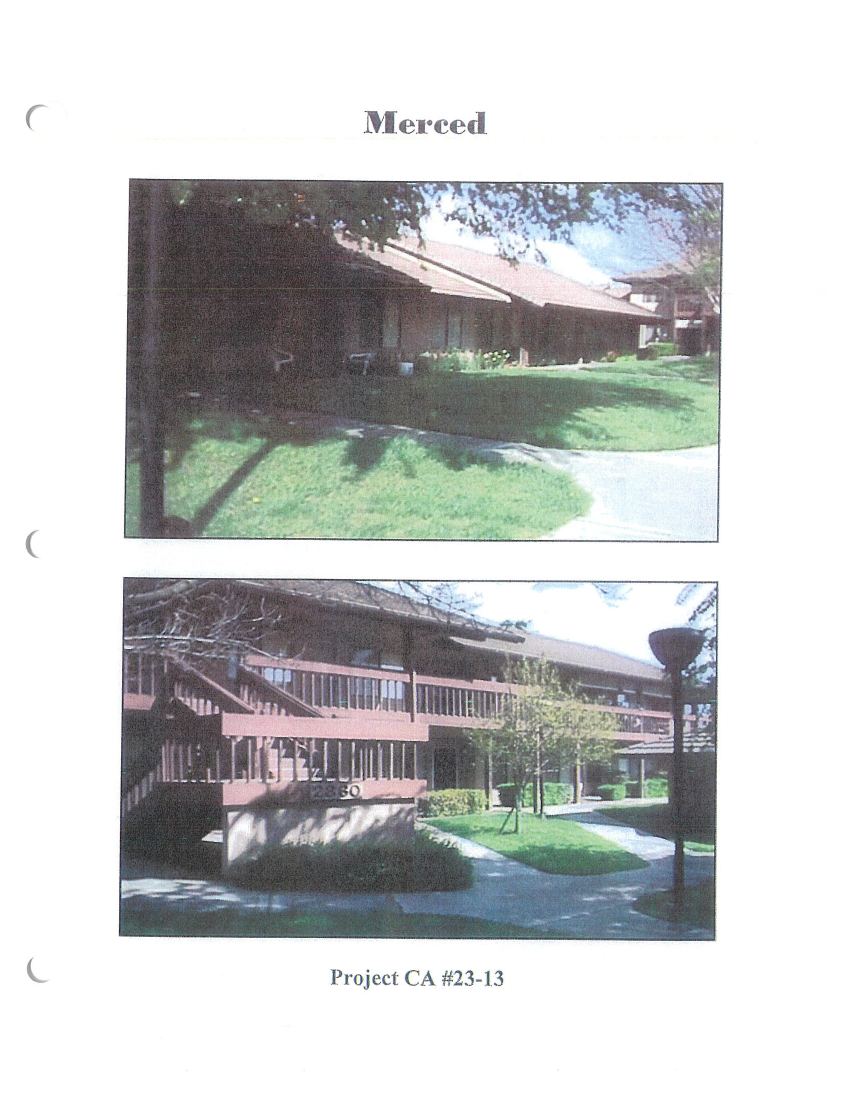
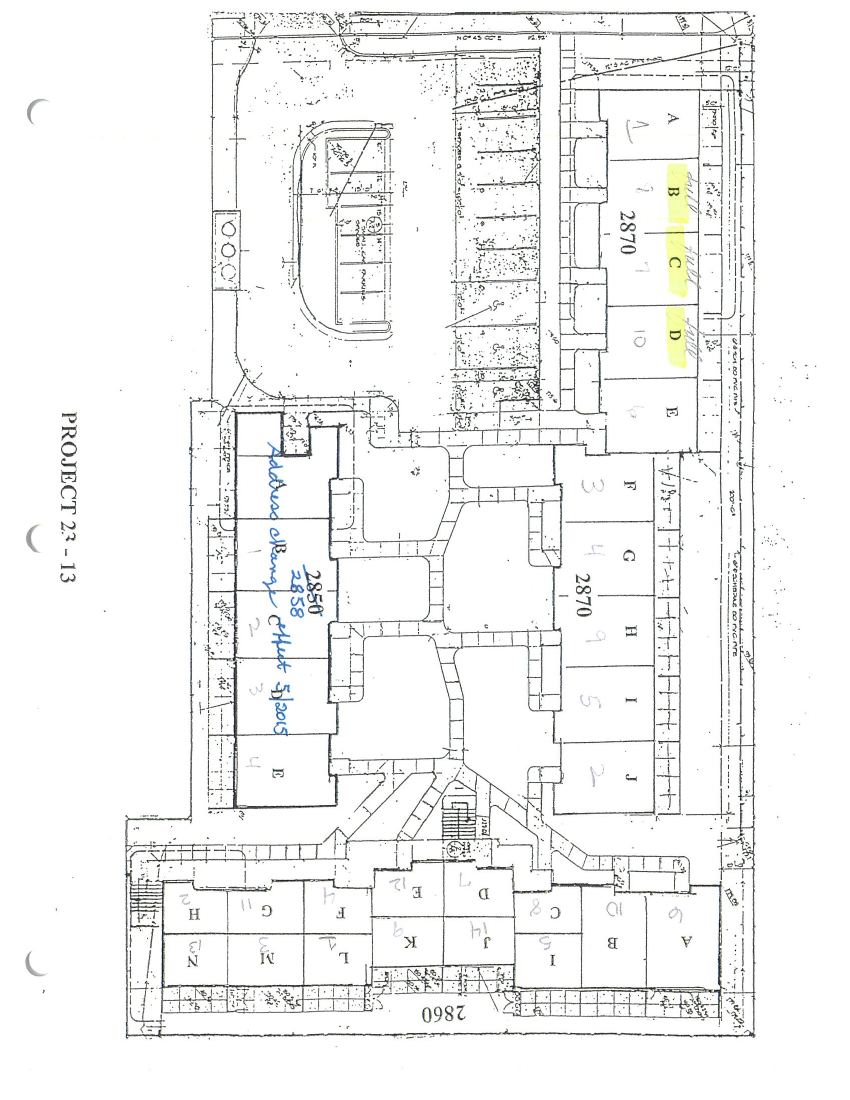
Serene and peaceful is the best way to describe this project for seniors. This fully landscaped complex in north Merced, is centrally located to shopping centers and the Merced Mall. These one and two story apartments, built in 1983, offer seniors comfortable living with all the amenities.
Building Data
- Total # of Buildings
- 3
- Total # of Units
- 28
- Designated Elderly
- 25
- Handicap Units
- 3
- 1 bedroom
- 28
- Square footage
- 680
Unit Amenities: central heat/AC, carpets, vertical blinds, emergency pull alarms, private patios, and yard maintenance.
Nearby Services: close to shopping centers, Merced Mall, restaurants, doctors offices and bus transportation.
View site / floor plan
Atwater
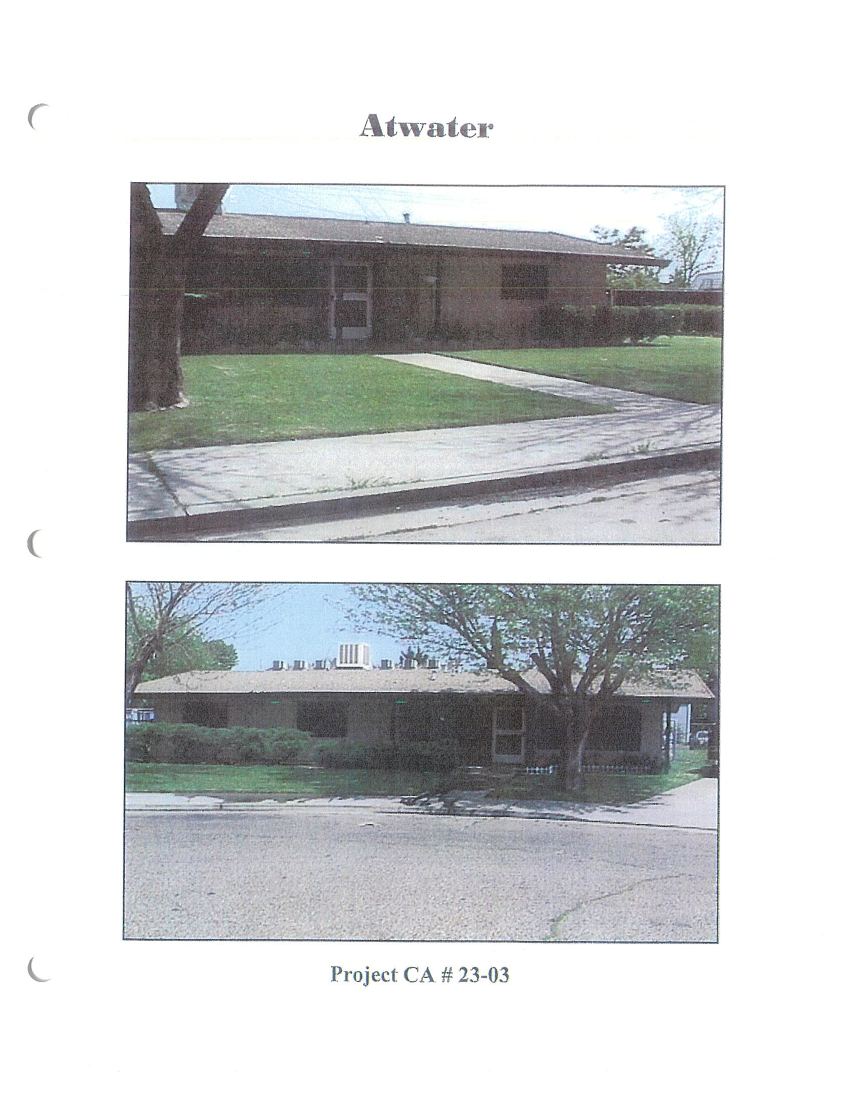
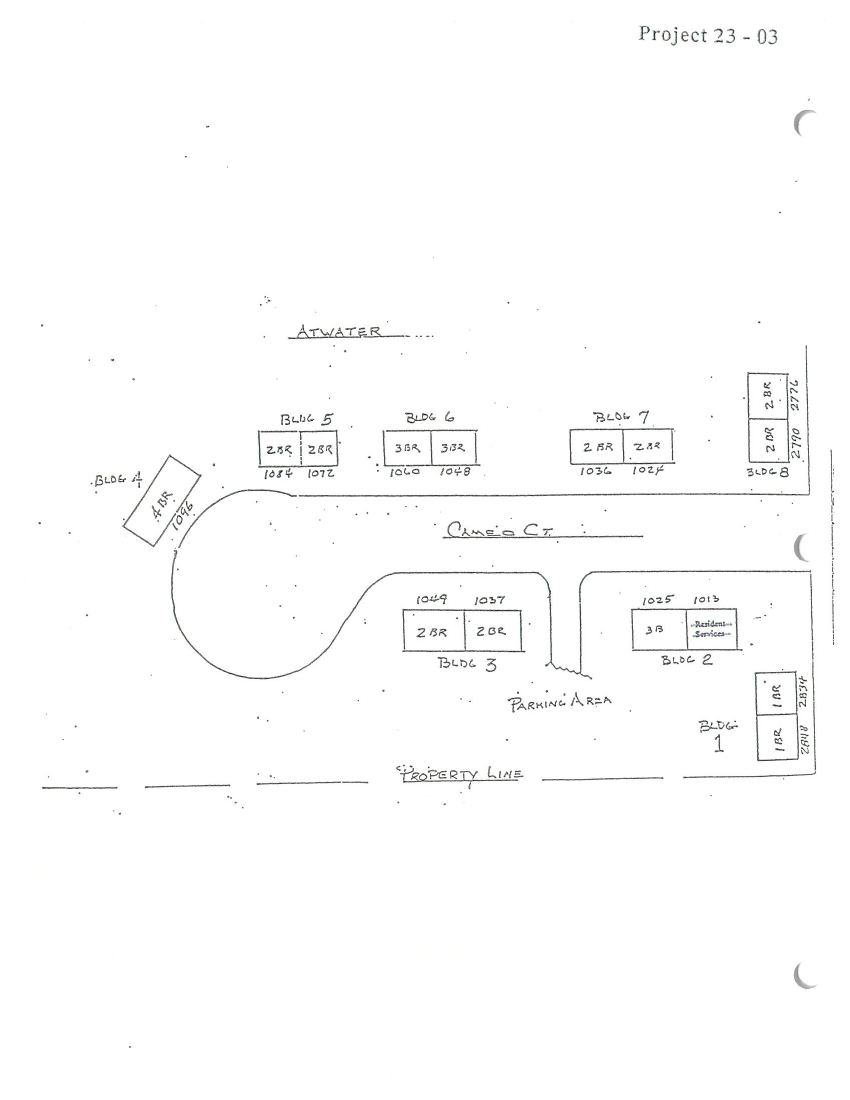
These duplex units are located on Cameo Court just off Crest Road. This tree lined cul-de-sac with its front yards and fenced backyards, offers a quiet peaceful neighborhood. Bellevue Elementary School and Buhach Colony High School as well as two parks including a baseball field and skate park are within walking distance. This project was last modernized in 1991.
Building Data
- Total # of Buildings
- 8
- 1 Bedroom
- 2 units 609 square feet
- Total # of Units
- 14
- 2 Bedroom
- 8 units 739 square feet
- Designated Elderly
- 0
- 3 Bedroom
- 3 units 988 square feet
- Handicap Units
- 0
- *4 Bedroom
- 1 unit 1056 square feet
Unit Amenities: gas stoves, refrigerators, front yards & fenced backyards, private parking pads.
Nearby Schools: Bellevue Elementary and Buhach Colony High Schools.
Nearby Services: close to shopping centers and restaurants, near Osborn and Castle Parks, Atwater Community Center, and Housing Authority Office.
View site / floor plan
Livingston
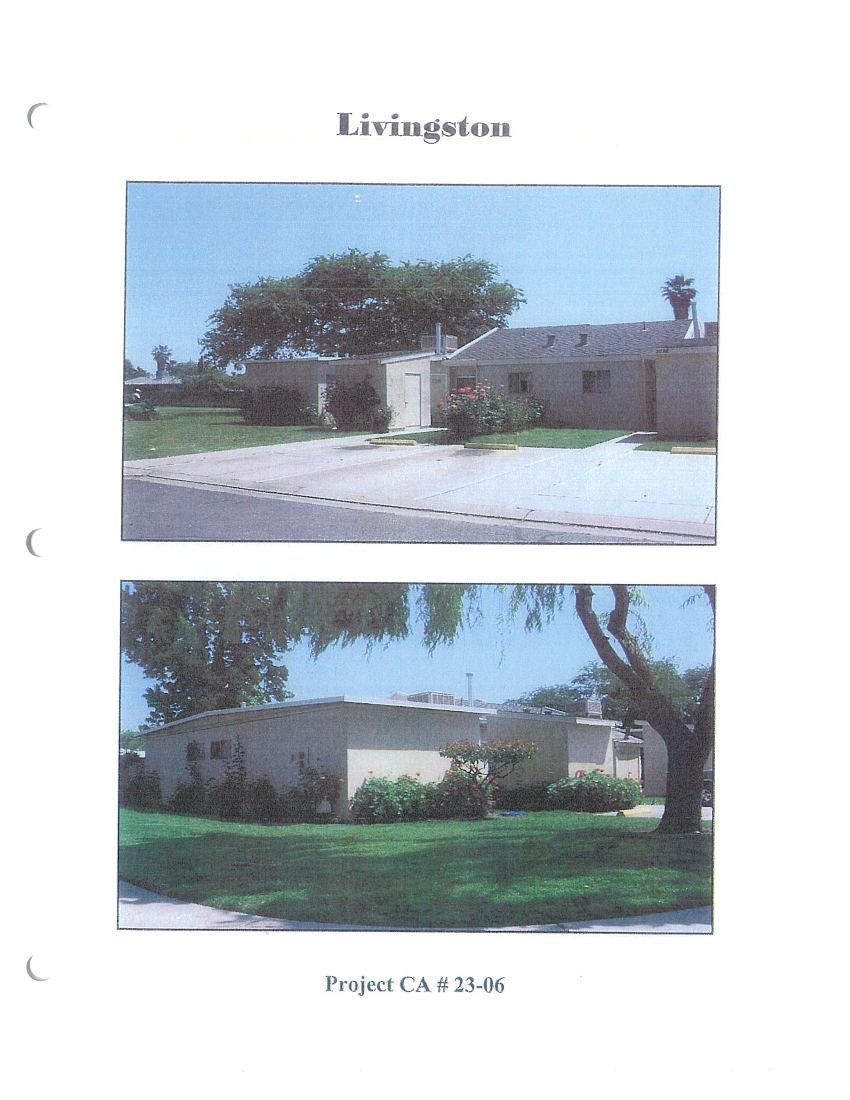
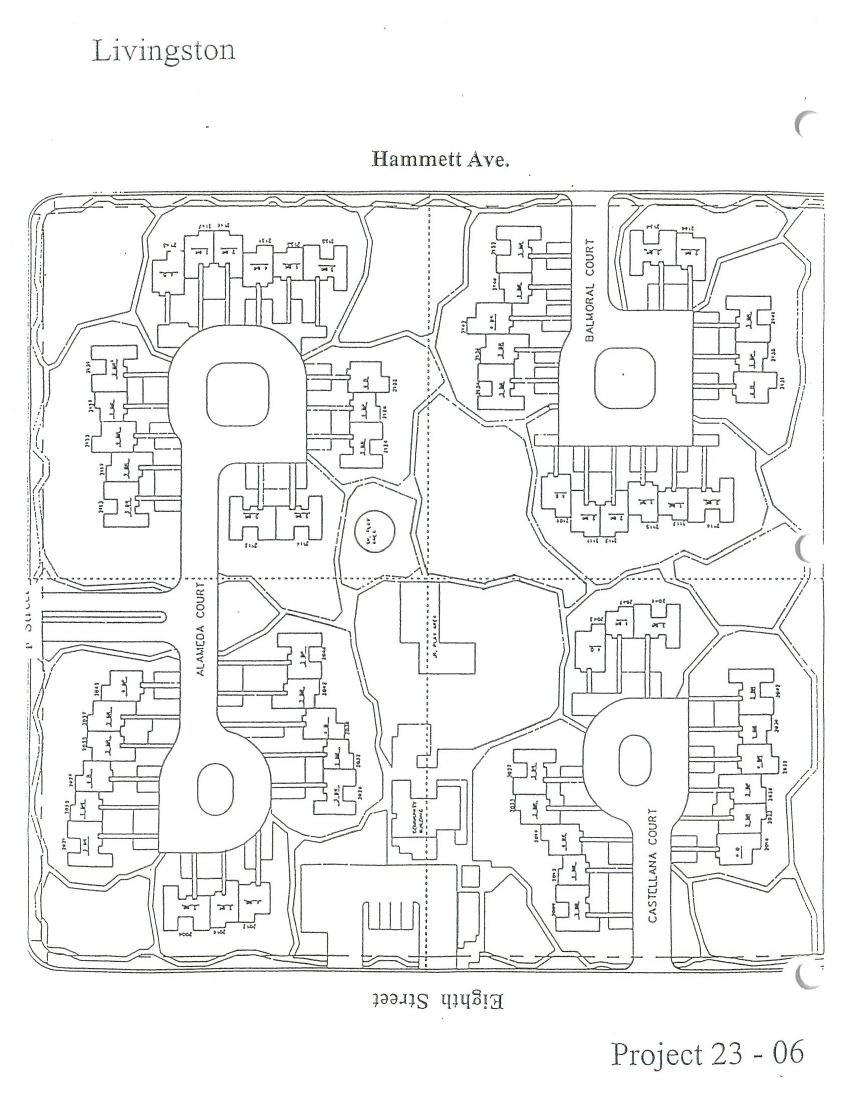
This project is situated between Hammatt and 8" streets at F Street and encompasses three cul-de-sacs, Castellana, Alameda, and Balmoral Courts. With its landscaped common areas, large playground, and Resident's Center with an active 4-H Club, this is an ideal place for families. Located next to the complex are an elementary school and a high school, and the business district is only blocks away. This project was built in 1972, and was modernized in 1993.
Building Data
- Total # of Buildings
- 14
- 1 Bedroom
- 11 Units 624 square feet
- Total # of Units
- 60
- 2 Bedroom
- 14 Units 760 square feet
- Designated Elderly
- 0
- *3 Bedroom
- 19 Units 885 square feet
- Handicap Units
- 0
- *4 Bedroom
- 16 Units 1370 square feet
Unit Amenities: gas stoves, refrigerators, fenced backyards, private parking pads.
Nearby Schools: Campus Park Elementary, Livingston High School.
Nearby Services: Housing Authority Office, Resident Center, medical facilities and business district.
View site / floor plan
Atwater
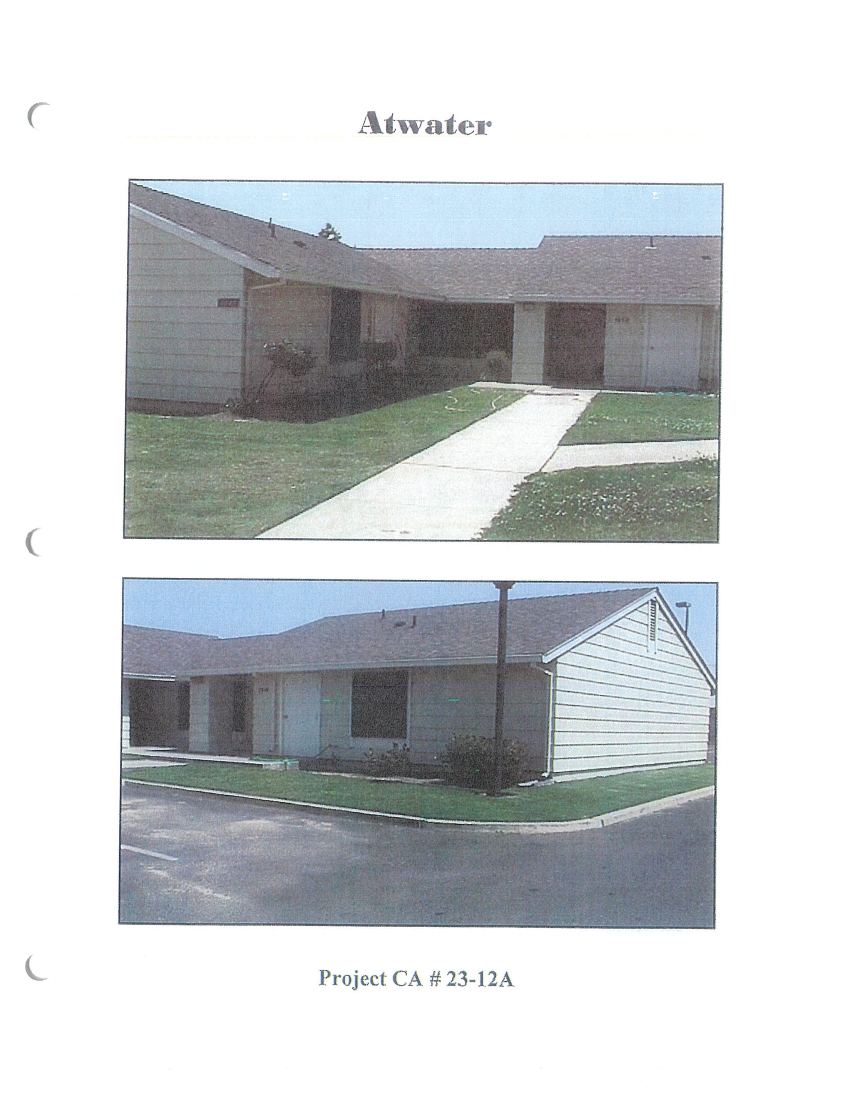
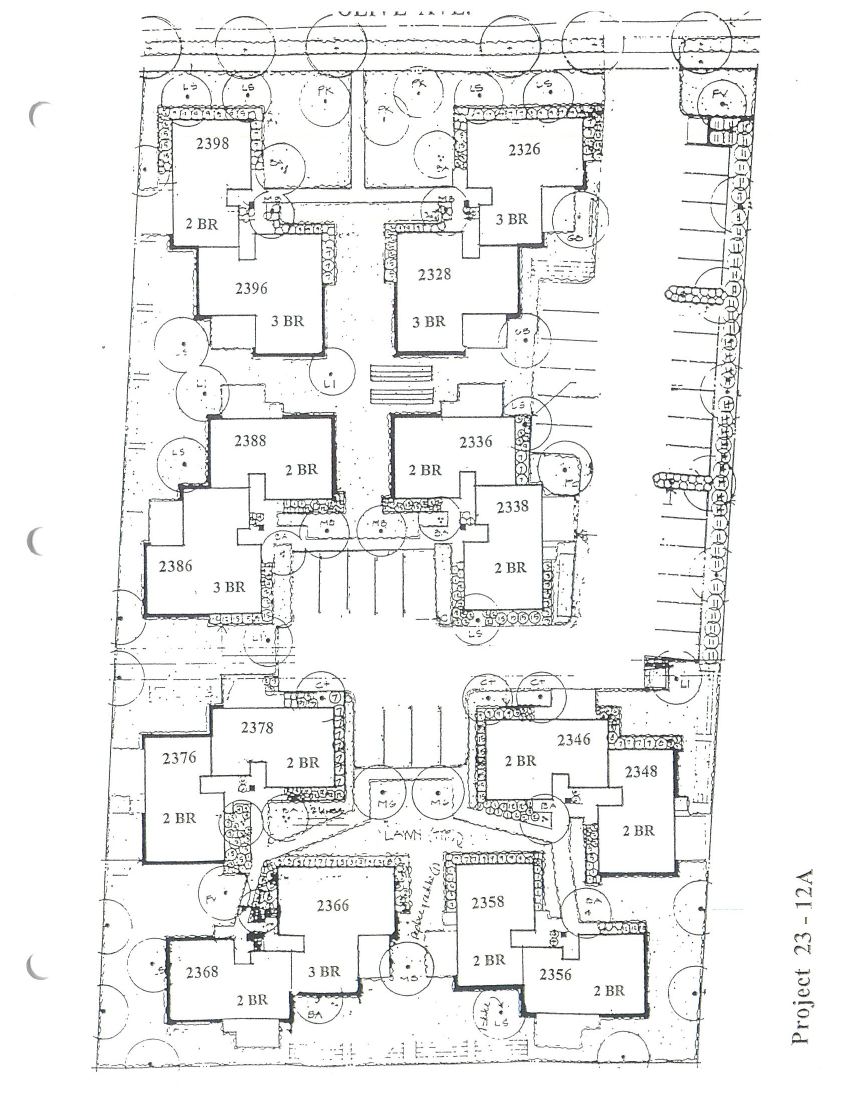
This project was built in 1982 in two sections. One parcel is located at Crest Road and Kelso Street and the other on Olive Avenue. Both projects are close to Bellevue and Aileen Colburn Elementary schools, an advantage for young families. The Crest Road complex includes the Housing Authority Office and a Resident Center, while the Olive Avenue complex is near downtown Atwater for convenient shopping.
Building Data
- Total # of Buildings
- 18
- 1 Bedroom
- 0 Units N/A
- Total # of Units
- 36
- 2 Bedroom
- 16 Units 808 square feet
- Designated Elderly
- 0
- *3 Bedroom
- 20 Units 1120 square feet
- Handicap Units
- 4
- 4 Bedroom
- 0 Units N/A
Unit Amenities: gas stove, refrigerator, ceiling fans and fenced patios.
Nearby Schools: Bellevue Elementary, Aileen Colburn Elementary and Buhach Colony High Schools .
Nearby Services: shopping centers, restaurants, Housing Authority Office, Resident Center, Osborne Park, and Atwater Community Center.
View site / floor plan
Winton
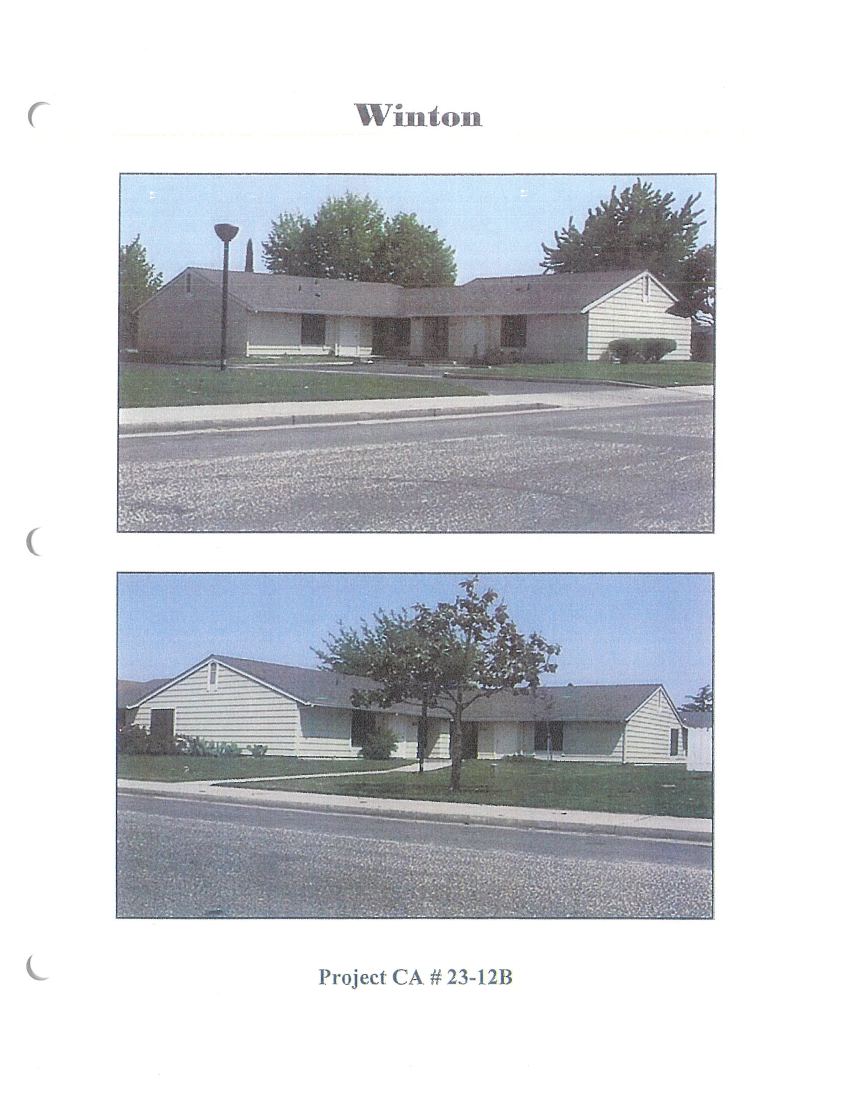
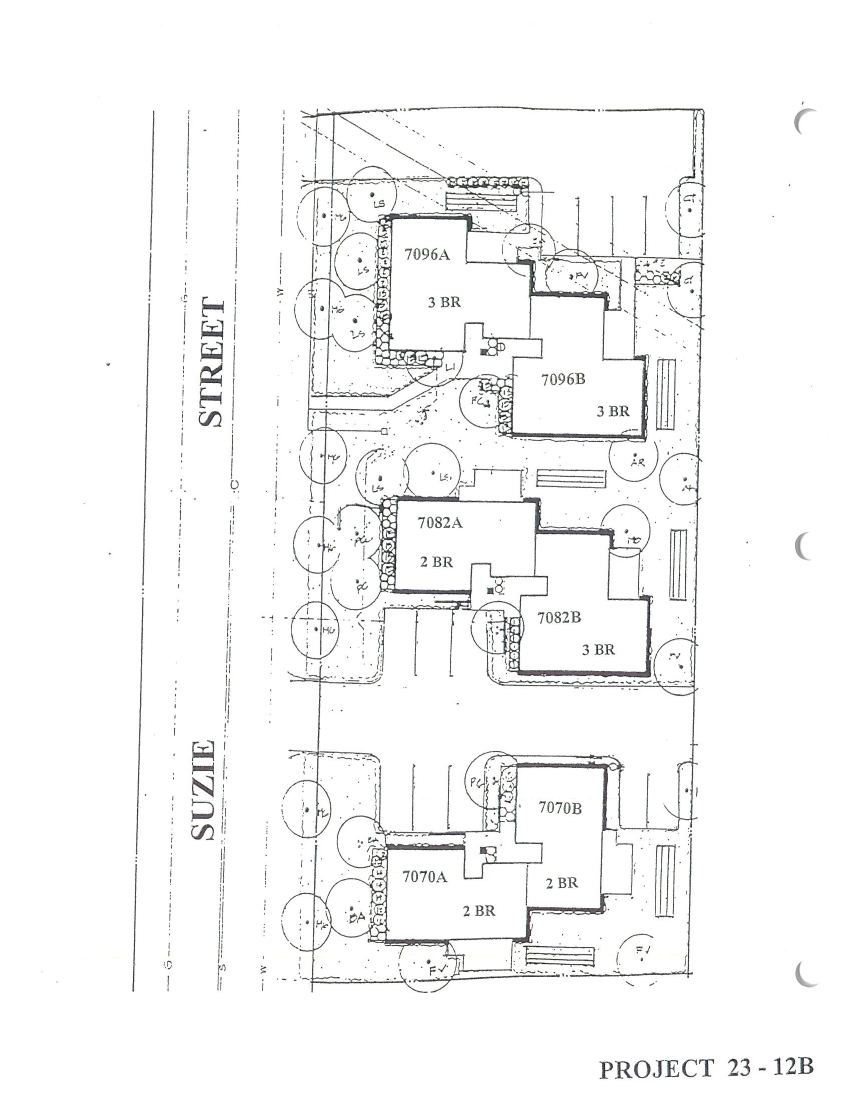
The smallest of the Housing Authority projects, this complex consists of just six units. It is located on Suzie Street, and close to the Winton business district. Built in 1982, it follows the same construction lines as project 23- 12A.
Building Data
- Total # of Buildings
- 3
- 1 Bedroom
- 0 Units N/A
- Total # of Units
- 6
- 2 Bedroom
- 3 Units 808 square feet
- Designated Elderly
- 0
- *3 Bedroom
- 3 Units 1120 square feet
- Handicap Units
- 0
- 4 Bedroom
- 0 Units N/A
Unit Amenities: gas stove, refrigerator, ceiling fans, solar screens and fenced patios. '.
Nearby Schools: Elementary and Middle Schools.
Nearby Services: near business district and Winton Community Park.
View site / floor plan
Los Banos

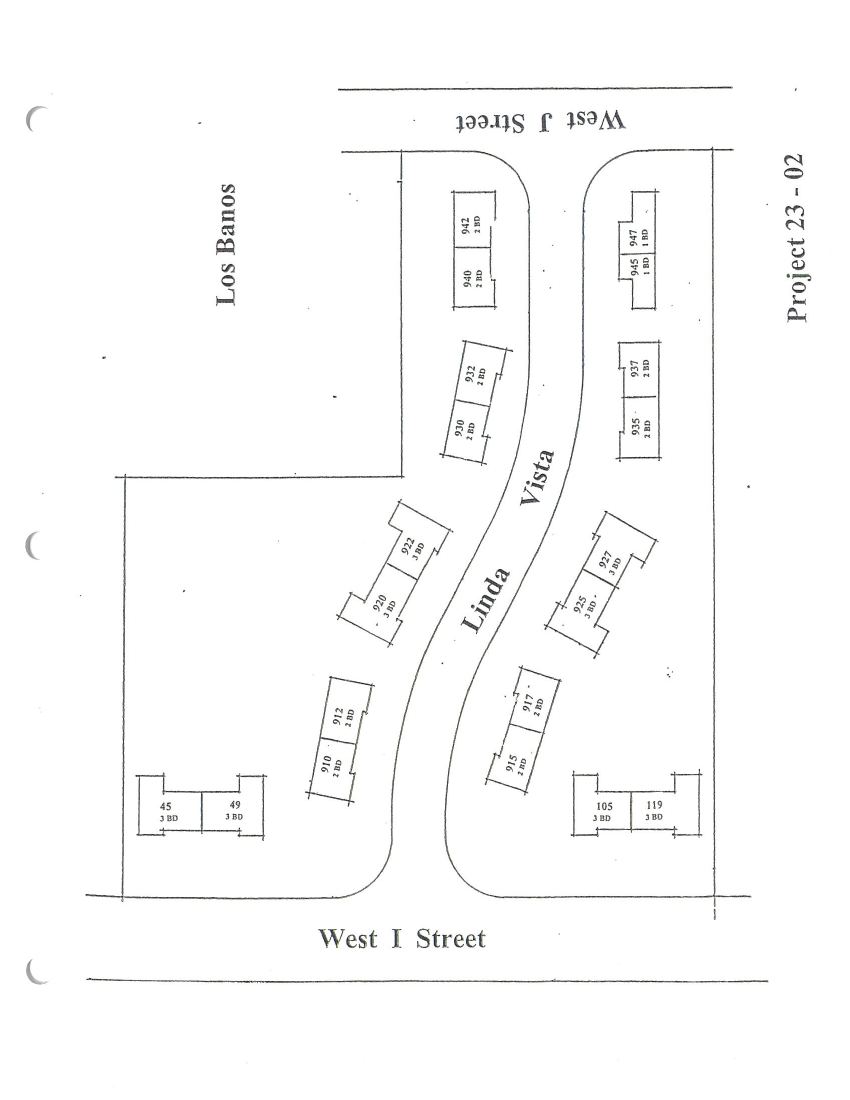
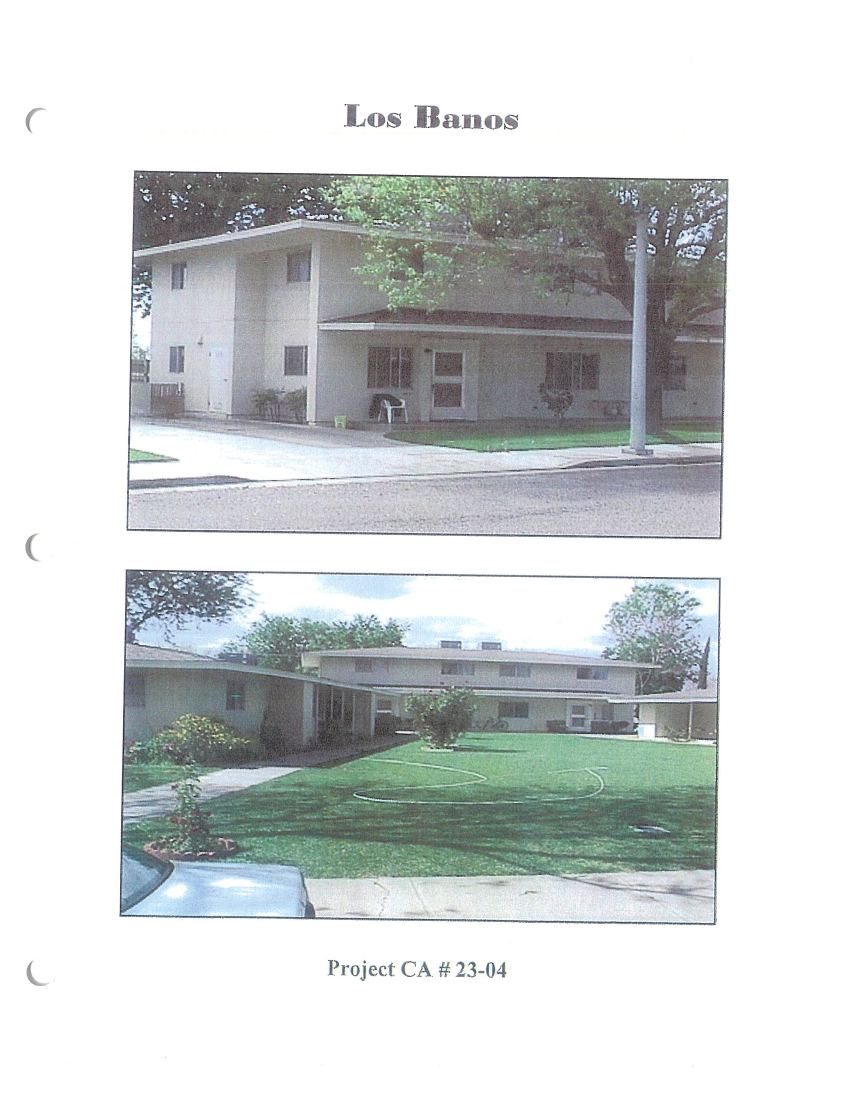
Close to downtown Los Banos and the Los Banos Fairgrounds, this project encompasses the entirety of Linda Vista Street. These apartments, with their tree lined front yards and fenced backyards, make for comfortable family living. Built in 1954, this complex was modernized in 1990.
Building Data
- Total # of Buildings
- 10
- 1 Bedroom
- 2 units 624 square feet
- Total # of Units
- 20
- 2 Bedroom
- 10 units 830 square feet
- Designated Elderly
- 0
- 3 Bedroom
- 8 units 1059 square feet
- Handicap Units
- 0
- 4 Bedroom
- 0 units N/A
Unit Amenities: central heat/AC, gas stoves, refrigerators, private parking pads, and fenced backyards.
Nearby Schools: busing to Los Banos schools.
Nearby Services: Los Banos Community Hospital, close to downtown and shopping centers.
View site / floor plan
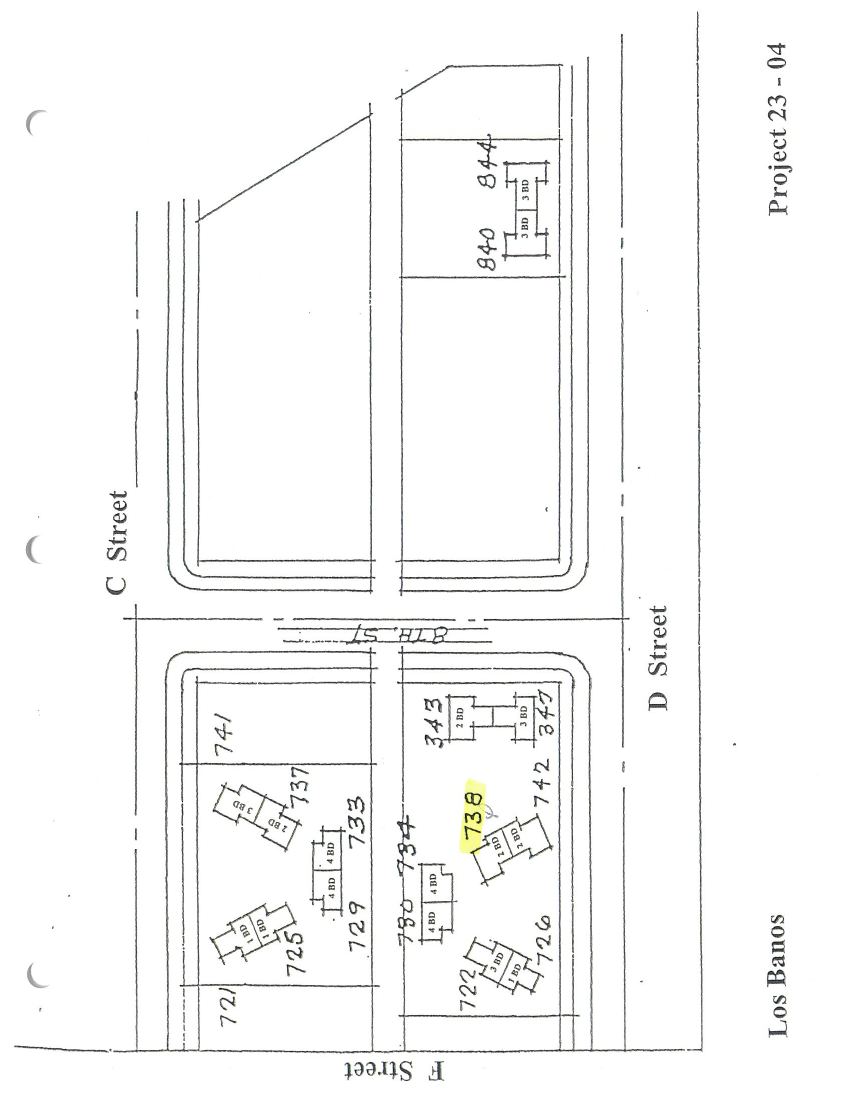
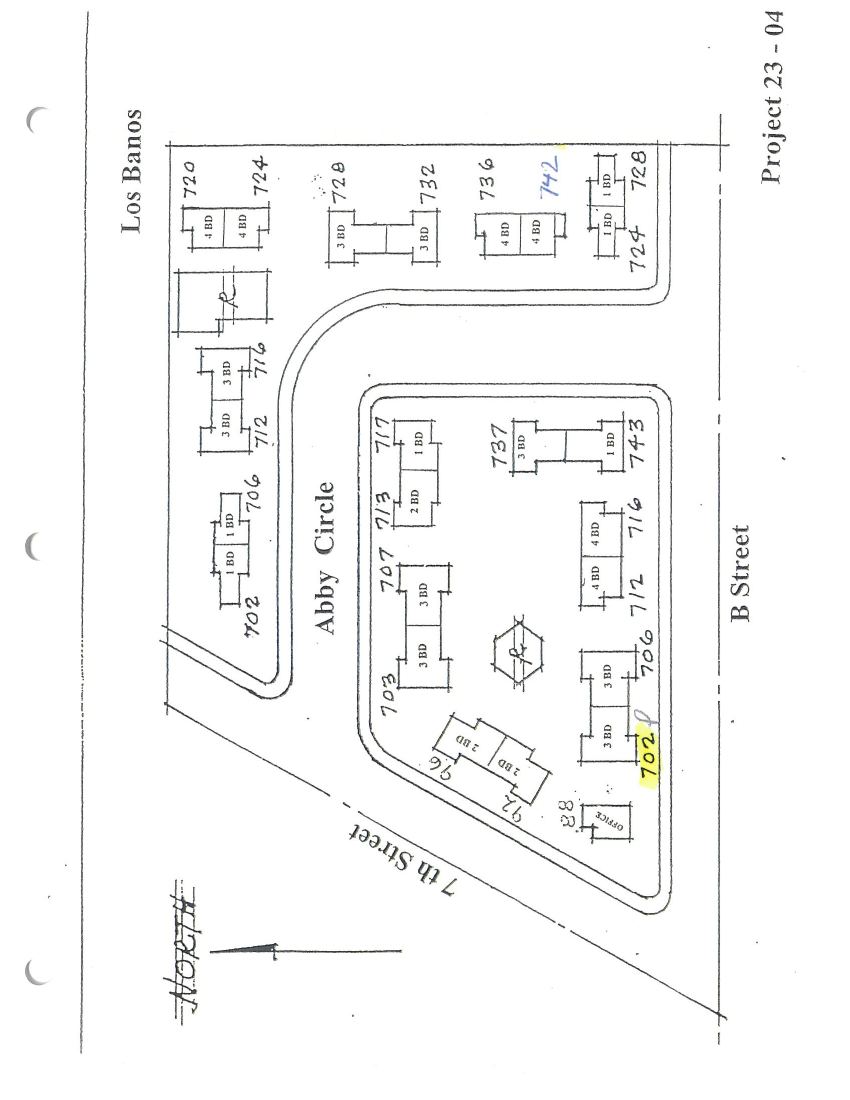
Los Banos
There are three sites in this complex. The first is built on Abby Circle & "B" Street, the second on "C" Street, and the last is on "D" Street. Built in 1965, these units were modernized in 1996, with new interiors, exteriors, driveways, and landscaping. A Housing Authority Office is included in the Abby Circle complex. All three complexes are located close to downtown Los Banos, the Los Banos fairgrounds, and several schools.
Building Data
- Total # of Buildings
- 21
- 1 Bedroom
- 8 units 624 square feet
- Total # of Units
- 40
- 2 Bedroom
- 8 units 830 square feet
- Designated Elderly
- 0
- 3 Bedroom
- 14 units 1059 square feet
- Handicap Units
- 10
- *4 Bedroom
- 10 units 1624 square feet
Unit Amenities: central heat/AC, tile showers, front yards and fenced backyards, private parking pads, gas range, and refrigerators.
Nearby Schools: Miano Elementary School and San Luis Adult School.
Nearby Services: downtown, fairgrounds, shopping centers and restaurants, Housing Authority Office.
View site / floor plans
South Dos Palos
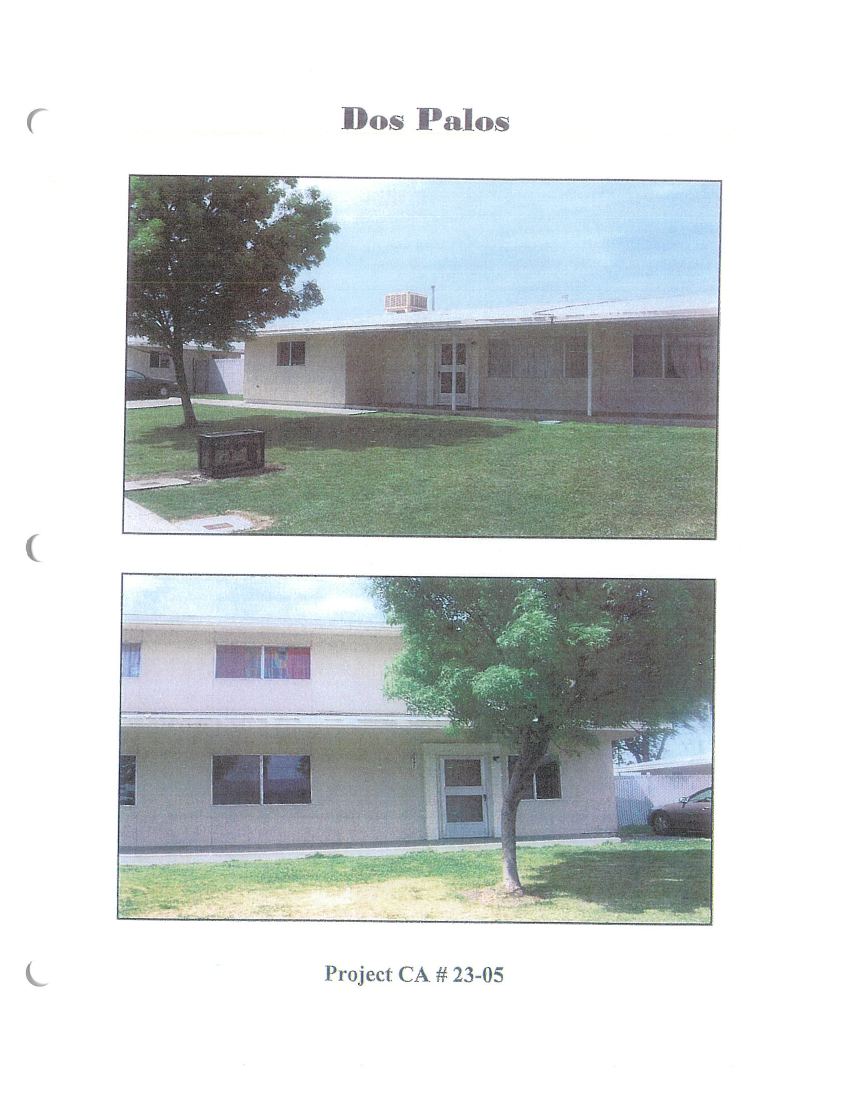
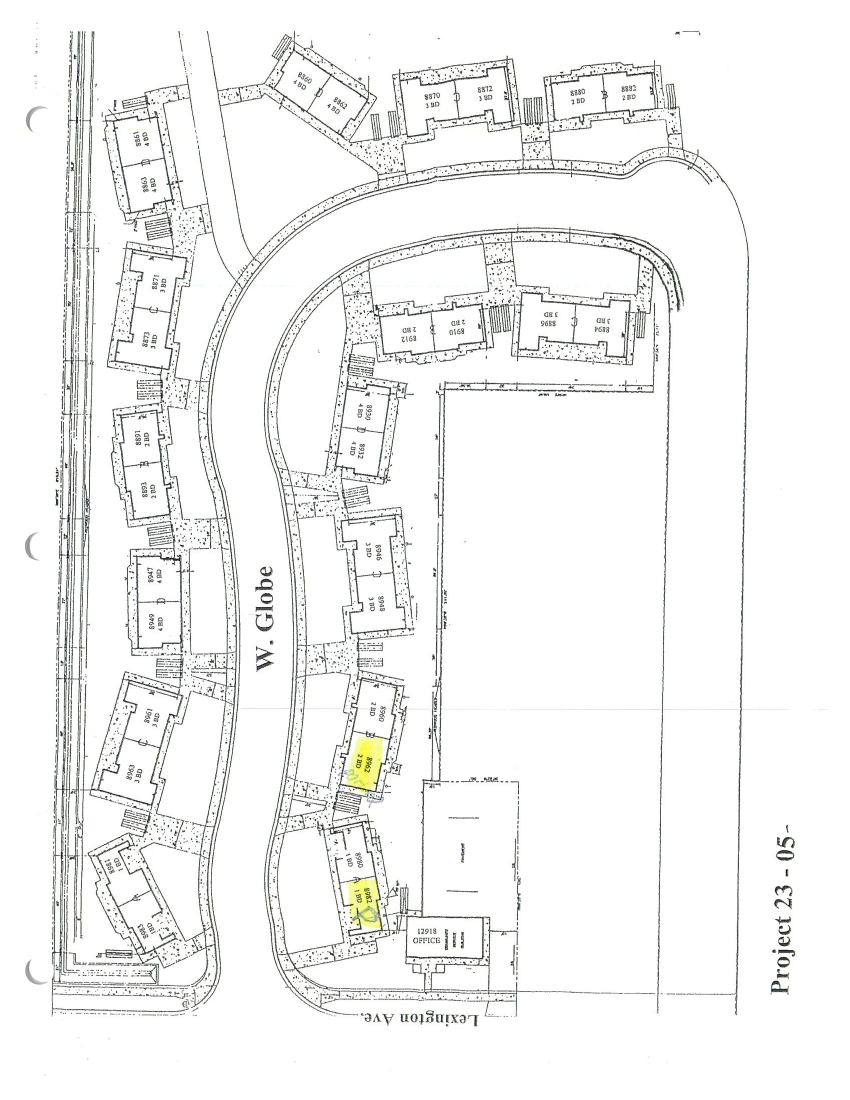
Located on West Globe Avenue, this complex incorporates two projects, 23- 05 and 23-12D. This project, 23-05, was built in 1967 and later modernized in 1992. It offers garden size front yards with fenced backyards. Also included in this project is a community playground, Housing Authority Office, and a Resident Center, offering a variety of programs for children, such as Girl Scouts and the Community Action Agency.
Building Data
- Total # of Buildings
- 16
- 1 Bedroom
- 4 Units 650 square feet
- Total # of Units
- 30
- 2 Bedroom
- 8 Units 865 square feet
- Designated Elderly
- 0
- 3 Bedroom
- 10 Units 1092 square feet
- Handicap Units
- 2
- *4 Bedroom
- 8 Units 1740 square feet
Unit Amenities: gas stoves, refrigerators, fenced backyards, private parking pads.
Nearby Schools: busing to Dos Palos Schools.
Nearby Services: Housing Authority Office, Resident Center, close to downtown Dos Palos and shopping centers.
View site / floor plan
Los Banos
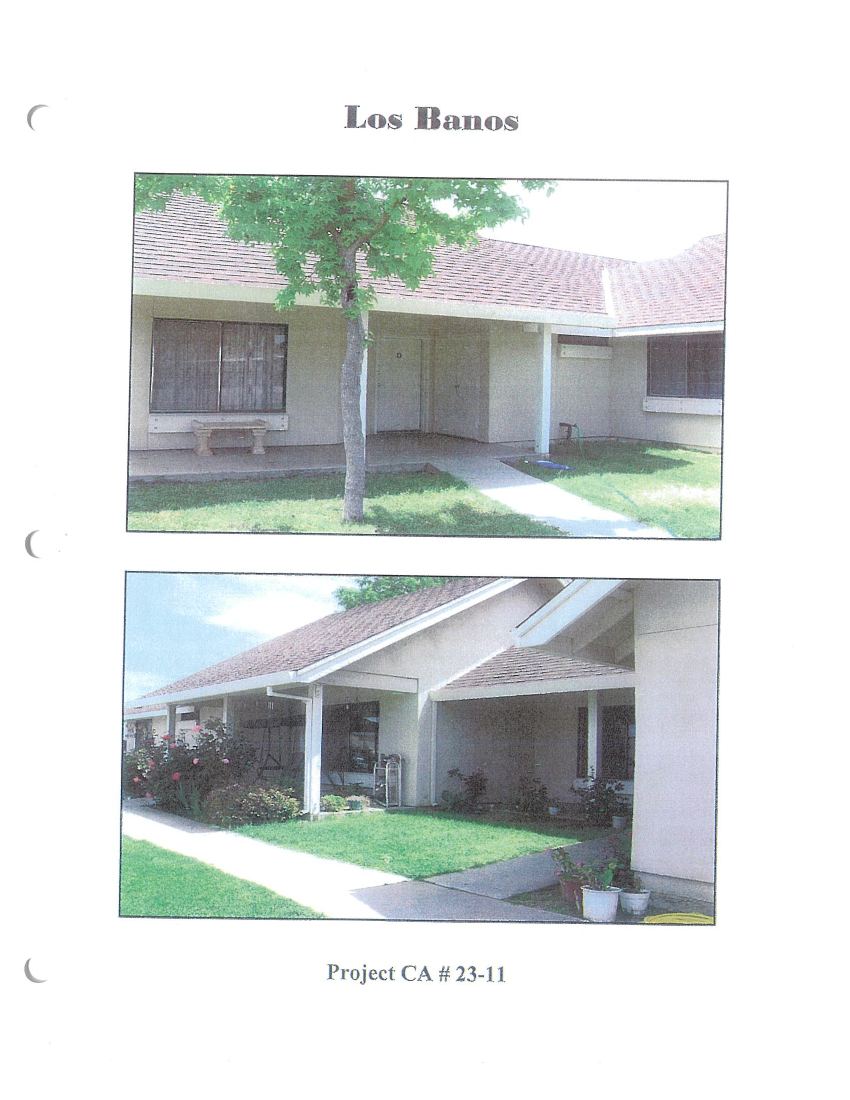
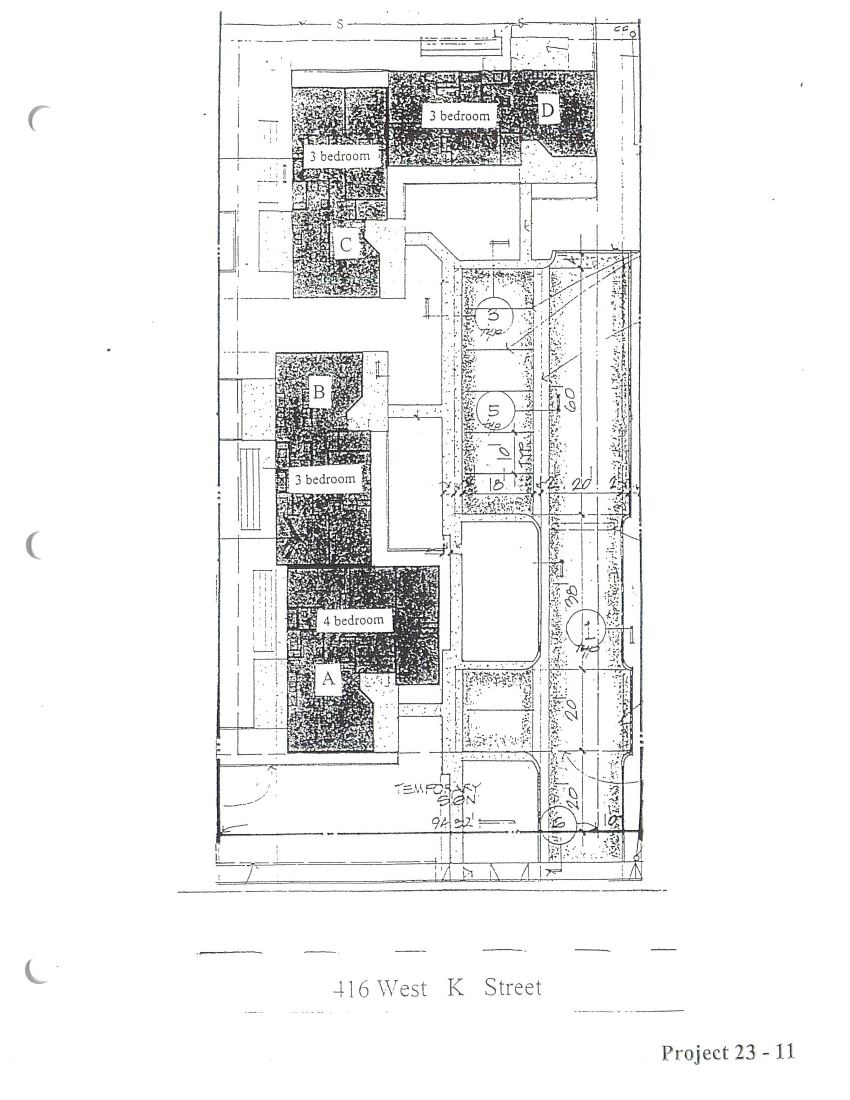
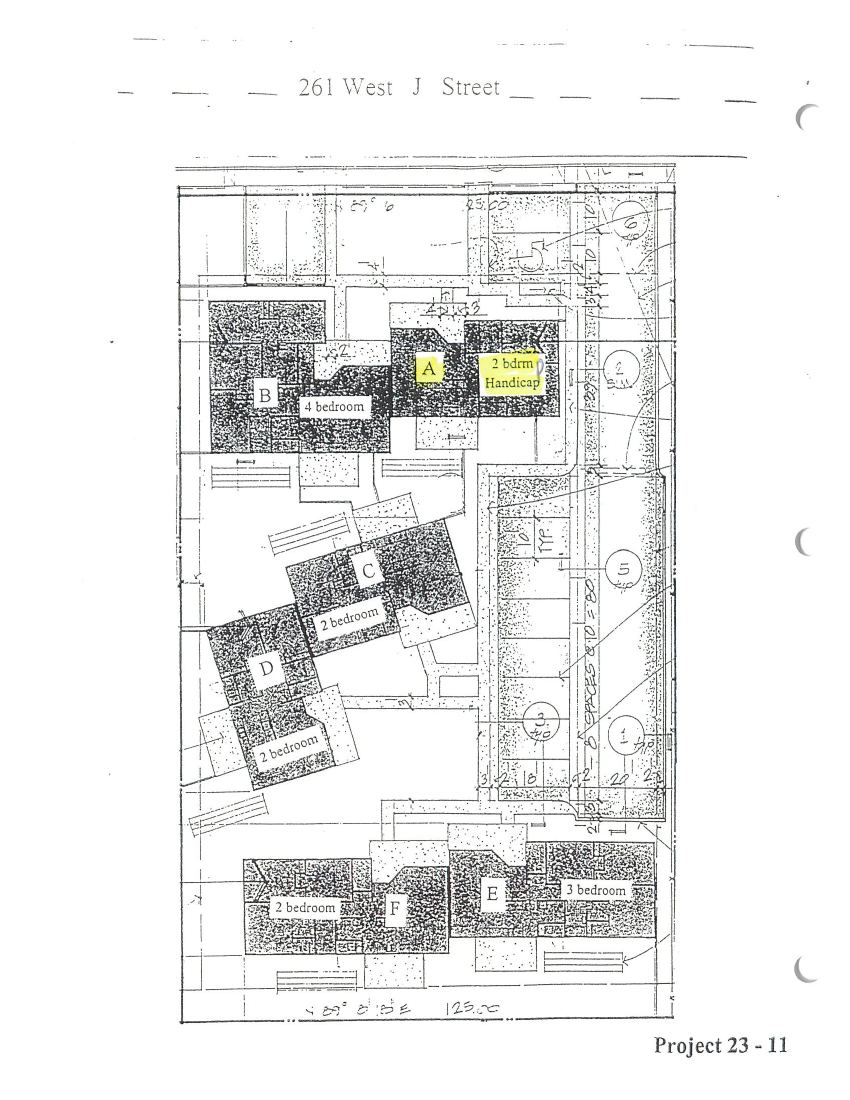
This 1982 project was built in two sections. One parcel is located on West J Street and the other is on West K Street. Both complexes are close to downtown and medical facilities. They are private projects that offer comfortable family living.
Building Data
- Total # of Buildings
- 5
- 1 Bedroom
- 0 Units N/A
- Total # of Units
- 10
- 2 Bedroom
- 4 Units 946 square feet
- Designated Elderly
- 0
- *3 Bedroom
- 4 Units 1186 square feet
- Handicap Units
- a
- **4 Bedroom
- 2 Units 1432 square feet
Unit Amenities: gas stove, refrigerator, built-in laundry room.
Nearby Schools: busing to Los Banos schools.
Nearby Services: medical facilities, close to downtown, shopping centers, and fairgrounds.
View site / floor plans
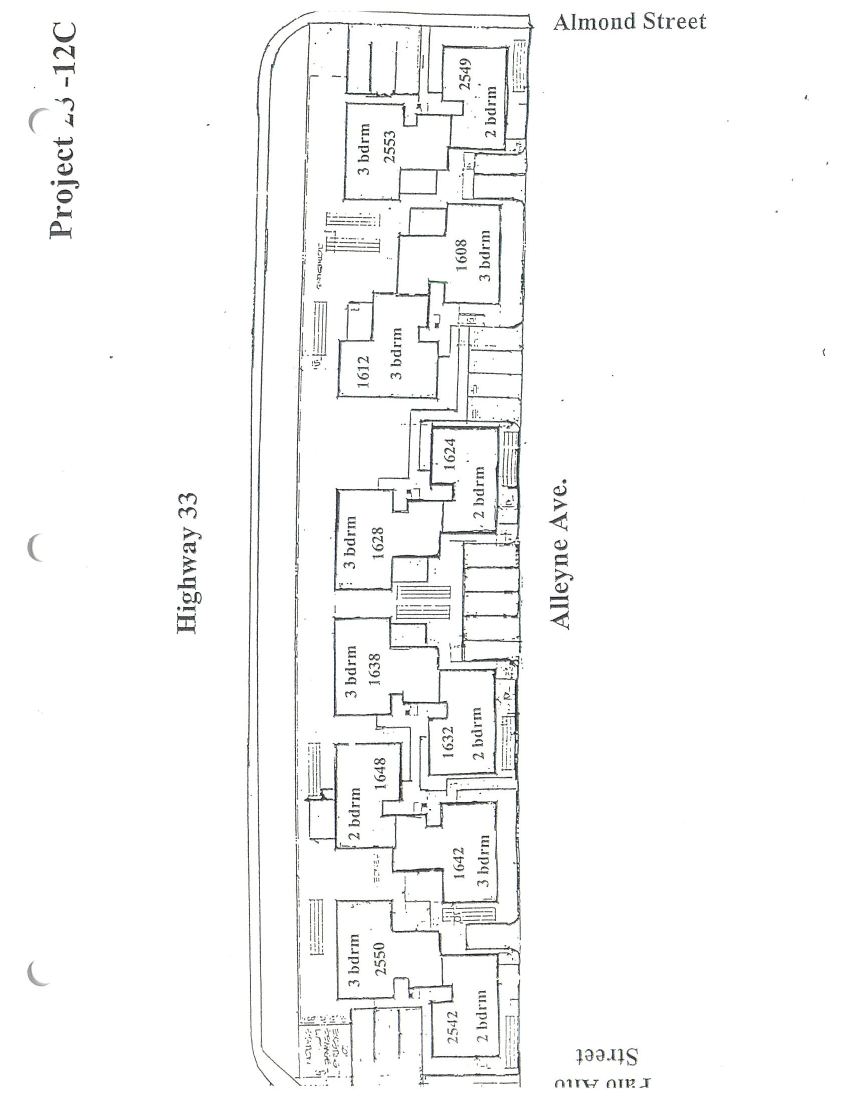
Dos Palos
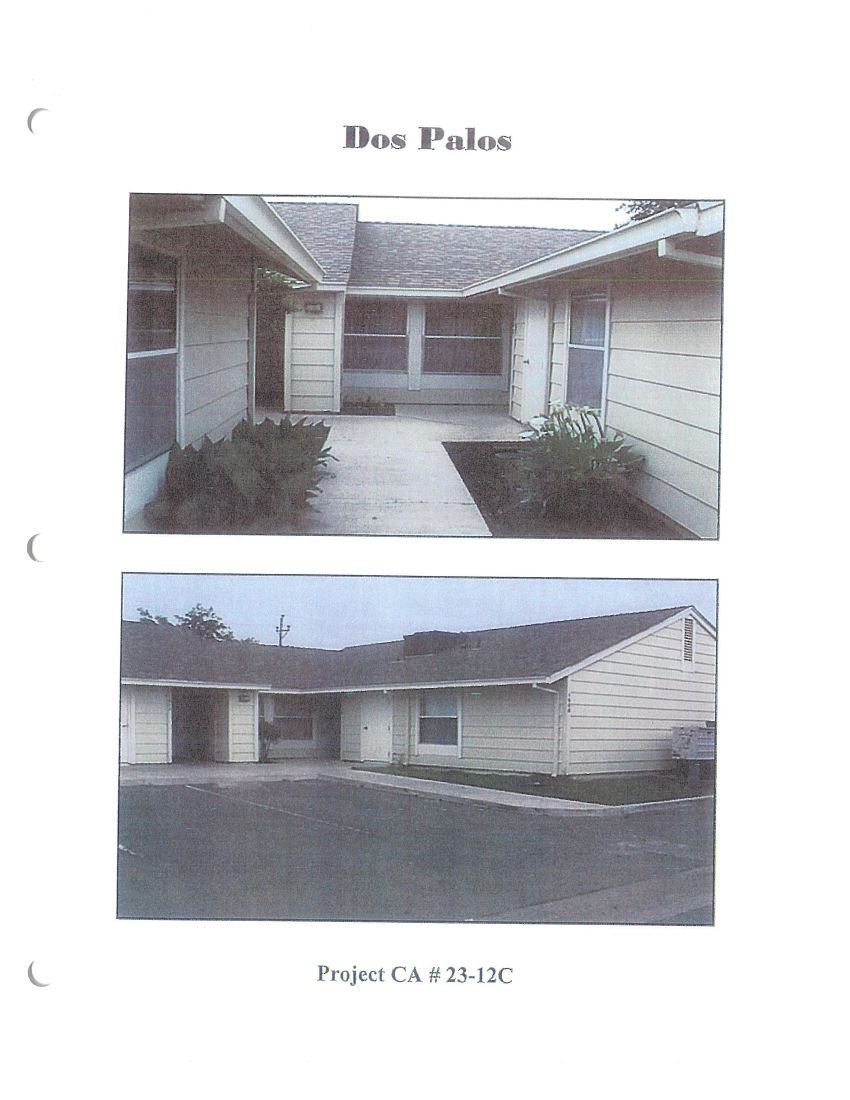
This small 12 unit complex is located on Alleyne Street and bordered by Palo Alto and Almond Streets. These units feature large rooms with fenced patios and common yards. The Dos Palos business district, shopping, and schools are readily accessible. Built in 1982, new roofs and upgraded paint were added in 1996.
Building Data
- Total # of Buildings
- 6
- 1 Bedroom
- 0 Units N/A
- Total # of Units
- 12
- 2 Bedroom
- 5 Units 950 square feet
- Designated Elderly
- 0
- *3 Bedroom
- 7 Units 1120 square feet
- Handicap Units
- 0
- **4 Bedroom
- 0 Units N/A
Unit Amenities: gas stove, refrigerators, private patios, large rooms, built-in laundry room.
Nearby Services: shopping centers, restaurants, next to downtown Dos Palos.
View site / floor plan
South Dos Palos
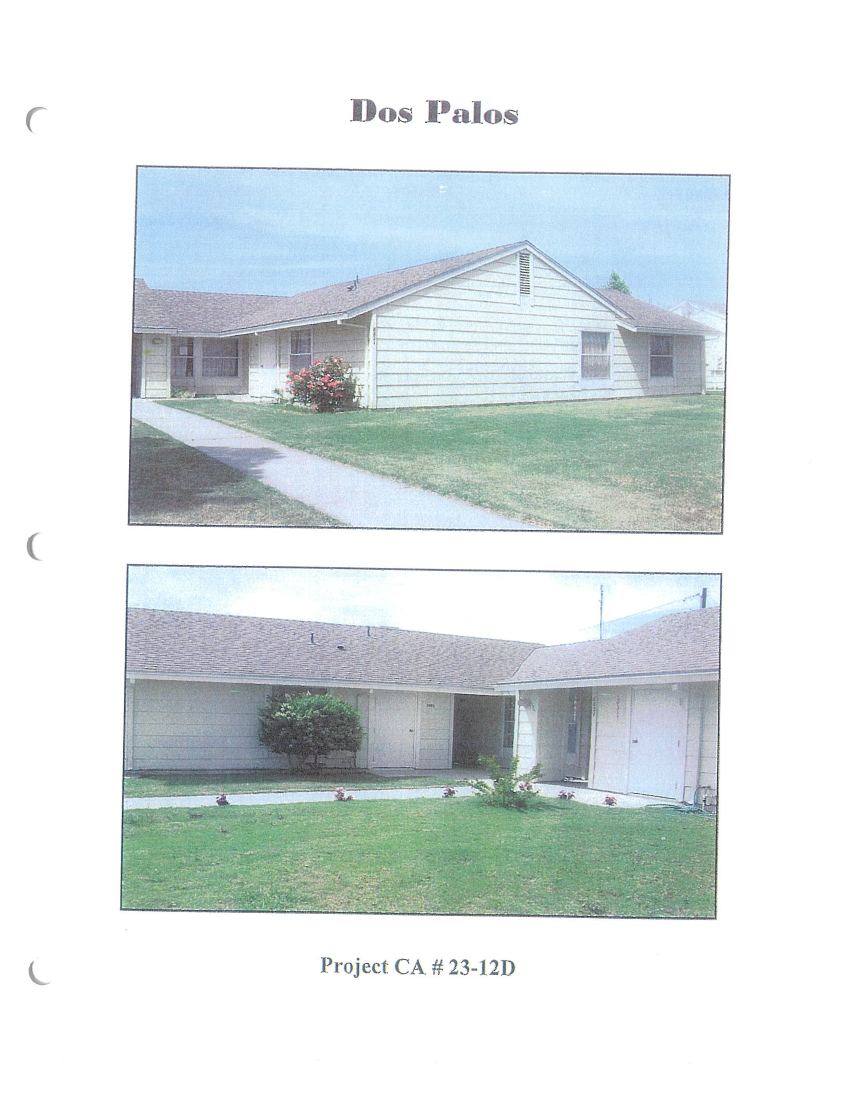
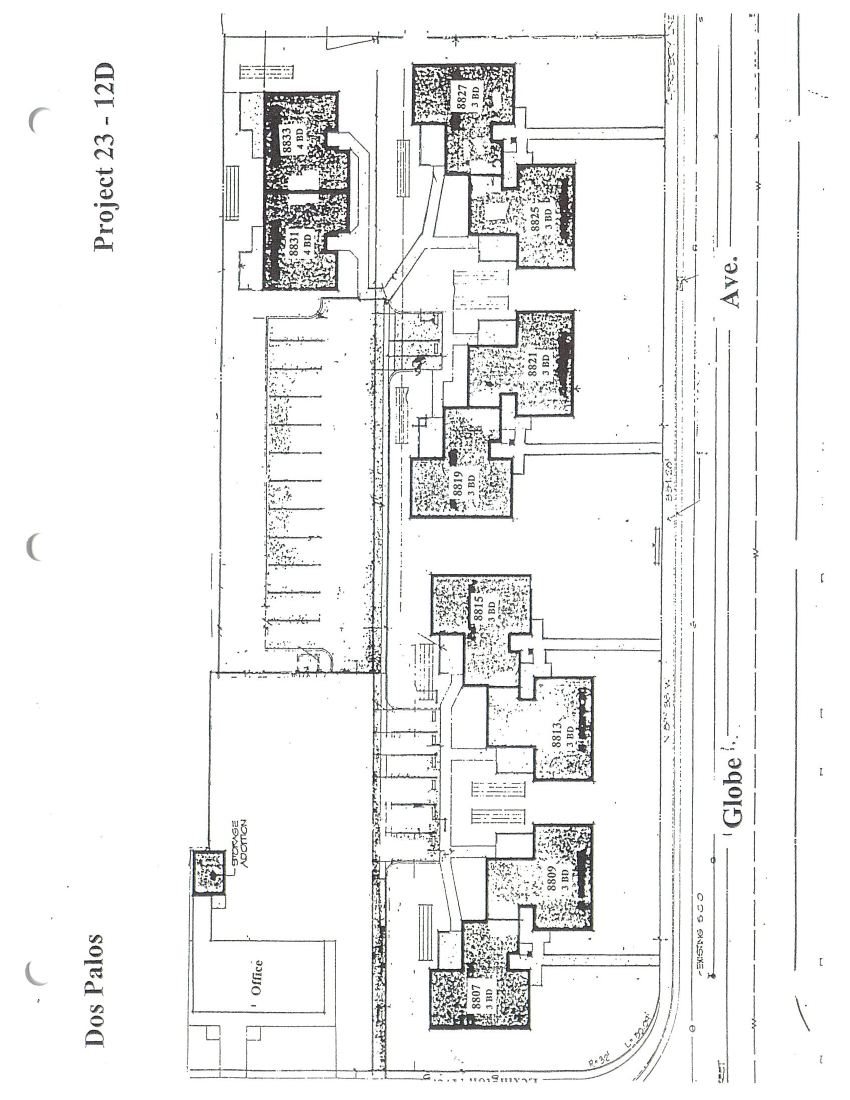
Located on West Globe Avenue, this complex incorporates two projects, 23- 05 and 23-12D. This project, 23-12D, was built in 1982, and updated in 1996 with new roofs and painting. Also included in this project are large front yards, fenced patios, a Housing Authority Office and a Residents Center, offering a variety of programs for children including Girl Scouts and the Community Action Agency.
Building Data
- Total # of Buildings
- 5
- 1 Bedroom
- 0 Units N/A
- Total # of Units
- 10
- 2 Bedroom
- 0 Units N/A
- Designated Elderly
- 0
- * 3 Bedroom
- 8 Units 1210 square feet
- Handicap Units
- 0
- *4 Bedroom
- 2 Units 2030 square feet
Unit Amenities: gas stove, refrigerators, laundry rooms, and fenced patios,.
Nearby Schools: busing to Dos Palos schools.
Nearby Services: Housing Authority Office, Resident's Center, close to downtown Dos Palos and shopping centers.
View site / floor plan
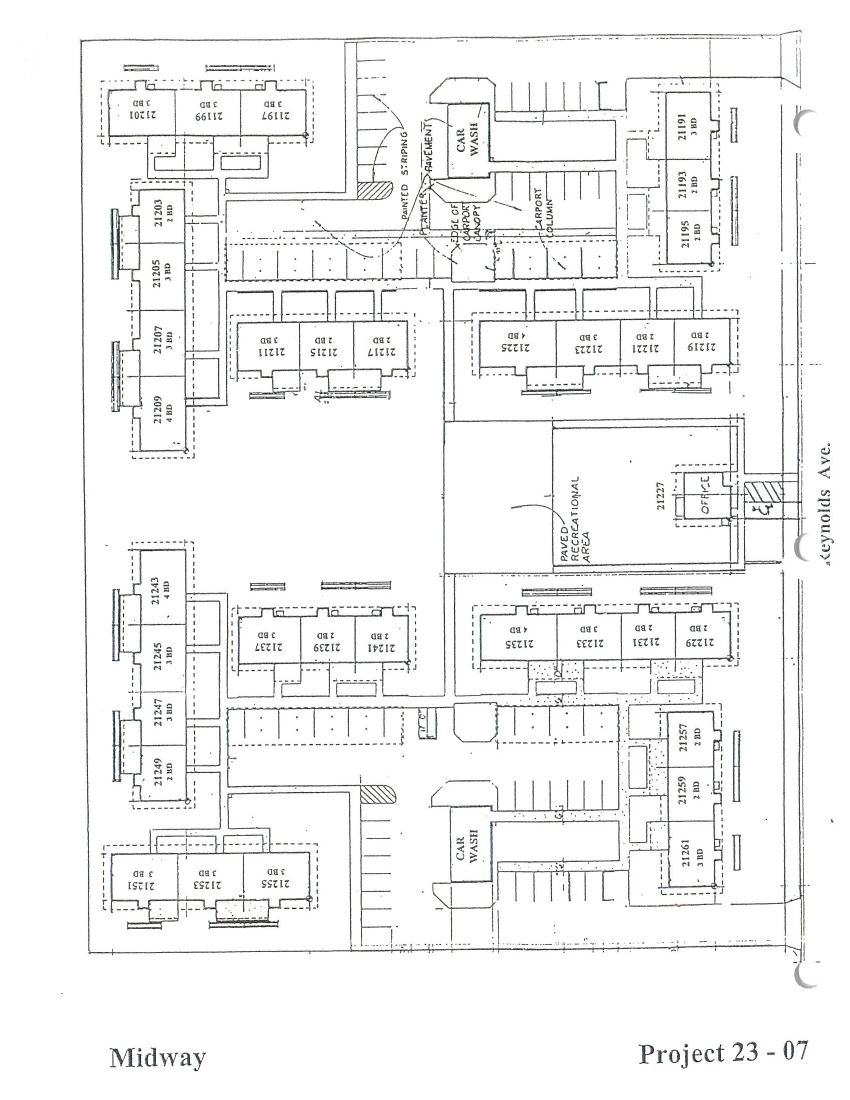
Valley View Homes – Midway
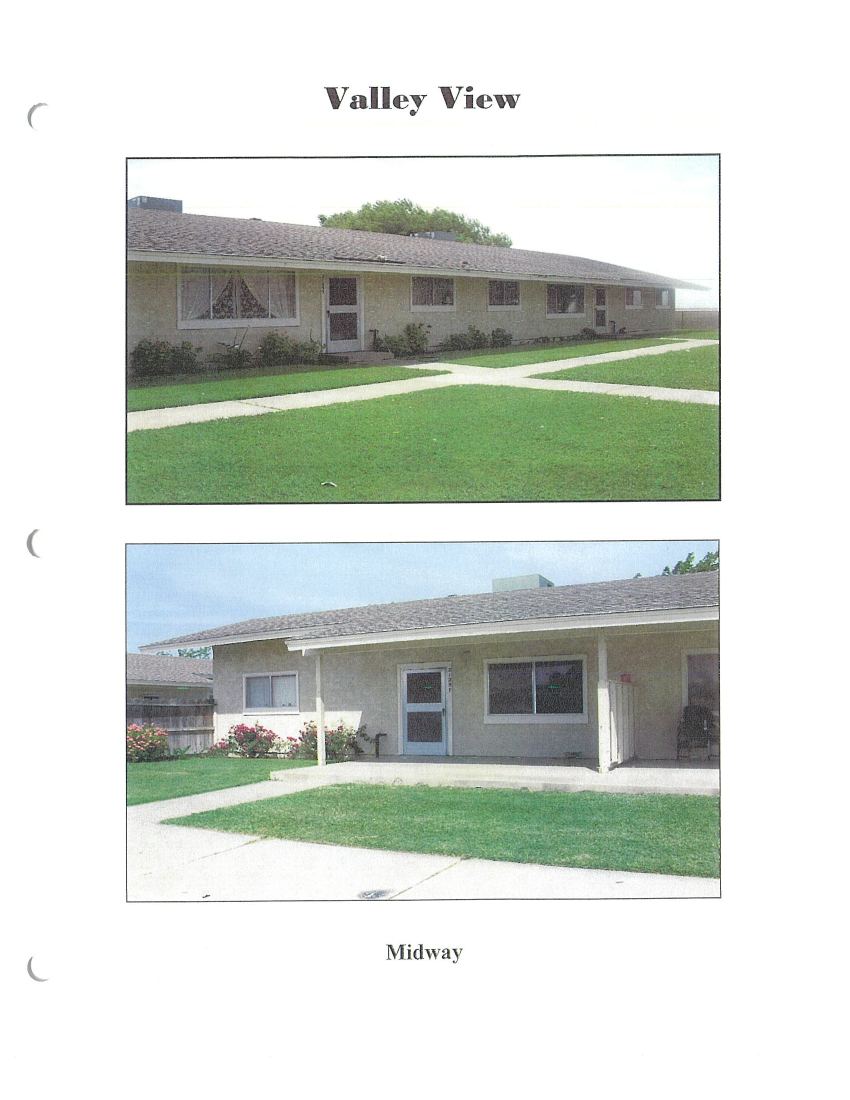
Homes Project. Located on South Reynolds this complex includes a paved recreational area, two car wash areas, and lots of open lawn space. Built in 1972, these units have recently been upgraded with newly planted trees, exterior paint, and fenced backyards. Further improvements are planned.
Building Data
- Total # of Buildings
- 11
- Office/shop
- 1 N/A
- Total # of Units
- 34
- 2 Bedroom
- 16 853
- Designated Elderly
- 0
- 3 Bedroom
- 14 1000
- Handicap Units
- 0
- *4 Bedroom
- a 1161
Unit Amenities: gas stoves, refrigerators, private backyards, carports, available car wash area.
Nearby Schools: busing to Dos Palos schools.
Nearby Services: close to downtown Dos Palos and shopping centers, Housing Authority Office on-site.
View site / floor plan
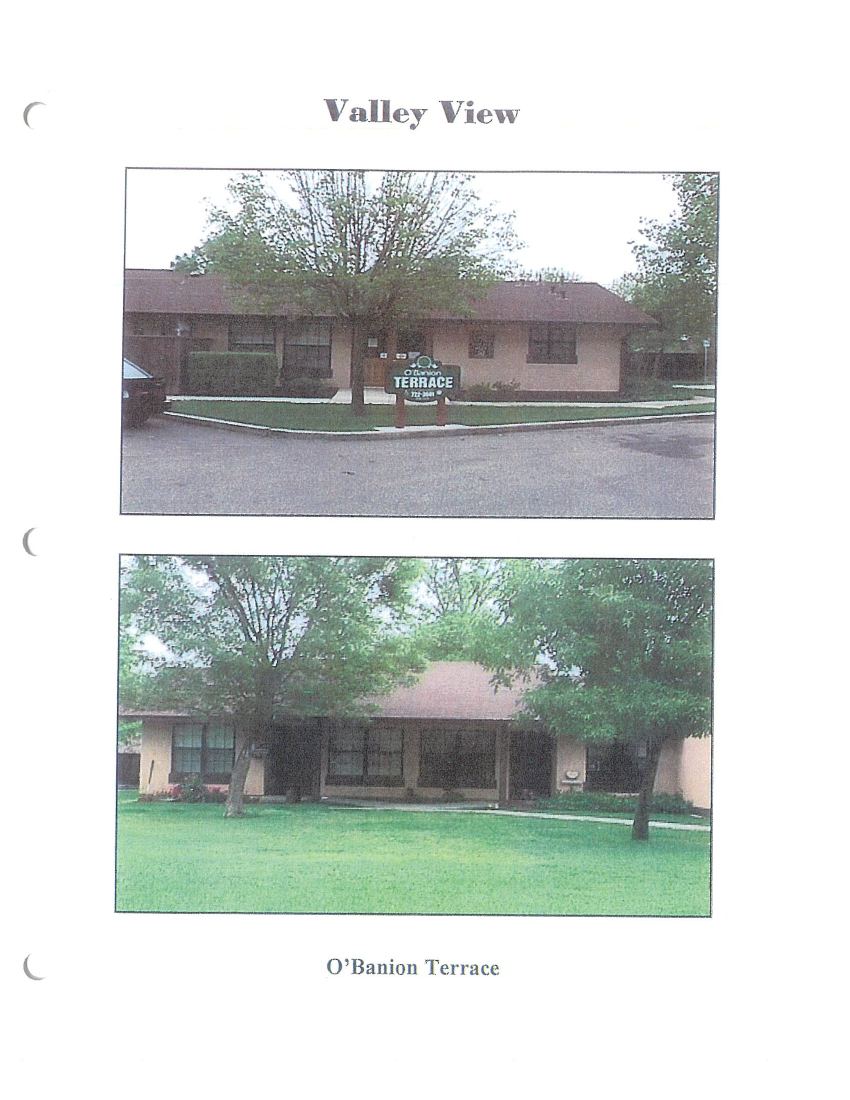
Valley View Homes – O'Banion Terrace (Dos Palos)
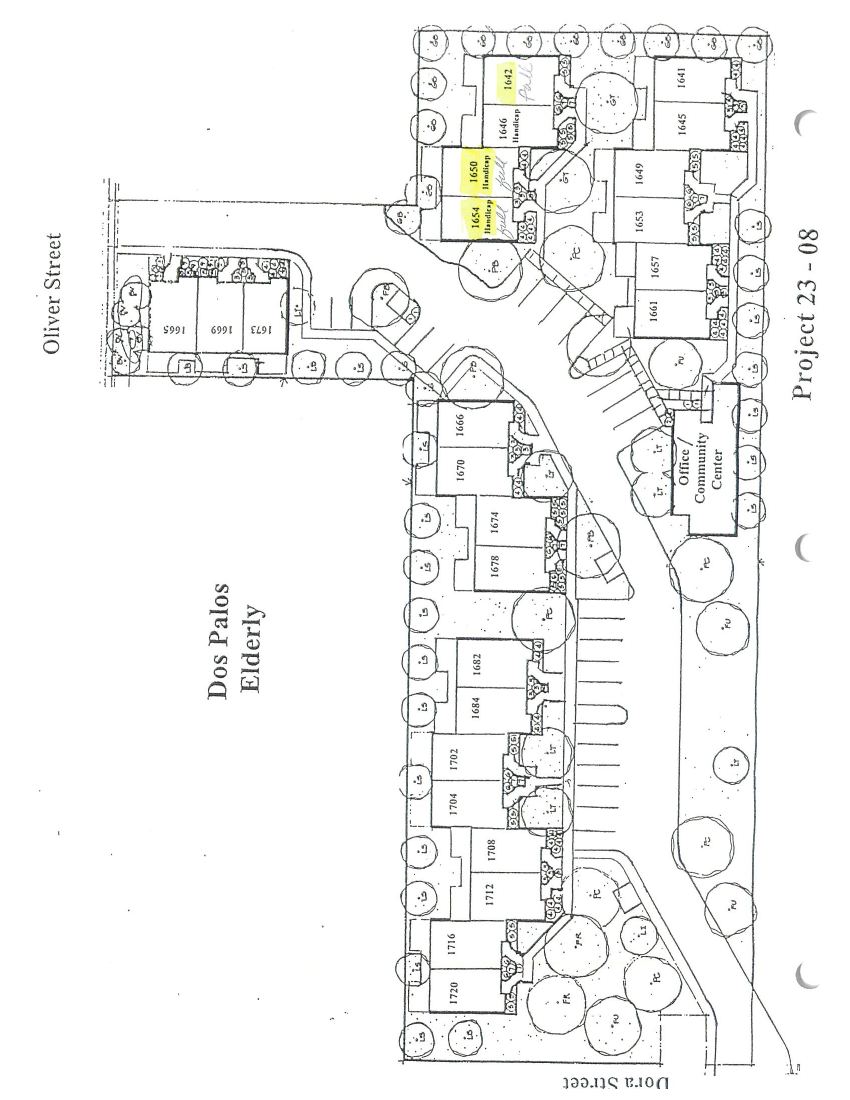
Building Data
- Total # of Buildings
- 5
- Total # of Units
- 25
- Designated Elderly
- 22
- Handicap Units
- 3
- 1 bedroom
- 25
- Square footage
- 720
Unit Amenities: central heat/AC, carpets, vertical blinds, emergency pull alarms, private patios, and yard maintenance.
Nearby Services: one block to downtown, close to parks and city services.
View site / floor plan
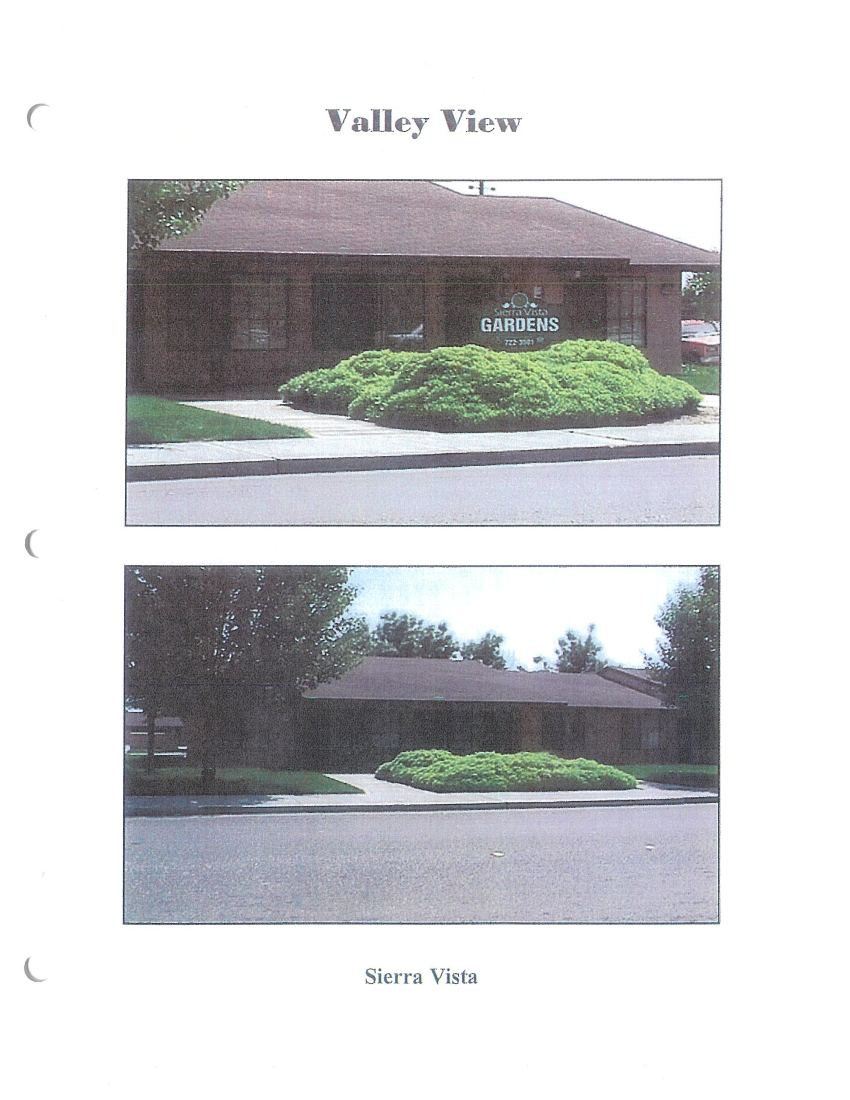
Valley View Homes – Sierra Vista (Atwater)
Building Data
- Total # of Buildings
- 4
- Total # of Units
- 14
- Designated Elderly
- 12
- Handicap Units
- 2
- 1 bedroom
- 14
- Square footage
- 720
Unit Amenities: central heat/AC, carpets, vertical blinds, emergency pull alarms, private patios, and yard maintenance.
Nearby Services: one block to downtown Atwater, close to shopping centers, medical facilities, and bus transportation.
View site / floor plan
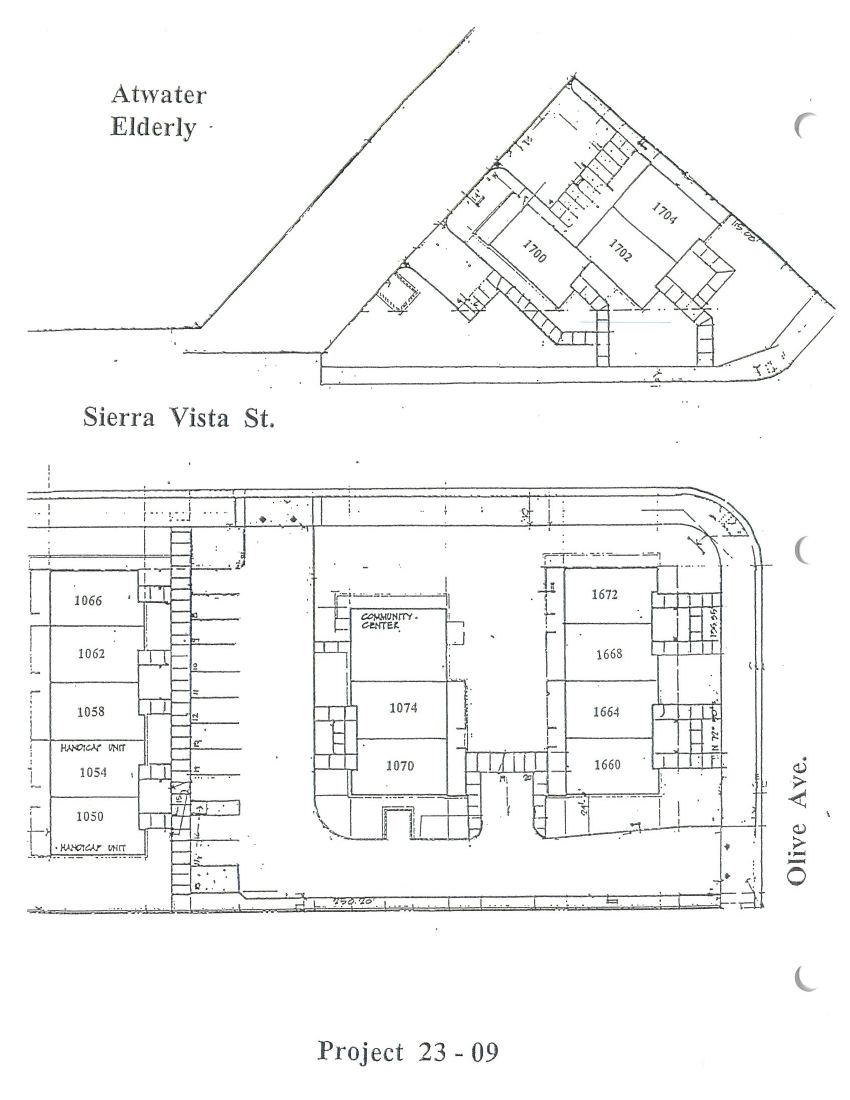
Project-Based Voucher Communities
Privately-owned communities where rental assistance is tied to specific units under a long-term Housing Assistance Payment (HAP) contract.
Merced Commons I
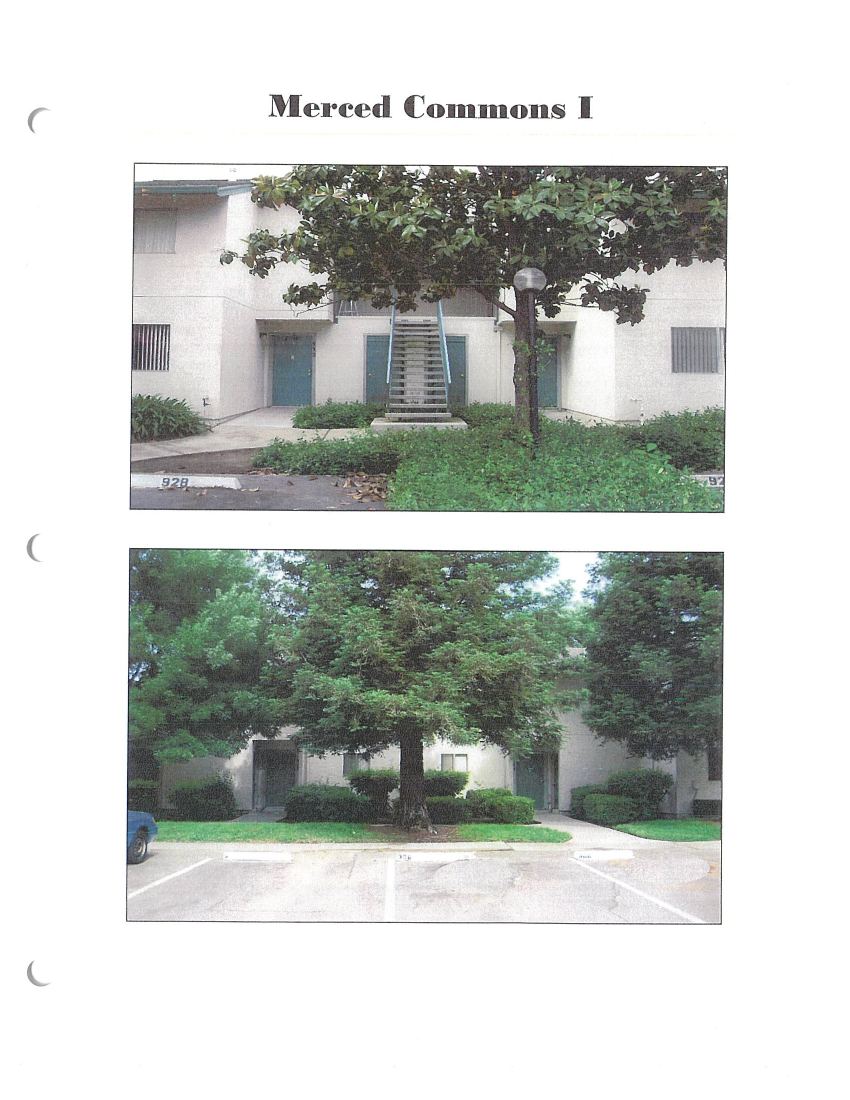
Building Data
- Total # of Buildings
- 8
- Office/shop
- 1/1 N/A
- Total # of Units
- 76
- 1 Bedroom
- 27 800
- Designated Elderly
- 0
- 2 Bedroom
- 38 1000
- Handicap Units
- 4
- 3 Bedroom
- ll 1200
Unit Amenities: electric stoves, refrigerators, private backyards, assigned apartment.
Nearby Schools: Sheehy Elementary, Reyes Elementary, Tenaya Middle School.
Nearby Services: Convenient to several parks, the airport, and Merced County Fairgrounds.
View site / floor plan
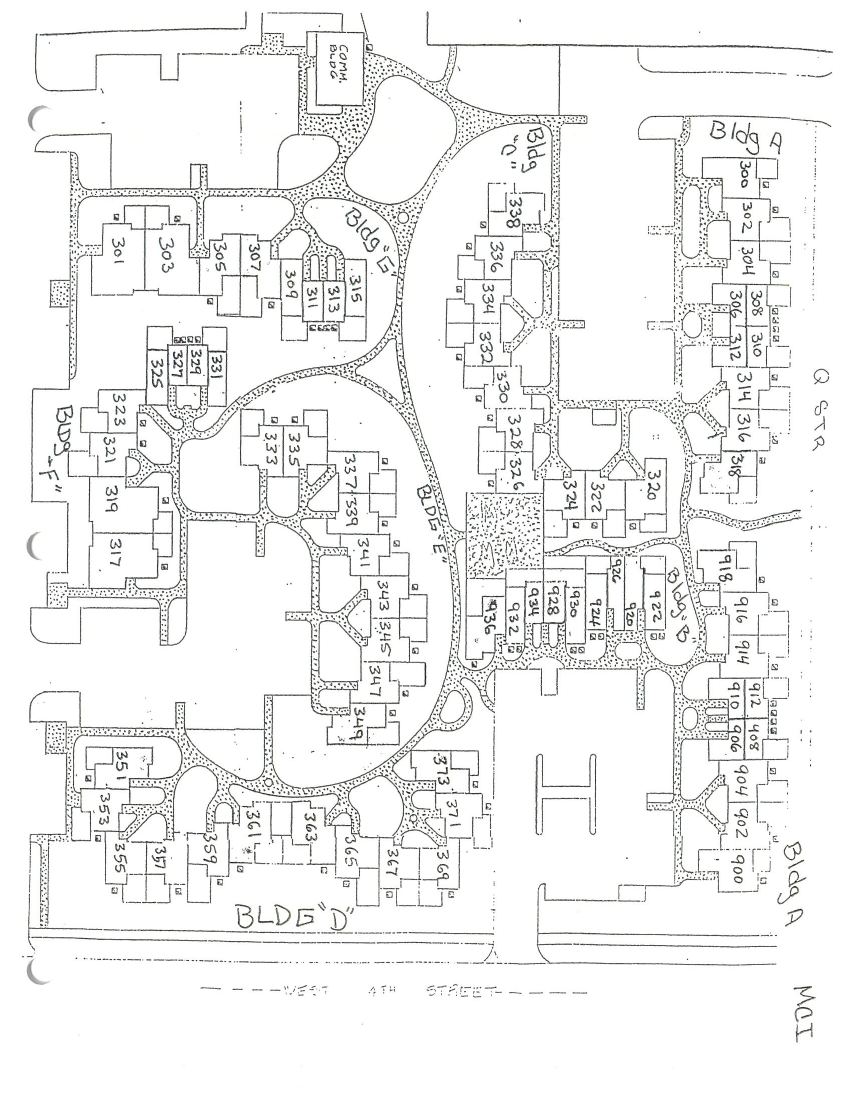
Merced Commons II
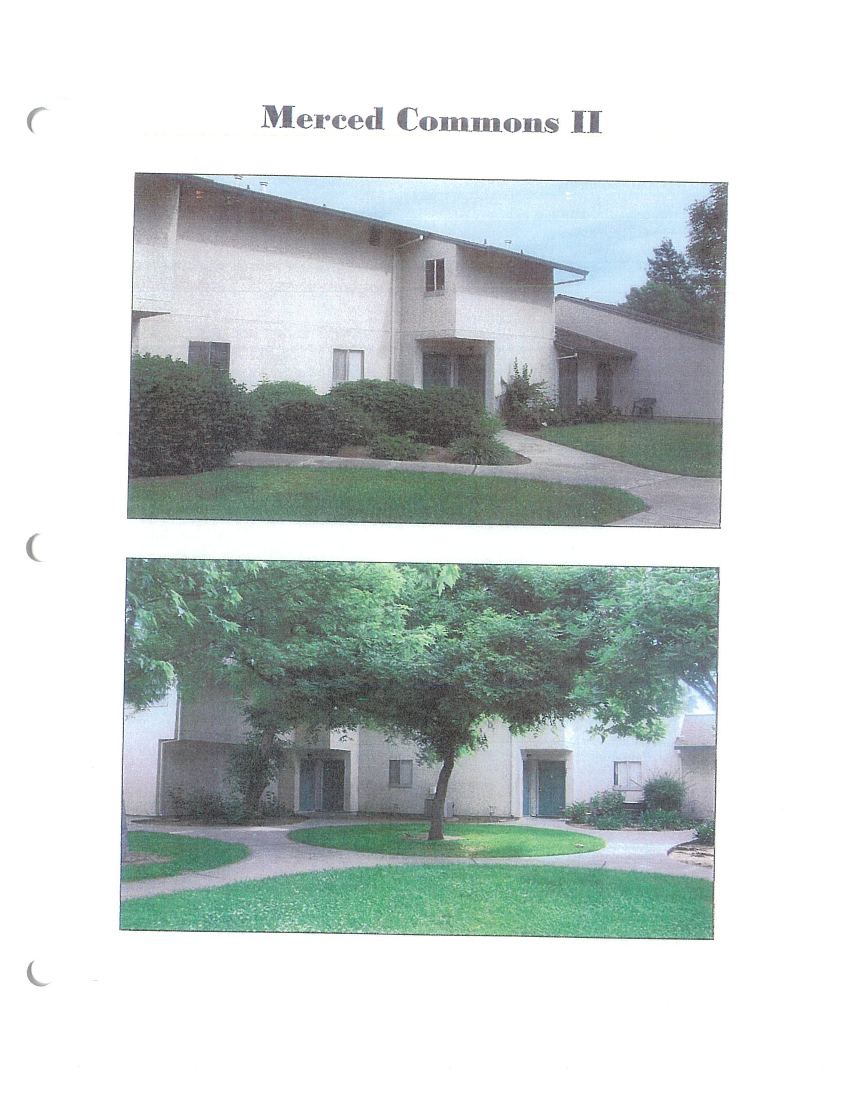
Building Data
- Total # of Buildings
- 9
- Office/shop
- N/A N/A
- Total # of Units
- 71
- 1 Bedroom
- 18 800
- Designated Elderly
- 0
- 2 Bedroom
- 35 1000
- Handicap Units
- 7
- 3 Bedroom
- 18 1200
Unit Amenities: electric stoves, refrigerators, private backyards, assigned parking spaces, laundry rooms.
Nearby Schools: Sheehy Elementary, Reyes Elementary, Tenaya Middle School.
Nearby Services: Convenient to several parks, the airport, and Merced County Fairgrounds.
View site / floor plan
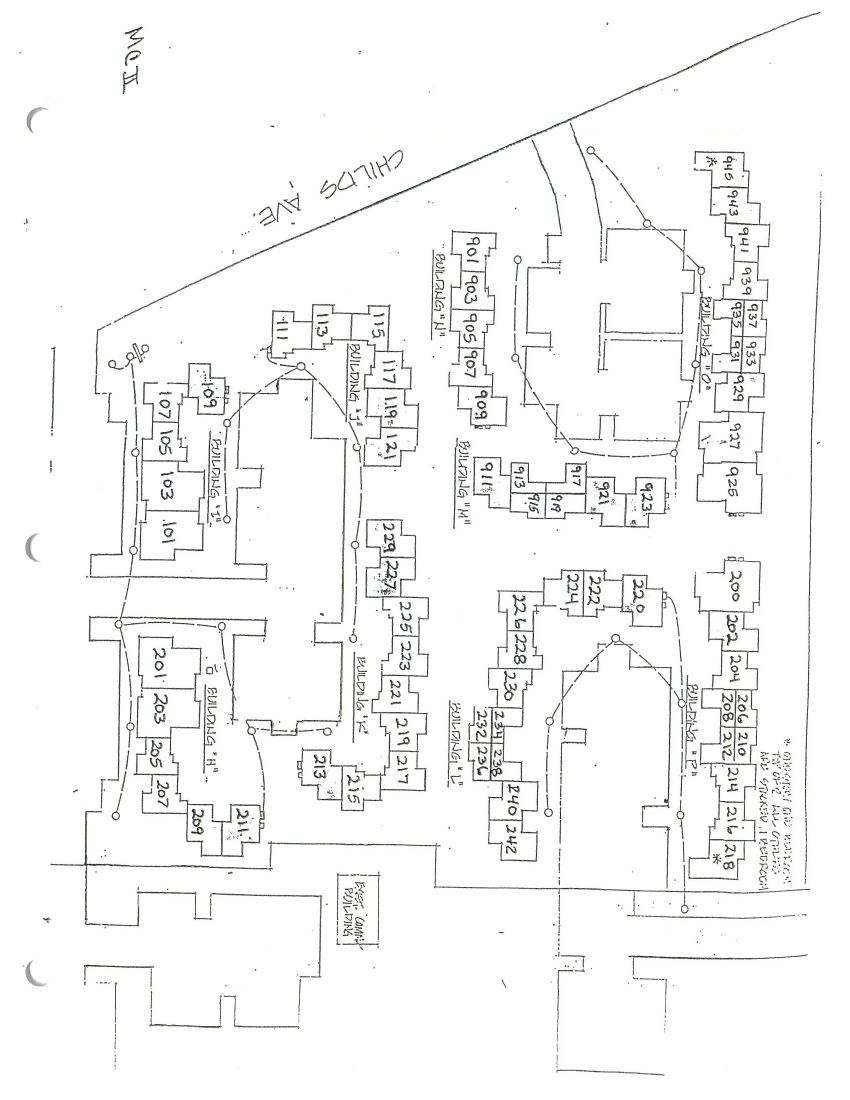
Oak Terrace (Merced)
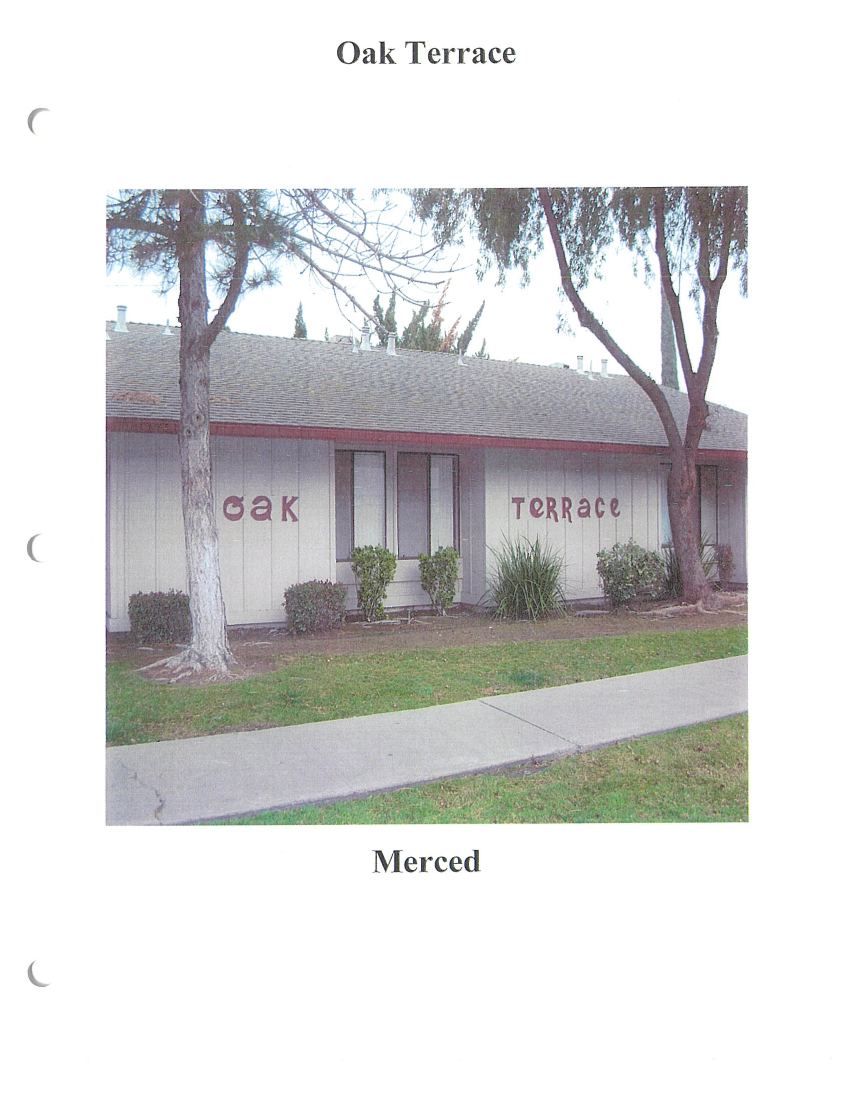
Building Data
View site / floor plan
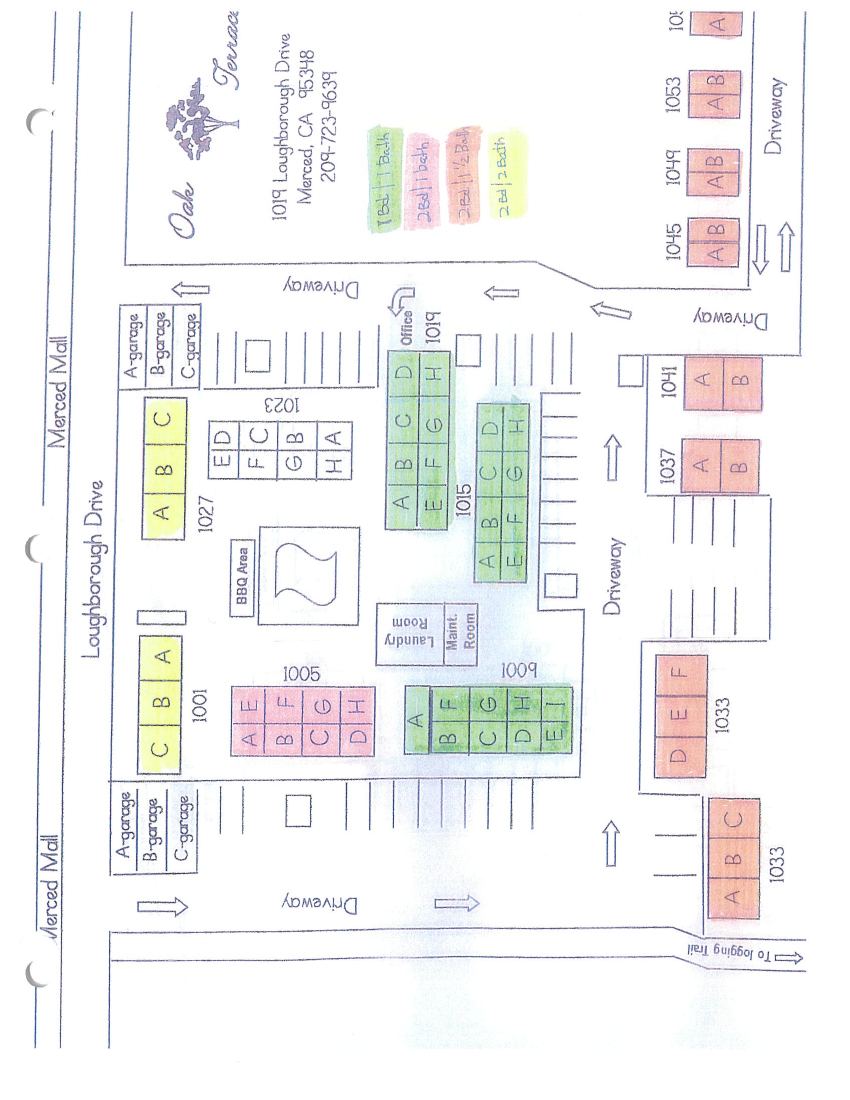
Migrant & Farm Labor Housing
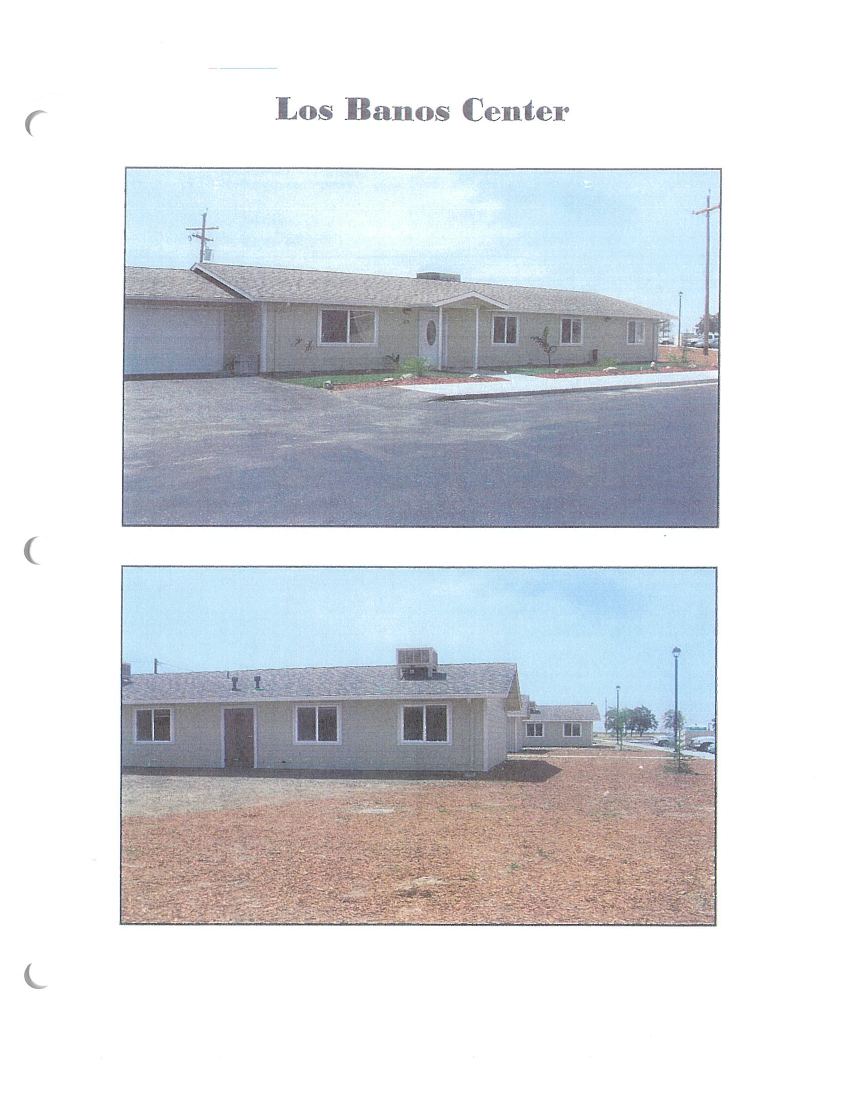
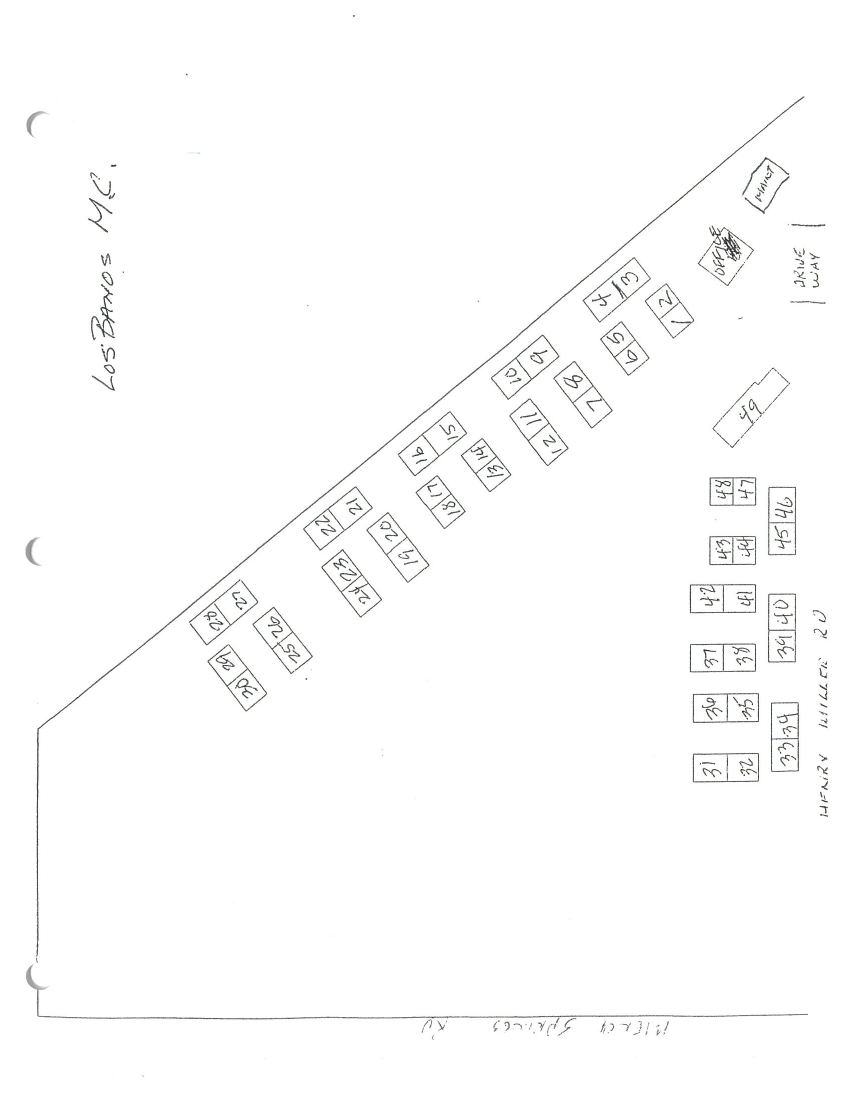
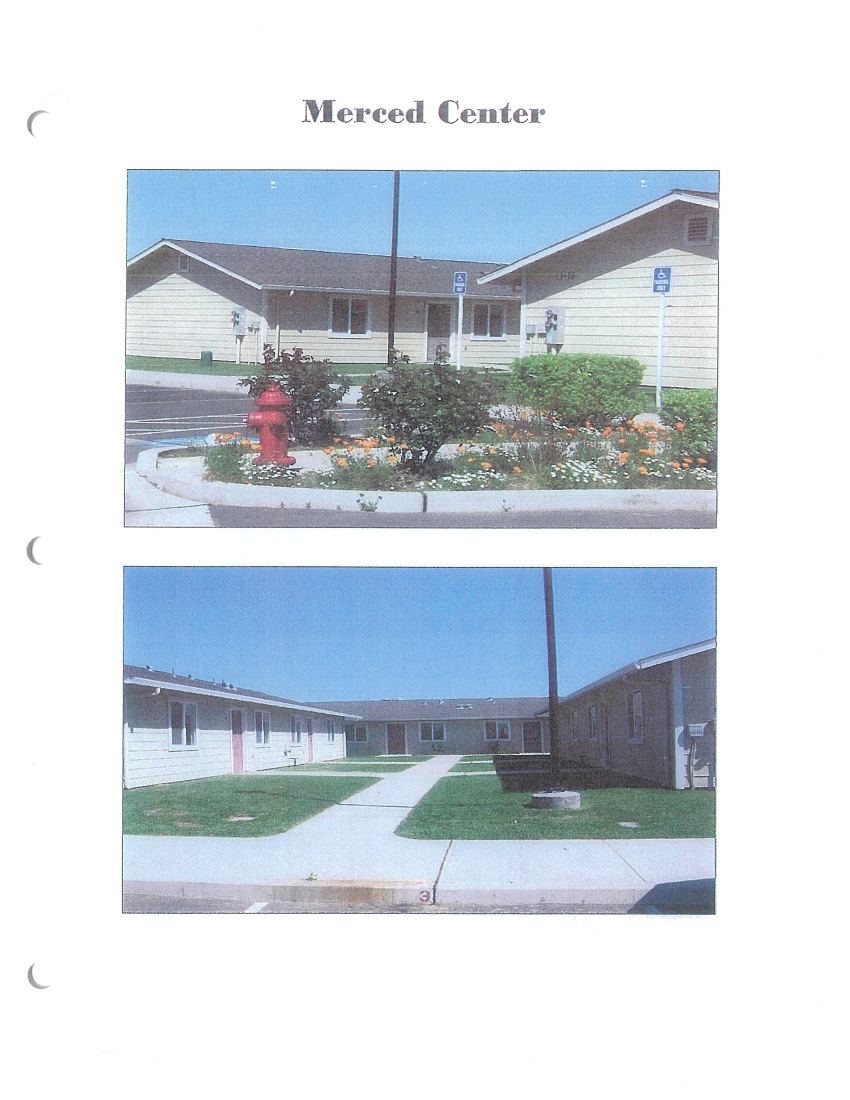
The Housing Authority of the County of Merced manages three migrant housing centers in the county. The newest center (constructed 2006) is the Los Banos site, which provides 48 units. The other centers are located in Atwater/Livingston (62 units) and Merced (54 units). The centers are normally open for occupancy for a 6-month period, generally between late April and November to cover the heart of the growing seasons. Eligibility for the centers is set by the State Office of Migrant Services (OMS) and includes restrictions involving migratory status and income sources.
Each center includes a fully staffed Day Care and Infant Care Center. The Infant Center cares for children ages 6 weeks to 2 years old, while the Day Care facilities care for ages 2 to 6 years old.
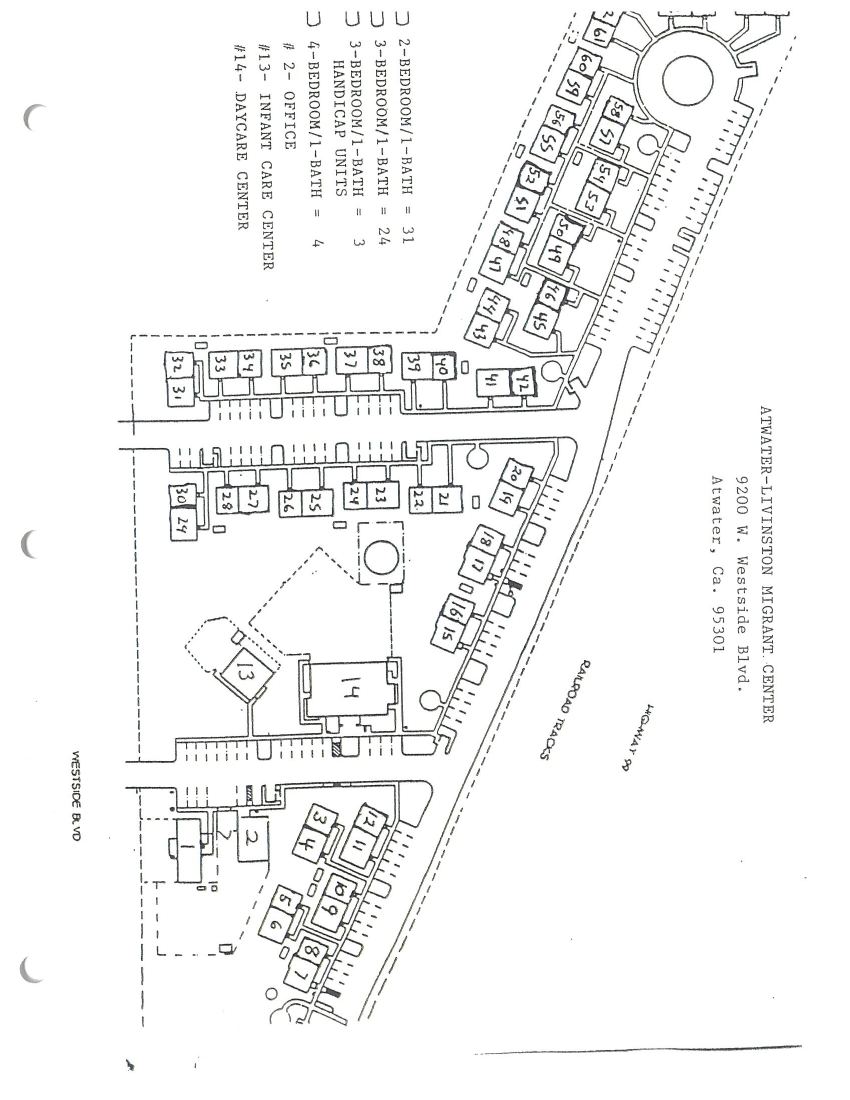
Atwater / Livingston Migrant Center
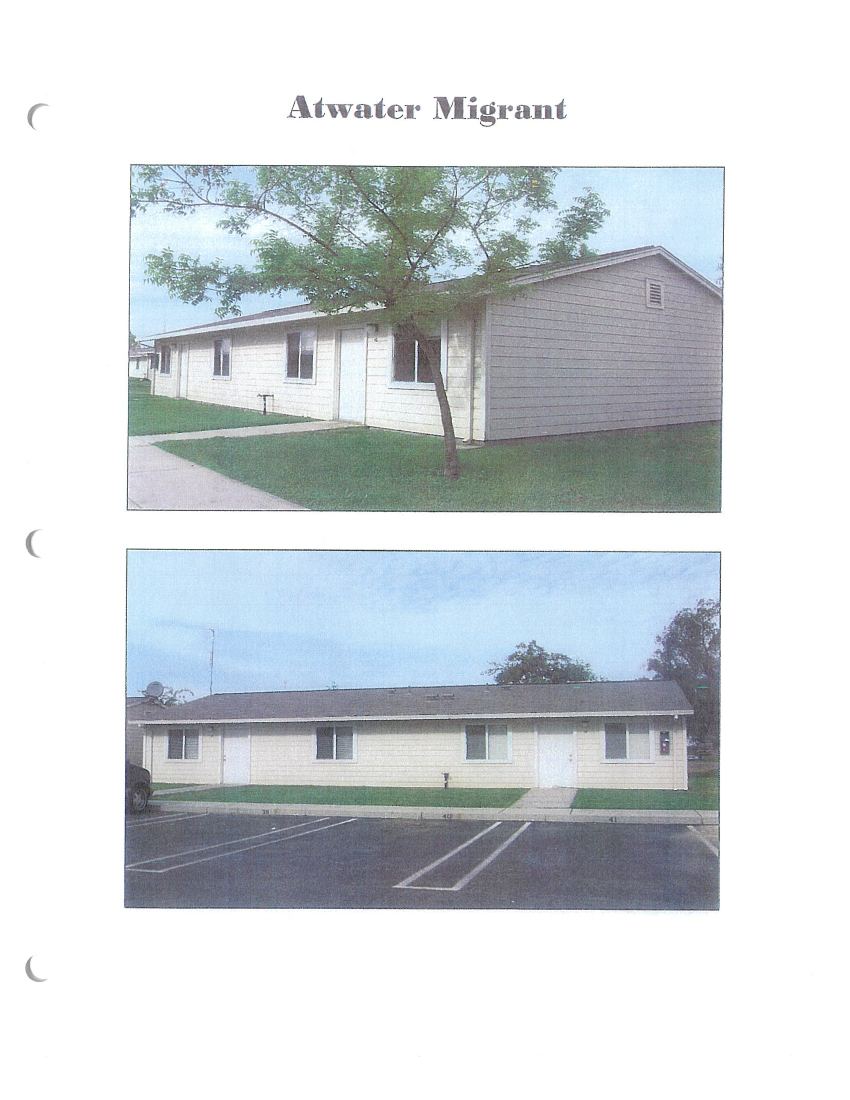
Building Data
- Total # of Buildings
- 66
- Office/shop
- 0 N/A
- Total # of Units
- 62
- 2 Bedroom
- 31 572 square feet
- Designated Elderly
- 0
- 3 Bedroom
- 27 780 square feet
- Handicap Units
- 3
- 4 Bedroom
- 4 884 square feet
Unit Amenities: units come furnished with gas stove, refrigerators, beds, dresser, kitchen table and chairs.
Nearby Schools: Elementary and Junior High Schools.
Nearby Services: Infant Care and Day Care Centers on-site, laundry rooms, close to shopping and restaurants in Atwater.
View site / floor plan
Los Banos Migrant Center
Building Data
- Total # of Buildings
- 25
- 1 Bedroom
- 0 N/A
- Total # of Units
- 49
- 2 Bedroom
- 12 573 square feet
- Designated Elderly
- 0
- 3 Bedroom
- 28 780 square feet
- Handicap Units
- 3
- 4 Bedroom
- 8 884 square feet
Unit Amenities: units come furnished with gas stove, refrigerators, beds, dresser, kitchen table and chairs.
Nearby Schools: busing to Los Banos schools.
View site / floor plan
Merced Migrant Center
Building Data
- Total # of Buildings
- 50
- 1 Bedroom
- 0 N/A
- Total # of Units
- 52
- 2 Bedroom
- 12 573 square feet
- Designated Elderly
- 0
- 3 Bedroom
- 36 780 square feet
- Handicap Units
- 3
- 4 Bedroom
- 4 884 square feet
Unit Amenities: units come furnished with gas stove, refrigerators, beds, dresser, kitchen table and chairs.
Nearby Schools: Franklin Elementary, Rivera Junior High and Merced High Schools. .
Nearby Services: Merced Mall, shopping, restaurants, medical services.
Handicap-Accessible Units
The Authority maintains designated handicap-accessible units across multiple communities. The tables below list accessible units by project, address, and accessibility level.
| Project # | Address | Accessibility Level |
|---|---|---|
| Merced | ||
| 23-01 | 1321 W. 5th Street | Full handicap |
| 23-01 | 452 Lesher Avenue | Partial handicap |
| 23-10 | 1205 W. 2nd Street | Full handicap plus |
| 23-10 | 1207 W. 2nd Street | Full handicap plus |
| 23-10 | 1206 W. 2nd Street | Full handicap plus |
| 23-10 | 1208 W. 3rd Street | Full handicap plus |
| 23-13 | 2870 Park Avenue B | Full handicap |
| 23-13 | 2870 Park Avenue C | Full handicap |
| 23-13 | 2870 Park Avenue D | Full handicap |
| Atwater | ||
| 23-12A | 1051 Kelso Street | Partial handicap |
| 23-12A | 1063 Kelso Street | Partial handicap |
| 23-12A | 1072 Kelso Street | Partial handicap |
| 23-12A | 1090 Kelso Street | Partial handicap |
| Dos Palos | ||
| 23-05 | 8962 W Globe Avenue | Partial handicap |
| 23-05 | 8982 W. Globe Avenue | Partial handicap |
| Los Banos | ||
| 23-04 | 702 Abby Circle | Partial handicap |
| 23-04 | 738 "D" Street | Partial handicap |
| 23-11 | 261 W. "J" Street A | Partial handicap |
| Valley View | ||
| 23-08 | 1642 Dora Street; Dos Palos | Full handicap |
| 23-08 | 1654 Dora Street; Dos Palos | Full handicap |
| 23-08 | 1650 Dora Street; Dos Palos | Full handicap |
| 23-09 | 1050 Sierra Vista Avenue; Atwater | Full handicap |
| 23-09 | 1054 Sierra Vista Avenue; Atwater | Full handicap |
Full handicap — roll-in showers and grab bars, wider doors, lever-style door handles.
Full handicap plus — all amenities of a full handicap unit plus visual flashers and a central smoke alarm.
Partial handicap — wider doors and lever-style door handles (no roll-in showers or grab bars).
Merced Commons (Project-Based Voucher) Accessibility
| Unit | Accessibility Level |
|---|---|
| Merced Commons I | |
| 301 | Partial handicap |
| 303 | Partial handicap |
| 317 | Partial handicap |
| 319 | Partial handicap |
| Merced Commons II | |
| 101 | Partial handicap |
| 103 | Partial handicap |
| 200 | Partial handicap |
| 201 | Partial handicap |
| 203 | Partial handicap |
| 925 | Partial handicap |
| 927 | Partial handicap |
Authority Programs Overview
The Housing Authority of the County of Merced administers a wide range of federally and state-funded housing assistance programs. The summaries below are taken from the original handbook and describe the Authority’s major program areas at the time of publication.
Public Housing
The basic mission of the Authority is to provide safe, decent, and affordable housing for very low and low income residents of Merced County. There are 421 units that are owned and operated by the Authority, located in the cities of Merced, Atwater, Winton, Livingston, Los Banos, and Dos Palos. Residents pay 30% of their adjusted gross income to the Authority as rent. There are some families that pay a flat rent which is 80% of the HUD-established Fair Market Rent.
Housing Choice Voucher Program (HCV)
This program is designed to provide participants with rental assistance. Participants are able to find and lease privately-owned houses or apartments that meet the requirements of the program. Rental assistance is paid to the landlord directly by the Authority on behalf of the participating family. The family then pays the difference between the actual contract rent charged by the landlord and the rental assistance paid by the Authority.
Migrant Farm Worker Housing
The Authority manages four migrant housing centers in the county. The newest center is the Felix Torres in Planada. The other centers are located in Los Banos, Atwater, and Merced. The centers are normally open for occupancy for a 6-month period generally between May and November to cover the heart of the growing seasons. Eligibility for the centers is set by the State Office of Migrant Services (OMS) and USDA Rural Development. Some restrictions involving migratory status and income sources apply.
Year-Round Farm Labor Housing
The Authority owns, manages, and maintains the Felix Torres Farm Labor Housing complex exclusively for farm laborers that is operational year-round. Eligibility for the complex is set by USDA Rural Development.
Project-Based Voucher Program (PBV)
The Project-Based Voucher Program allows the Authority to enter into a Housing Assistance contract with the owner for specified units and for a specified term. Rental assistance is designated within the property.
HUD-VASH
The HUD-VASH program allows eligible Veterans to obtain safe, affordable, accessible, permanent housing in a location of their choice. The primary goal of the program is to help move Veterans and their families out of homelessness while receiving supportive services from the VA.
Shelter + Care
The Shelter + Care Program provides housing assistance for individuals in the private rental market who are:
- Homeless
- Low Income
- Disabled (at least one adult family member)
- Have a current Supportive Services Care Plan with a Service Provider Agency
Family Unification Program (FUP)
Targeting families for whom the lack of adequate housing is a primary factor in the separation or threat of imminent separation of a child or children from their families and/or allowing the reunification of families already separated.
Mainstream Vouchers
The Mainstream Voucher Program offers rental assistance to non-elderly persons with a disability. This program receives special funding from HUD. The Mainstream Voucher program is a partnership between the Authority and agencies in Merced County who provide supportive services to persons with disabilities.
Emergency Housing Vouchers (EHV)
The Emergency Housing Voucher (EHV) program is available through the American Rescue Plan Act (ARPA). These vouchers are utilized to provide rental assistance for individuals and families who meet one of the following criteria:
- Homeless
- At risk of homelessness
- Fleeing, or attempting to flee, domestic violence, dating violence, sexual assault, stalking, or human trafficking
- Recently homeless or have a high risk of housing instability
This program is based on direct referrals to the Authority by the Continuum of Care (CoC). Anyone who believes they are eligible must contact the CoC to begin the eligibility screening process.
Recent Authority Achievements
In the past couple of years the Authority has tremendously increased the number of vouchers available for the Merced County community. Some of the achievements at the time of the original handbook include:
- VASH vouchers increased from 67 to 123.
- Mainstream Vouchers grew from an original allocation of 20 to 26.
- Emergency Housing Vouchers grew from an original allocation of 60 to 68.
- In 2017 the Authority allocated 125 vouchers exclusively for the Coordinated Entry System (CES); this has been increased to 150.
- The Family Self-Sufficiency (FSS) program has been extended to Public Housing residents in addition to HCV participants.
- The Authority has renewed its contract with several Project-Based Voucher (PBV) properties securing continued affordable low-income housing for the residents of Merced County.
- The Authority has remodeled numerous Public Housing units with new roofs, energy-efficient windows, updated kitchens and bathrooms, and other improvements.
HACM Board of Commissioners Bylaws
ARTICLE I - THE AUTHORITY
Section 1. Name of Authority. The name of the Authority shall be "The Housing Authority of the County of Merced."
Section 2. Seal of Authority. The seal of the Authority shall be in the form o f a circle and shall bear the name of the Authority and the year of its organization.
Section 3. Office of Authority. The offices of the Authority shall be at such locations in the County of Merced, State of California, as the Authority may, from time to time, designate by resolution. The Authority may hold its meetings at such places, as designated by public notice.
Section 4. Governing Laws. The Authority was created pursuant to the provisions of California Health and Safety Code Section 34200 et. seq. (Housing Authority Law) and shall operate its business in compliance with the applicable laws and regulations of the United States, the U.S. Department of Housing and Urban Development, the Housing Authority Law and these Bylaws.
Section 5. Board of Commissioners. The Board of Commissioners (hereafter known as the "Commission") shall consist of seven members appointed by the County Board of Supervisors (hereafter known as the "Appointing Board"). The Authority prefers to have one Commissioner appointed from each of the five (5) supervisorial districts to ensure maximum representation from all areas of the County served by the Authority. Two of the seven members chosen shall be tenants/clients of the Authority, preferably one shall be a public housing tenant and one shall be an HCV/Section 8 tenant. One of the tenant Commissioners shall be over sixty-two (62) years of age, if the Authority has tenants of such age.
All Commissioner vacancies shall be announced by the Commission and notice of vacancy shall be forwarded to the Appointing Board by the Board Secretary within ten (10) days of receipt of notice or resignation. Prospective Commissioner applicants must comply with all of the provisions and conditions of the Appointing Board's AT LARGE BOARD OF SUPERVISORS APPOINTMENTS process. In addition to the foregoing, tenant Commissioner vacancies shall be publicized to agency clients/tenants.
A tenant Commissioner shall have all the rights, powers, duties, privileges, and immunities of any other Commissioner, pursuant to current California Health and Safety Code.
If a Commissioner misses three (3) consecutive meetings or six (6) meetings in any twelve (12) month period without a medical or other compelling reason, his/her situation shall be discussed by the Commission and an appropriate course of action recommended. The Commissioners through the Board Secretary will, upon a majority vote, recommend to the Appointing Board that the Commissioner be removed and another Commissioner be appointed to serve the remaining term.
Section 6. Commission Contracts. The Commission shall employ an Executive Director, who shall also be the Secretary/Treasurer of the Authority. Additionally, the Commission may contract for technical experts, and any other officers and/or agents that it requires, and shall determine their qualifications, duties, terms of employment, and compensation in accordance with Authority policies and procedures.
The Commission shall adopt personnel rules and regulations applying to the Authority staff. Those rules shall contain procedures affecting conflicts of interest, use of funds, and personnel procedures on hiring and firing, including removal of personnel for inefficiency, neglect of duties, or misconduct. Such rules and regulations shall be of public record.
ARTICLE II – OFFICERS
Section 1. Officers. The officers of the Authority shall be a Chairperson, Vice Chairperson and Secretary/Treasurer.
Section 2. Chairperson. The Chairperson shall preside at all meetings of the Authority. At each meeting, the Chairperson shall submit such recommendations and information necessary and proper concerning the business, affairs and policies of the Authority. The Chairperson maintains and promotes a cooperative and collaborative working relationship with and among other Board members, Authority staff and management, and represents the Authority in a professional manner with those encountered in the regular conduct and performance of his/her official duties.
Section 3. Vice Chairperson. The Vice Chairperson shall perform the duties of the Chairperson in the absence or incapacity of the Chairperson. In case of the resignation or death of the Chairperson, the Vice Chairperson shall perform such duties as are imposed on the Chairperson until such time as the Authority shall select a new Chairperson.
Section 4. Secretary. The Secretary shall be the Executive Director of the Authority and, as Executive Director, he/she shall have general supervision over the
administration of its business and affairs, subject to the direction of the Commission.
As Secretary, he/she shall keep the records of the Authority, shall act as Secretary of the meetings of the Authority and record all votes, and shall keep a record of the proceedings of the Authority in a journal of proceedings to be kept for such purpose, and shall perform all duties incident to his/her office. He/she shall keep in safe custody the seal of the Authority and shall have power to affix such seal to all contracts and instruments authorized to be executed by the Authority.
The Secretary shall also be the Treasurer of the Authority. As Treasurer, he/she shall have the care and custody of all funds of the Authority and shall deposit the same in the name of the Authority in such bank or banks as the Authority may select. He/she shall keep regular books of accounts showing receipts and expenditures and shall render to the Commission, at each regular meeting (or when requested), a detailed report of the financial condition of the Authority.
The Commission shall also evaluate the performance of the Secretary annually.
Section 5. Signature Authority. The Executive Director, serving as the Treasurer of the Authority, shall have the authority to sign all contracts, orders and/or checks for the payment of money and shall pay out and disburse such monies on behalf of the Authority. The Chief Financial Officer of the Authority shall also have signature authority for all contracts, orders and checks. All checks, contracts or other items, which spend or obligate the Authority to disburse an amount in excess of $100,000 shall be pre-approved by the Commission; except in an emergency situation, the Chairperson may authorize such expenditure provided that the Commission is advised of the Chairperson's emergency authorization at the next regular meeting of the Commission.
Section 6. Additional Duties. The officers of the Authority shall perform such other duties and functions as may, from time to time, be required by the Commission or the Bylaws or rules and regulations of the Authority.
Section 7. Election or Appointment. The Chairperson and Vice Chairperson shall be elected at the annual meeting of the Commission from among the Commissioners, and shall hold office for one year or until their successors are elected. An officer may be elected for more than one term.
The Secretary shall be appointed by the Commission. Any person appointed to fill the Office of Secretary, or any vacancy therein, shall serve at the pleasure of the Commission, but no Commissioner of the Authority shall be eligible to serve in this capacity.
Section 8. Vacancies. Should the office of Chairperson become vacant or if the Chairperson is suspended for any reason, the Vice Chairperson shall immediately assume the office of Chairperson for the balance of the term. Should the office of Vice Chairperson become vacant for any reason, including suspension, the Board should take action as soon as possible to elect a Commissioner to become the Vice Chairperson for the balance of the term of office.
Section 9. Committees. The Commission shall, at such times deemed necessary, establish committees to assist management or to address special projects. Such committees may be either designated as "standing" or "special". Committee meetings shall comply with current Brown Act requirements. Authorization for establishment of committees shall be by formal Board resolution. Committee members shall be appointed by the Commission, and may include Commission members and agency staff who have the expertise consistent with the committee assignment. However, no committee shall have more than (3) sitting Commission members. Appointments to "standing" committees shall be made at each annual meeting of the Commission or as otherwise appointed by the Commissioners. Appointments to "special" committees shall be for the duration of the committee purpose. Each committee shall designate a committee Chairperson, and determine the time and place of meetings within the jurisdiction of the Authority, as directed by the committee Chairperson. Reports from committees shall be part of the regular Commission agenda. Upon expiration of term, or resignation, appointment of Commission members to a committee shall be rescinded as of their exit date from the Commission.
ARTICLE III - MEETINGS
Section 1. Annual Meeting. The annual meeting of the Commission shall be held on the third Tuesday of March at a properly designated time, at the regular meeting place of the Authority. In the event such date shall fall on a legal holiday, the annual meeting shall be held on the next succeeding business day or other date designated by the Commission.
Section 2. Regular Meetings. The Commission shall meet once each month (if there is sufficient business of the Authority to warrant said meeting) in regular session at the regular meeting place, 405 "U" Street, Merced, California, at 12:00 p.m., or later, on the third Tuesday of each month. The Commission may change the date, time, and place of a monthly meeting to accommodate scheduling conflicts or other issues that may arise. Written notice of the date, time and place of such regular meeting shall be delivered personally to each Commissioner, or sent by email or mail to each, at least two days before the meeting. If the need arises, the Commission may hold additional meetings to conduct the business of the Authority.
Section 3. Special Meetings. A special meeting may be called at any time by the Chairperson or by a majority of the members of the Commission by delivering personally, by email or regular mail written notice to each member of the Commission and to each local newspaper of general circulation, radio or television station requesting notice in writing. The notice shall be delivered personally or by email or regular mail and shall be received at least twenty four (24) hours before the time of the meeting as specified in the notice. The call and notice shall specify the date, time and place of the special meeting and the business to be transacted or discussed. No other business shall be considered at these meetings of the Commission. Written notice of a special meeting may be waived pursuant to the provisions of the Brown Act at California Government Code Section 54956.
Section 4. Quorum. The powers of the Commission shall be vested in the currently appointed Commissioners thereof. Four Commissioners shall constitute a quorum for the purpose of conducting its business and exercising its powers and for all other purposes, but a meeting may be adjourned until such time as a quorum is present. A meeting of the Commission will not be considered legal and binding unless it is determined by the Chairperson that a quorum of members is present. Section 5. Order of Business. At the regular meetings of the Commission the following shall be the order of business:
1. Call to order and roll. 2. Commissioner or agency additions/deletions to the agenda. 3. Approval of the minutes of the previous meeting. 4. Unscheduled oral communication. 5. Consent calendar. 6. Committee Reports. 7. Discussion, Information, Resolutions, and Action items. 8. Commissioners' comments. 9. Closed session. Adjournment.
All resolutions shall be in writing and shall be entered into a journal of the proceedings of the Commission. Action items are not required to be in the form of a written resolution, but shall be documented and entered into a journal of the proceedings of the Commission.
Section 6. Manner of Voting. The voting on all resolutions coming before the Commission shall be by roll call, and the yeas and nays shall be entered in the minutes of such meeting. For all other items coming before the Commission which require action, a voice vote shall be used and the minutes of such meeting shall contain the vote totals for each item as well as, listing any individual Commission members who vote against or abstain on any actionable item. The concurrence of four (4) Commissioners shall be necessary to take
any action unless otherwise required by law.
Section 7. Manner of Compensation. Each Commissioner is entitled to receive FIFTY DOLLARS AND NO CENTS ($50.00) per diem for attending the regular monthly Board Meeting pursuant to the provisions of California Health and Safety Code Section 34274. For attendance at any additional and/or Special or Committee Meetings of the Board of Commissioners, each Commissioner is entitled to receive TWENTY-FIVE DOLLARS AND NO CENTS ($25.00) for meetings of less than two (2) hours duration or FIFTY DOLLARS AND NO CENTS ($50.00) for meetings lasting two (2) hours or more. Each Commissioner is also entitled to receive necessary traveling and subsistence expenses in the discharge of his/her duties. Commissioners are limited to receive a maximum amount of TWO HUNDRED DOLLARS AND NO CENTS ($200.00) per month.
ARTICLE IV
Section 1. Amendments to Bylaws. The Bylaws of the Authority shall be amended only with the approval of a majority of the members of the Commission at a regular or special meeting. However, no amendment shall be adopted unless at least three days' notice thereof has previously been given to all members of the Commission.
↑ Back to topThe Commissioner's Handbook
This is a manual for Commissioners of Public and Private, Government, Profit and Non-Profit Organizations
BY Herb Small
Table of Contents Chapter Page Chapter Titles
1 1 Definitions
2 4 The Commissioner's Role and Responsibility
3 13 The Chairperson's Role and Responsibility
4 21 The Executive Director's Role and Responsibility versus The Commissioner's Role and Responsibility
5 32 Planning
6 42 The Meeting
Appendix
A 1 By-law B 13 Certification of Appointment C 14 Commissioner's Position Description D 15 Oath of the Office of a Commissioner E 16 Chairperson's Position Description F 17 Executive Director's Position Description G 21 Performance Appraisal of the Executive Director H 22 Performance Appraisal System I 23 Executive Directors Evaluation Form J 25 Evaluation Element From K 26 An example of an agenda L 29 Sample of possible names of policies
↑ Back to topForward
This manual is written as a guide to help the commissioner understand his or her role on the Commission. It also discusses the commissioner's relationship to the different elements of the leadership in the organization (Chairperson, Executive Director and the other Commissioners) that must work together. However, you must understand that this is written in the context of an ideal Commission and the way it should operate. Your organization may function differently due to outside requirements but these are exceptions. You may be quite comfortable in the current way your organization operates, and that's fine, but you should strive for the ideal. What is presented here is that each commissioner should occasionally step back and look at the way your organization and Commission operates. This manual can be helpful as a guide and used as a comparison for your evaluation. You must occasionally ask yourself, "as a Commission, can we do better?" If things are going well you may not need to change them, however, if you conclude that changes need to be made use this manual or parts of it as you need. Whatever you do make sure it makes sense for your organization. This is NOT a manual to let the Executive Director do what he or she wants. After one of my presentations an Executive Director told me that her Chairperson walked out half way through the training and went home. I asked her what were his reasons and he told her that, "it was all about letting the Executive Director to whatever they want." Unfortunately, the chairperson missed the point. This manual is to help you understand the shared responsibility of running the organization. Who has what responsibilities and authority, and why? The dynamics and communications between the Commission and Executive Director are very important in making sure that the organization is running smoothly. What are the dynamics between commissioners and Chairperson? What is the fine line between the Chairperson's role and the Executive Director's responsibility? I will examine and clarify these differences and show each role functions and relates to the overall responsibility. The information is taken from current literature, by observations, and just plain common sense. The reason you need to understand these relationships, is because old and new commissioners sometimes forget what their roles and responsibilities are on the Commission. This manual explains those important roles and is meant to re- emphasize that each position has certain responsibilities and that they should never overlap. These are standard operating procedures for most organizations, large or small, public or private, and are the considered the norm. The bottom line is that each commissioner should evaluate their Commission's own operation and ensure that their Commission is providing the most efficient and effective delivery of services they can to their constituency. About the Author
Herb Small has worked for the U. S. Department of Housing and Urban
Development for 23 years. He has held many jobs within the Department but the work he has enjoyed the most and found most interesting has been working with commissions and the Executive Director. This is a compilation of his first hand work with those commissions and his readings of the literature concerning this subject. From this work he realized there wasn't a single book that gave people a simple but effective idea of what they are supposed to do when they get on a commission.. He has written this manual in the context of a perfect Commission, therefore, if your Commission is operating differently, but it is functioning, then use this manual as a guide or model to help change your operation, but only if your Commission, or some part of it, is not functioning.
Mr. Small's primary job has been to review the commission's operation, examine their policies, and determine how the staff implements that policy. He has attended many Commission meetings and observed many different styles of operation. However, one of the areas that has frustrated him most is the way individual commissioner's are trained and what is expected of them. That is the reason he has written this manual: to help everyone on the commission know and understand their role and what to do from an individual's perspective as they decide their organization's future.
I wish to thank Ellen Sonntag for editing this manual for me. It isn't easy to proof read your work, especially when it is 50 plus pages long and you're doing it part time and at home.
↑ Back to topChapter 1: Definitions
Before we begin there are some key terms used in the following chapters that have different meanings to people. We need to define these words and look to see what the Thesaurus says about other words we can use with them interchangeably. It is important that whatever you call yourself, your organization or the way you function we all have the same understanding.
Let us look at some of these key words used throughout this manual. We are defining them to show how they are used with their synonyms, or interchangeably.
1. A commission is "A group of people given official authorization to perform certain functions or duties." The commission is a group of people who are given authority to do something. The authority can come from federal, state or local laws and is usually described in a set of by-laws that the commissioners have drawn up.
Synonyms for commission are (as nouns) authorizing, commitment, command, duty, delegation, office, responsibility, function, board, committee, agency, commissioners; (as verbs) empower, order, entrust. In this case, we can also include councils, legislative bodies, or other groups of people organized to perform any task in society when society has given its approval to form and function per laws, and by the organization's purpose and by-laws.
2. The by-law is "A rule of law governing the internal affairs of an organization." When your organization was incorporated it was required to have a set of laws that govern the commission's operation, these are called by-laws. Your organization, whether a for-profit, not-for-profit, government, or private entity should have a set of by-laws that the commission must follow.
A synonym for by-law is "by common consent."
3. The chairperson is "A person who presides over an assembly, meeting, committee, or board." For the purpose of discussion in this manual the person not only presides over the commission but is responsible for its operation, agenda planning, and what happens during, before, and after the meeting. The chairperson is not responsible for the organization, staff or program implementation. The chairperson is the team leader, council, and the one who is responsible for motivating the commissioners.
Synonyms for chairperson are chair, chairman, chairwoman, presiding officer, speaker, house speaker, stump speaker, and whip.
4. A commissioner "is someone who is authorized by a commission to perform certain tasks and duties." The authority to act as a commissioner comes from the commission through its by-laws. In some cases a commissioner is appointed by an outside entity to be on the commission. The authority to be on the commission comes from their appointment. However, the commission, and its by-laws, will explain specifically what the duty, purpose, and powers of the commissioner is when serving on a commission.
Synonyms for commissioner are government official, spokesperson, administrator, bureaucrat.
5. An organization is "A number of persons or groups having specific responsibilities and united for a particular purpose." Your organization must have a purpose, goals, operating polices, and a clear line of authority. The by- laws describe the commission's purpose, who the officers are, how, when, and where they are to operate. Once the commission is organized it then decides how it is going to operate, hiring a manager, establishing a budget, setting goals and polices, and monitoring these activities to see that they are accomplished.
Words and synonyms for organization are group, association, society, establishment, order, union, league, club, fraternity, as well as a business, bureau, department, government.
6. A policy is "1. A plan or course of action, as a government, political party, or business designed to influence and determine decisions and actions. 2. A course of action, guiding principle, or procedure considered to be expedient, prudent or advantageous." This is how you establish the rules of operation for your organization. The commission establishes the policy and the organization carries them out. They can be brief or detailed but they must provide enough information to allow staff, and others, to interpret their meaning.
In many cases the commission allows the staff to provide the written details needed concerning the implementation and procedures to carry out a policy. In other cases there may be rules from the government, or other entities, that require the commission to adopt certain polices.
For example, Congress passes a law that requires your organization not to discriminate. The commission must include this language in its personnel policy and make sure the staff is following it.
Words synonymous with policy are procedure, administration, plan, approach, order, course, method, expediency, and handling.
7. A resolution is "1. A firm determination, 2. An act of resolving to do something, 3. A course of action determined or decided on, 4. A formal statement of decision or expression of opinion put before or adopted by an assembly." This is how the commission tells its organization how it is to operate. A policy of the commission is passed by resolution, by the majority votes of the members present.
Words that are synonymous with resolution are resolve, proclamation, formal expression, decree, formal opinion, pronouncement, interpretation, solution, clarity, answering, declaration, end result, explanation, and judgment.
8. A client is "1. One whom professional services are rendered,... 2. A customer: patron. 3. One dependent on the patronage or protection of another." OR clientele is "1. The clients of a professional person as a group. 2. Customer or patron of a group." These are the people your organization serves. They are the organization's main purpose for existence. Your organization's must provide its service to an individual client or group of clients (clientele) and is for this class of customer. They are your organizations target group and, as with any organization's purpose, the person, or group (clientele) you must satisfy.
Words that are synonymous with client are: Customer, patron, potential buyer, buyer. Words that are synonymous with clientele are: body of customers, patronage, customers, target group, constituency, buyers, following.
↑ Back to topChapter 2: The Commissioner's Role and Responsibility
Welcome and thank you for being a volunteer or elected official for your organization. Whatever your reasons for becoming a commissioner, you are now entrusted with the future of your organization. You are now a member of a commission. You are, as are all of the commissioners collectively, charged with taking care of the needs of your organization.
I assume you have read your by-laws, the long and short range goals of your organization, any state, federal or local laws which affect your operation, and reviewed the operating policies of your organization. Your responsibility is to assure that the organization is following, developing and being managed according to the commission's plans and policies. Your job is to ensure that all of these activities are being performed by the organization's operation.
That's quite a handful! So what is your organization? What is its purpose? Who does it serve? Some feel that the organization is the physical structures or its cash and other assets. Employees, or individual commission members, or the chairperson, all may think that they are the organization. The definition of the organization is the Commission, meeting in a duly authorized meeting, with a quorum, that is to take action on issues of the organization. When we talk about the Commission, this is what is meant. The commission establishes the organization's purpose and who it serves through its by-laws and policies.
The commission establishes the goals of the organization. This is accomplished at the commission meeting. You do this by establishing direction through policies. These policies determines the way in which the organization provides its services. This is accomplished by having good operating practices and effective leadership. That is your first responsibility to the organization, providing good effective leadership.
What is your responsibility as a commissioner? Here are 3 areas of responsibilities you have as a commissioner: 1. First and foremost is your responsibility to serve the interest of your organization's purpose. The only reason you exist is to serve as an advocate and be the focus on the interest and needs of your organization. When you are deciding something for the organization you must always take into consideration the question, "How will this decision help serve the goals of the organization?" 2. The job of the commissioner is to set policy for the organization's operation. You must fashion policies to ensure that the organization is run effectively, efficiently, ethically and legally. These policies are the basis on which you and the staff must operate when undertaking the work of the organization.
3. An important role of a Commissioner is to set the short and long range goals for the organization; make sure that everyone in the organization knows, understands, and works toward those goals; and you, as a member of the commission, must evaluate the organization to see that it is meeting those goals.
Why are you a commissioner of your organization? You were selected because of your experience, background and interest. With your experience and background you are able to bring your knowledge and expertise to the commission. You bring this experience to the commission to help it make important decisions during its deliberations. You are here because you are interested. Here are 10 general expectations of a commissioner. 1. Review and know the organization's mission, purpose, goals, policies, programs, services, strengths, weaknesses, and needs.
2. Serve in a leadership position and undertake all special assignment willingly and enthusiastically when asked.
3. Monitor the commission's activities through its deliberations and keep it on track. Do not make exceptions to any policy except in extreme or rare cases.
4. Avoid any prejudiced judgments on the basis of information received from individuals or outside groups. Always take information like this under advisement. Urge those with grievances to follow the commission's established policies and procedures for complaints.
- Follow the trends of the organization and other organizations in your industry.
6. Monitor the staff's activities through their reports to the commission. If there is something that is not clear, or is confusing, make sure it is clearly explained to your full satisfaction. You must know and understand what is being brought before you before you can make a decision on it.
7. Evaluate all of the activities of the organization and by the end of each year come to consensus as a commission, that says, "Yes, we have met our goals." 8. Make sure every decision you make brings a sense of fair play and ethics to the commission's deliberations.
- Bring a sense of humor to the commission's deliberations.
10. When a vacancy occurs on the commission work with the other commissioners to suggest possible nominees who are clearly men and women of integrity, achievement, and distinction. They should be people who can make significant
and meaningful contributions to the work of the commission and enhance its progress. A good mix of backgrounds is important (e.g. Lawyers, Businesspersons, Educators, Farmers, Professionals, Union Representatives, and others) so they bring their diverse knowledge forward to make a contribution.
Remember you can be held responsible for the commission's actions even if you are not present at a commission meeting to make a vote. Don't pass up a commission meeting because you do not want to be present when a controversial issue comes up.
You should have clear policy regarding any liability insurance you have through the organization. Someone should speak to you about your Commissioner's Liability Insurance. Make sure it is in effect. Generally, if you make a decision that may come back to haunt you later, you should know how your insurance would cover you.
You are serving on the commission of a sophisticated operation; in some cases a multimillion dollar a year government or private business. You have to know, plan, and make sure that everything is appropriate for the rules that govern your operation.
Here are 5 thoughts you should remember and bring to every commission meeting:
1. Be prepared to participate in the commission meetings, including all appropriate organizational and subcommittee meetings.
2. Ask timely and substantive questions at commission and committee meetings that are consistent with your conscience and convictions. You must support the majority decision on all issues decided by the commission.
3. Maintain the confidentiality of the commission's executive sessions. Speak for the commission only when authorized to do so.
4. Suggest agenda items for commission and committee meetings to ensure that significant policy and related matters are fully addressed and discussed in the open.
- Attend every commission or assigned committee meeting.
Here are 3 ideas concerning your relationship with staff, tenants, outside individuals, or groups.
1. Counsel the Executive Director and offer support in his or her often difficult relationships with outside groups and individuals.
2. Avoid asking for special favors of the staff, including special requests for extensive information, without at least prior consultation with the Executive Director, commission, or the appropriate committee chairperson.
3. Do not take it upon yourself to meet with staff, inquire with constituents, or seek any public forum yourself. Always ask for information from, and through, your Executive Director, or Commission, preferably at a commission meeting.
Here are 5 ways of avoiding a Conflict, or a possible Conflict of Interest.
1. Serve the organization as a whole rather than any special interest group or constituency.
2. Avoid even the appearance of a conflict of interest that might embarrass you, the commission, or organization. Disclose any possible conflict of interest to the commission in a timely manner. If in doubt---disclose it.
3. Maintain independence and objectivity on all matters coming before the commission. Do it with a sense of fairness, ethics, and personal integrity; even though it may not necessarily be dictated by law, regulation, or custom.
4. Never accept (or offer) favors or gifts from (or to) anyone who works for, is a constituent of, or does business with your organization.
5. Never assume you can use anything of the organization for your personal use. YOU MUST NOT! All assets (i.e. equipment, vehicles, computers, money, materials, etc.) are a part of the organization. Authority can only be given by the full commission, not an individual.
Your fiduciary (financial) responsibilities may be limited because you do not have direct responsibility. However, you should understand them as a matter of Internal Control.
Here are 5 areas you should know and understand about the way your organization handles its assets and money.
1. The commission must establish good policies which exercise prudence with the control and transfer of the organization's funds and assets. Make sure the commission has a very tight internal control policy and that the policy is being followed by staff.
2. Every commissioner must read and understand the organization's financial statements. Even if you do not have direct responsibility or authority to sign checks, accept money, or approve the disposition or collection of assets, you, as a commissioner, could still be held responsible. Your review is important to help the commission fulfill its fiduciary responsibilities. You are notifying the other commission members and staff that these internal documents are being read and understood. If there is a question, ask it. This will alert everyone that you are watching the financial operations.
3. Make sure that all outside financial reports (audits) are read and understood and everything in them demonstrates good accounting and internal control practices. If there is something that cannot be explained to your satisfaction, call a meeting with the Auditor to give you a complete explanation. All findings must be closely scrutinized and closed by the commission, not the staff.
4. Do not place yourself, or an employee of the organization, in a situation where there are no checks and balances concerning ANY and ALL assets of the organization. DON'T MAKE YOUR EMPLOYEES CROOKS by giving them opportunities to have direct access to the organization's assets (e.g. these means money, materials, equipment, tools, automobiles, credit cards, etc.) without at least someone checking on them.
1. Without a clear internal control policy everyone in the organization is at risk, including the commissioners. It is the commission's responsibility to make sure that there is a strong internal control policy that protects the assets of the organization.
I have investigated many situations where honest employees were put into terrible positions by poor internal controls. This includes the Executive Director, staff, part time employees, commissioners, and others. Most have lost their jobs, or worse, gone to jail because of unclear or no internal control policy. One example of this activity includes:
- All of the commissioners were required to pay back money to the organization because they assumed they could take their wives on official trips. This was not the case. Only those activities directly related to their job, as a commissioner, may be funded by the organization.
2. You must carefully read all of the financial reports and statements for the organization. Look for trends or other activities that may be suspect. The monthly bills should be checked. Better yet, ask for a consolidated 3 or 6 month financial report that gives you a breakdown of expenditures, by contractor or vendor. This is very helpful in monitoring the bills. An example of this would be:
- After reviewing the credit card charges for 6 months we determined that the Executive Director was using the credit card for personal items. The commission never reviewed the individual bills, they just passed a resolution to pay the bills. The Executive Director went to jail and had to pay back the expenditures to his organization.
3. Above all, ASK QUESTIONS! If you see items you feel may be ambiguous or repetitive, are not normal under approved operating practices, or not in an approved contract, it never hurts to ask.
- After reviewing the bills through the commission minutes for a 6 months period, trends can be seen which show poor planning or contracting. An easy one is when an organization was buying paint. They would buy less than $1500 per month or the cap the Commission required for purchases. Since the staff bought $1,500 worth of paint for 6 months at the same store, this broke the intent of the commission's policy. It just happened that the purchasing agent's brother-in-law owned the paint store where the organization was purchasing its paint.
5. Make sure there is a good system of checks and balances no matter what size of organization you have and how many people handle your assets. As many
people as possible should be involved in checking and double checking your money and purchases. The one thing a commission can not budget for is the loss of money, inventory or other critical assets to do the organization's work.
- Do not give the appearance of a conflict of interest.
2. Make sure all decisions are fully discussed and made at an open commission meeting.
3. If you or another commission member has information concerning an issue make sure that you, or they, divulge it in an open commission meeting.
4. If you, a staff person, another commission person, an appointing official, or their relative has an interest in any issue coming before the commission or organization, be sure that it is fully discussed in an open commission meeting.
5. Make sure all of your decisions are above reproach, are based on the best information available, and can be defended in your own mind. You must have all of the facts when making a decision. If all of the facts are not present, do not make a decision. Wait until all of the information is available before you act.
6. If you have a question about a conflict of interest ask your organization's lawyer to give you an opinion. If in doubt assume that a conflict exists and get a legal opinion before you act.
Conflict of Interest
Each commissioner, and everyone in the organization, must have a position description. Below I have given you an example of a description of the duties of the commissioner. The commissioner should regularly review their position description to make sure they understand their role in the organization and on the commission.
The Duties of a Commissioner
The commissioner serves on the commission as a full voting member. The commissioner works with, and through, the commission. The commissioner is an advocate and practitioner of the goals of the organization. The commissioner attends and participates in all commission meetings (Special, Executive, and Emergency), on assigned committee(s), or at the will of the commission. The commissioner helps set policy for his/her organization through the commission through his/her vote and participation in making policy. He/She fashions those policies to ensure that the organization is run effectively, efficiently, ethically and legally. The commissioner helps set short and long range goals for the organization to assure the future viability of the organization. The commissioner makes sure everyone in the organization knows, understands, and works toward the commission's short and long range goals. The commissioner provides input and participates in the evaluation of the commission and organization to assure that they meet their goals at the end of each year. The commissioner provides input into and participates in the annual evaluation of the Executive Director.
Below are 7 practices I have observed several commissioners doing ,that should not be done. Remember, you are a member of a commission. This is where you get your authority. If you are not meeting as an official member of the commission, a subcommittee, or with direct approval of the commission, you are a private citizen and have no voice in the organization's operation.
1. A commissioner was holding meetings with constituents. This on its own is not bad, however, the commissioner was doing this without the permission from either the commission or staff of the organization. It was causing quite a conflict for the staff. They were attempting to run the daily operations and were constantly being told that they had no authority and that the constituents would go to the commissioner to get their decision overturned.
2. A commissioner would attend commission meetings and sit in the corner and not participate. The news media would pick up on this activity and made the commission look bad. This caused a great deal of controversy for the other members of the commission who thought the commissioners' actions were immature and inappropriate.
3. A commissioner was retired and every November through March would take off for his retirement residence in Florida. The commission could not conduct some meetings because there were not enough people for a quorum. Actions were taken by the commission in his absence. This proved to be a problem for him
when the full commission was sued by a contractor. Even in this commission members absence, the courts concluded that he had as much blame as the rest of the commissioners even though he was not present to vote on the contract. This member of the commission was the chairperson.
4. A commissioner would walk the grounds once a month before each commission meeting. He would then bring all of his findings to the commission meeting and grill the Executive Director about numerous things he found. Although they didn't affect the overall operation of the organization they were a constant bother to the staff and other commission members. This caused a great deal of tension at the commission meetings. Eventually the commission ran through two good Executive Directors before they took control of the situation. They were able to get the chairperson to resign due to his constant interference.
5. A commissioner would meet with the media and blast the commission for its actions or inaction on issues he felt were not appropriate, or on resolutions he wanted passed by the commission without discussion. This of course caused the other commissioners to throw up their hands in disgust. The commission censured him, passed a resolution that gave him a cease and desist order, and eventually they tried to ignore him. Finally, the commissioner quit to run for mayor. He lost.
6. The Executive Director told a commissioner that it was none of her business when asked for the financial status of the organization. The commissioner felt something was wrong but the other commission members continued to support the Executive Director. The entire commission eventually became suspicious when an audit pointed out some irregularities. The Executive Director was eventually found out and convicted of stealing money from the organization.
7. One commission member was given authority to hire a staff person without input from the Executive Director or anyone else. She hired her daughter. She caused all kinds of problems for the staff and commission. Once the commissioner was off the Commission, the staff person was fired.
The client as a commissioner. Some organizations have had a great deal of success with putting clients on the commission. The purpose of this is to bring your commission closer to the perspective of the people you serve. Some organizations feel this is like putting the "fox in charge of the hen house." That is simply not true. The purpose is to bring the client's perspective to the meeting, after all this is the reason you exist in the first place.
It is important to understand that there is a fine line between bringing in a client's point
of view and they intern representing the clientele or an individual you serve. In no instance should the client commissioner represent his or her fellow clients or himself or herself in matters dealing with the organization.
A tenant commissioner has all of the same duties and responsibilities of Commissioner as described earlier in this Chapter. The client has no other duties or responsibilities and shall not represent any other client or other organization either as an individual or as contractor with the organization. The client represents his or her opinion on the commission as a commissioner and brings only his or her special knowledge to all commission meetings, as do the other commissioners, while serving as a the commissioner.
The purpose for having the client on the commission is simply to represent his or her views to the other commissioners. This is similar to those views brought to the meeting by other members on the commission. Just as you bring people in from all walks of life to provide your commission with their views (of say a banker, real estate brokers, housewife, insurance broker, entrepreneur or other individual) you are soliciting the views of you own clients. Some people say they don't need this view and that they can simply survey their clientele to find out what they want. Well you can do that, however, in a meeting when you have to decide a policy, I believe that it is least important to get a point of view from someone who is directly effected by your decision.
As with all commissioners on the commission it is important for the Chairperson to monitor the client to make sure that they are not crossing the line by representing himself or herself or another client or the clientele in general. The Chairperson must be the one to clearly define this, in the beginning, to the assure that the client knows where the fine line is in the deliberations. He or she must also monitor any discussion he or she has with the Executive Director to make sure they are not directing the staff or interfering with the day to day operation of the organizations staff.
Clearly, communications is important regarding the role and responsibility of each commissioner and especially the client commissioner before there are any misinterpretations. It must be the chairperson's responsibility to establish the working relationship and monitor them to make sure no one steps beyond them. However, the board must establish a written policy that everyone understands as far as the operating practices of the commission. This is normally part of the by-law (see Appendix A) and is something that must be explained and understood by everyone.
If the Chairperson is unable or unwilling to monitor this then the other commissioners must make it part of their job to assure that everyone is performing correctly according to their practice. Finally, the Executive Director has a role to train and provide information to the client commissioner just as he or she does to all of commissioners.
A well run commission is the responsibility of the chairperson, each commissioner, and the Executive Director. A client commissioner can work if given a chance and everyone knows and understands their roles. This is true of anyone associated with the organization. Remember communications is everyone's business, keep the lines open, provide training, and accept the client commissioner as if he or she were another member on the commission.
↑ Back to topChapter 3: The Chairperson's Responsibility
The position of Chairperson is one of prestige and recognition and denotes the respect and trust of his or her peers. The Chairperson is the number one volunteer of the organization. Because the Chairperson's position is so critical to the commission's operation, the commissioners must be sure to select the best person for the job.
The Chairperson is chosen from among the commission members and is the person they feel is most qualified to carry out these very important responsibilities. Each commissioner must know and understand the duties and responsibilities of the Chairperson in order to select the best person for the job. The Chairperson is no better than the trust given to him or her by the other commissioners. The Chairperson must have their complete confidence while performing his or her tasks of organizing, appointing and carrying out the functions of the commission.
The Chairperson has the power and authority of the commission. The Chairperson must oversee the commission's operation and represent the commission to outside constituencies. The Chairperson's main duty is guiding the commission's operation during its deliberations. He/She is responsible for all that happens before, during, and after each commission meeting. The governing responsibilities rest solely in the hands of the Chairperson who must guide the commission's policy development which will ultimately determine the fate of the organization. The Chairperson has the responsibility for the financial affairs and programmatic future of the organization.
These are pretty lofty responsibilities. The Chairperson must remember that his or her first responsibility is that of a commissioner. All of the items discussed in Chapter 1 must pertain to the Chairperson. The Chairperson's power and authority comes from his or her fellow commissioners and through the by-laws. The by-laws are the rules which govern the commission and establishes the general rules for how it works.
So what are the responsibilities of a Chairperson? I believe there are 10 areas of responsibilities for the job of Chairperson. Keep them in mind when selecting your Chairperson or when you are the Chairperson. They are:
- the chief volunteer or elected officer of the organization.
2. a partner with the Executive Director in achieving the organization's mission and goals.
- the leader of the Commission of Commissioners, which sets policy for the
organization, and to whom the Executive Director is accountable.
4. the person who is a conscience builder to all issues brought before the commission.
5. the chair of commission meetings, and must delegate to others, committee and subcommittee assignments.
6. the person who, along with the Executive Director, develops an agenda for each commission meeting, and seeks input from all other commissioners regarding agenda items.
7. the one who appoints individuals to standing and ad hoc committees and appoints the chairperson to each.
8. the person responsible for assuring that there is an annual review and evaluation of the Executive Director and makes sure that there is input from the other commission members.
9. The person who formally presents an evaluation of the Commission's progress at its annual meeting.
- the chief spokesperson for the organization.
Below are the 8 duties of the Chairperson that complement the responsibilities mentioned above. The Chairperson is the person who:
1. encourages and manages the commission's role in strategic planning for the organization.
2. serves as an ex officio member of all committees and attends their meetings when possible.
3. discusses all issues confronting the organization with the Executive Director and develops a strategy for dealing with them.
4. helps guide and mediate commission actions with respect to organizational priorities and governance concerns.
- monitors financial planning and financial reports.
6. formally evaluates the performance of the Executive Director with input from the other commissioners.
7. assures that all commission policies are being adhered to by both the commissioners and organization staff.
- performs other responsibilities as assigned by the commission.
Everyone must understand the role of the chairperson versus the role of the Executive Director. These two roles are important and must be clearly understood as two separate functions with very different authority and responsibilities. It is important to know that there is a difference and that the thin line between them must never be crossed.
• The chairperson is the Chief Volunteer Officer and is responsible for guiding the commission in its policy setting role.
• The Executive Director is the top paid staff person, is hired by the commission, reports to the commission, and is responsible for carrying out the commission's policies.
The chairperson is the most important commissioner on the commission. The chairperson is responsible for assuring that all pertinent matters are brought before that commission, fully discussed, and acted upon. It is the chairperson's responsibility to see that the commission's package is complete and contains all of the documents needed to support the issues brought before the commission meeting.
It is the chairperson's task to make sure that all commission policies are being adhered to by both the commission and staff. He/She must make sure that all of the policies, supporting documents and reports required by the commission are available to each commissioner. Matters of controversy should be thoroughly discussed and, if necessary, a committee may be appointed to discuss the issue in more detail.
It is the chairperson's responsibility to make sure that there is a consensus of the commission for each issue coming before the commission. Consensus building is important to assure that everyone on the commission is in general agreement on an issue. It does not mean that everyone must agree, but everyone can accept the decision of the commission.
The chairperson's job is to see that the commission moves on to meet its obligations. After appropriate discussions of an issue and a vote is taken, either for or against, he/she must make sure that every commissioner accepts the vote and moves on. It is the chairperson's job to see that this is accomplished.
The chairperson is the team builder; sees that all commissioners have appropriate background information and knowledge; and responsible for assuring all new commissioners are trained. The chairperson is the guide to making sure that the by-laws are followed; all laws governing the organization's operations are being followed; and the organization is living up to its contractual commitments.
The leadership role of the chairperson The chairperson's 4 leadership characteristic categories are: participation, information, evaluation and delegation. These are attributes needed to fulfill the job.
1. The chairperson sets the standards for participation in the organization. He/she can accomplish this by sharing information with all commissioners. He/she must ask for their advice and counsel, give sufficient time to work on issues, and comment favorably on the progress of those issues facing the organization. It is important to maintain this line of open communications with the other commissioners and individuals serving the commission.
It is important to note that the support and feedback of the commissioners, staff and others are just as important to the chairperson as it is to them. To give him or her positive reinforcement, support when it is needed, and allow everyone to participate in the process, is critical to the chairperson. This can go a long way in developing and maintaining the trust of the commissioners, staff and other people and organizations working with your organization.
2. The chairperson must stay informed, keep others informed, and share information with those who need it. The chairperson is entitled to know the status of any issue related to the mission and goals of the organization. The chairperson must communicate, and allow others to communicate on the status of all issues. He/she must allow everyone to report on both the organization's accomplishments and failures. This is done through written or verbal reports that are germane to the topic at hand. He/she must make sure there is enough detail given and that there are reasonable discussions concerning all issues brought to the commission.
3. Formal and informal evaluations are the constant responsibility of the chairperson. The chairperson, by working closely with the Executive Director,
can develop strategies, reports and documents which will help assess the progress of the organization. This can be accomplished by having a process in place to determine how the organization is performing. This is critical. Formal evaluations should be done at least annually, however, depending on the task, can be done more often if necessary.
An important job of the chairperson is to recognize when there is a problem. The chairperson must take immediate and appropriate steps to resolve the problem, and if necessary, recommend additional resources to solve the problem. This may require him/her to recommend hiring outside consultants or bring in someone with expertise who is familiar with the problem. The importance here is to get the problem solved before it grows out of hand.
4. The art of delegation is a very difficult concept for most people to understand. The chairperson should never do the task themselves. The chairperson has a commission full of commissioners, staff, volunteers from outside the organization who are interested, and he/she can recommend hiring consultants to get the work done. All of these people can provide the help to bring forward information and knowledge to make a good policy decision. Appointing a person to committees is an important part of the job. This is why the chairperson must have the support of the other commissioners and the authority to appoint committees.
Also, delegation does not mean turning the responsibility over to a committee, contractor, or staff person and forgetting about it and assuming it will be done. It is the chairperson's responsibility to make sure that he/she is clearly understood, specifies what function(s) is(are)to be done, explains the purpose it will serve, and requires that written progress and final reports are submitted at agreed upon times. It is the chairperson's responsibility to establish both the reporting time frames and formats. Finally, it is the responsibility of the chairperson to assure that the accomplishment of the task is complete.
Additionally, the chairperson must allow a committee, contractor(s), or staff person(s) to decide how a task is to be accomplished. The chairperson must monitor the activities and progress of the task but not interfere unless asked. Asking pertinent questions about progress at commission meetings or when reports are due is the job of the chairperson. If there are problems it is up to the chairperson to take the necessary corrective actions. The chairperson is ultimately responsible for seeing that the task is on track, on time, and is completed. Characteristics of the Chairperson Below are 5 Characteristics that are important in the chairperson.
- The chairperson must have a clear vision of the organization and its
direction. The chairperson must realize how the commission, committees, Executive Director and staff function separately and how they fit together to accomplish the organization's goals. He/She must have a pragmatic approach to the organization and determine its strengths and weaknesses. The chairperson must be the principal problem solver and have the ability to put the right person(s) in the right job. The chairperson must test his or her placements by seeing to it that the task is being accomplished. The chairperson must be willing to make corrections whenever necessary.
2. The chairperson must have the detachment that will allow him/her to step back from the organization and look at what is really going on. The chairperson must do this by evaluating the operation without regard to personal feelings. This is where the chairperson's sense of humor is most important. There may be more than a few things he\she may come across that will have a certain irony in them. Sharing these ironies with a sense of humor will relax others and convey that, although they are involved in the serious business of the organization, there is time for humor and laughter. The Chairperson must be able to put everything into perspective.
3. The chairperson must be impartial and objective in his\her approach to everything. The sense of open-mindedness and fairness should be part of every discussion concerning the organization and its individuals. The Chairperson must be willing to listen to all points of view and make sure that everyone's opinion is heard and taken into consideration during debate. This can draw out those who are reluctant to speak or participate. This is important to make sure that there is consensus on each issue.
4. Caring for his\her constituency, solving the problems and making every effort to serve the organization is what being the chairperson is all about. When there is an identified problem he\she can respond to those needs. When there is a new or special problem to be solved, this is when the fun really begins. This is the time that the chairperson can really get the job done by amassing all of his energies and having fun in the process. 5. Be consistent!!! If there is anything that can hurt the administration of a chairperson and those of the organization, it is the lack of consistency. By being wishy-washy on issues, changing your mind, or charting a new course without proper input and open discussions, you will cause friction and hard feelings within your organization. It is important that whatever the outcome of an issue everyone will have had input. The knowledge that an issue has been thoroughly discussed, will allow everyone to buy into its outcome, even if they are against it.
Avoiding Conflicts of Interest
The one area that can undermine the administration of any organization is a conflict of interest charge. Whether it is true or not is not important. Whether stated in public, or as rumors, it is a situation that falls upon the chairperson to investigate, determine whether or not it is true, and take appropriate action. The concern here is the trust of the employees, constituents, the community you work in, and the people doing business with your organization.
People want to believe there is a sense of fair play in the way your organizations does business. When there is an issue regarding insider deals most people feel that someone is getting an advantage because of who they know. Mayor Daley of Chicago once said, "If you can't help your friends and family, who can you help." Well, someone should have risen up and said this isn't about enhancing your friends and family, but to do the best job for your constituency. Sometimes it is easy to forget who you are to serve.
This is why the commission must adopt policies concerning conflict of interest problems. Nothing can bring your administration down faster than a charge of a Conflict of Interest. Not only must you pass good policies, you must be diligent by strictly enforcing them. If there is even a hint of a conflict, make sure it is discussed in an open session of a commission meeting. Guard against it at all costs.
No one in a decision making position whether a commissioner, an outside political force, or a member of the staff shall make decisions based upon knowing someone. Hiring relatives (Nepotism), awarding contracts, or any other such activity must be guarded against at all costs. Even if it is just an appearance of a conflict, it should be investigated and discussed in an open commission meeting. By confronting the issue head on and making sure that everyone is aware of the circumstances, whether true or not, you can repair a lot of damage. The confidence lost to your organization can throw the entire operation out the window. Even the appearance of a conflict is just as damning as an actual conflict.
1. Do not get into a situation where there is even the appearance of a conflict of interest.
2. Make sure all decisions are discussed and made at an open Commission meeting.
3. If it appears you or another Commission member have additional information concerning an issue, make sure that it is divulged in an open Commission meeting.
4. If you, a staff person, another Commission person, an appointing official, or their relatives has an interest in any issue brought before the organization, make sure that it is discussed in an open session.
5. Make sure all of your decisions are above reproach, they are based on the best information available, and can be defended in your own mind. You must have all of the facts before making a decision. If all of the facts are not present do not make a decision. Wait until all of the information is available.
6. If you have a question about a conflict of interest ask the organization's lawyer to give you an opinion.
7. If there is a question in your mind that there is a conflict, IT PROBABLY IS!!!!!
7 Ways of avoiding a Conflict, or possible Conflict, of Interest
↑ Back to topChapter 4: The Executive Director's Role and Responsibility
versus The Commissioners Role and Responsibility A common reoccurring problem with all organizations is the separation of the role of the commissioner, chairperson, and Executive Director. Everyone in these positions must understand each others roles. We have discussed the role of the commissioner and chairperson, therefore, we need to discuss them as they relate to the Executive Director. This is to ensure that everyone knows the role he or she plays in the organization. An important point here is to understand the limits of each others role and authority.
As a commissioner you must allow your Executive Director to function. The number one problem that I hear from Executive Directors is that their commission is interfering with the staff, constituents, or the daily operation. Let's look at some helpful hints that will help you determine the specific role that each of you have to play in the operation of your organization.
The commission hires and manages one employee - The Executive Director. This is the only employee the commission employs, recruits, evaluates, or communicates with on a regular basis. The only exception to this is if the organization has a Deputy Executive Director. The commission should, at a minimum, have input into the selection of the Deputy. The Deputy should be someone who complements the Executive Director and is not his or her clone. They should get along professionally but they must have different skills to ensure that the best management team is in place.
Each commissioner must treat the Executive Director as a manager rather than the head program person. This may cause a lot of problems for some commissioners because they see themselves as wanting to control things. If commissioners are to maintain a good working relationship with the Executive Director they must keep themselves out of the daily business of the organization. Infringing upon the Executive Directors role as the manager causes confusion and frustration throughout the organization. Commissioners must stay out of the management role. Let the manager manage, that is what you pay him or her to do.
5 items that will help separate your roles.
1.) Planning. Although the commission works with the Executive Director to establish short and long-range strategic plans, it is the Executive Director who is responsible for making the day-to-day plans and carrying them out. His or her job is to fulfill the current year's budget responsibilities while working toward the commission's short and long term objectives.
Commissioners are tempted to interfere with the Executive Director's role by telling him or her what equipment to purchase, approve the payment of bills before the staff pays them, or by recommending, or even requiring, the Executive Director to purchase specific equipment from certain suppliers, or require local purchases only.
IF THE ITEM IS BUDGETED the Executive Director must have the authority and responsibility for planning how and when to spend the money. As long as he or she follows the commission's procurement policy what difference does it make!
Commissions are sometimes so involved with the daily operations that they never have the time to sit down and talk about the short or long range goals of the organization. They never have the time to establish a strategic plan for the future of the organization. They leave this up to the staff or fate.
2.) Organizing. An Executive Director must organize the internal structure to help him or her deliver the best services to help meet the organization's goals.
Frequently, commissioners want a say what kind of staff positions should be created. For example, a commissioner might think the organization should hire a public relations specialist; while the Executive Director may want to hire a Comptroller. As the manager, the Executive Director must be able to create the kinds of positions and internal structure he or she deems necessary to fulfill the organization's needs to meet its goals.
The commission's responsibility is to approve positions through the budget process. The commission's purpose is to ensure control of the expenditures and ensure that the funds are available. It is not their responsibility to tell the Executive Director or staff how to operate. They can certainly ask for a justification especially if the money is a problem.
3.) Staffing. The Executive Director is in charge of hiring and firing staff members. The commission is in charge of hiring, firing and supervising the Executive Director.
As a commissioner, you must judge the Executive Director by the entire organization's ability to meet its goals. Never judge or evaluate the Executive Director based upon his or her personality or the way they do business. Let the Executive Director hire and evaluate the performance of his or her staff members and fire them, if
necessary. The commission evaluates the Executive Director's performance on the overall operation of the organization to meet its goals.
If the Executive Director is not meeting the commission's goals then you may need to meet with him or her to discuss the reason why they are not being met. Normally this would come at the end of the year during the evaluation process. However, it could happen at any time when there appears to be a problem.
4.) Directing and leading. An Executive Director must be the one who leads and motivates the staff. He or she should inspire, give direction, and communicate with staff on a daily basis.
The commissioners are the leaders of the organization, they are not leaders of the staff. The Executive Director must be the one who directs and leads the staff. The commissioners must direct and lead the organization through the Executive Director. The commission performs this by setting policy, approving or establishing a Mission Statement, establishing goals, and assuring that the Executive Director has all of the resources he or she needs to meet the goals of the organization.
5.) Controlling. The Executive Director measures and corrects the activities of staff members and controls the spending of the current budget throughout the fiscal year. The commission controls how much is allocated for each line item in the budget, such as staff payroll, contracting, and other day-to-day expenses.
It is very tempting for a commissioner to jump in and try to control things when they see something is not quite right. For example, if expenses are too high, a commissioner may want to order a reduction in staff. That is wrong! The Executive Director is in charge of controlling staff and how the current budget is spent, NOT THE COMMISSION. If the Executive Director sees a problem and needs to make adjustments in the budget, then he or she must bring it to the commission for approval. The most important point for a commissioner to understand is that he or she must stand back and give the Executive Director the opportunity to manage.
There will be some problems along the way and you have to expect them. But evaluate your Executive Director's performance as a manager by assessing what the entire organization is doing. As long as you get what you want, let the Executive Director do it his or her way. Here is a chart to determine "who does what"
No matter how hard you try to distinguish between policy and management decisions, there are always those gray areas. In some cases there simply isn't a way of knowing if the commission should take action or it should be left up to the Executive Director.
In the following chart you will note a small list of tasks and responsibilities between
the different roles. The list should be expanded within your own organization but should be worked out between you and your Executive Director. If you are unsure or confused about anything, you should sit down with the Executive Director, as a commission, and discuss those concerns of who does what and who has responsibility for what in the organization. On the other hand the Executive Director should feel free to bring up this issue with any commissioner when he or she feels that the commissioner(s) is/are stepping into the Executive Director's role.
This whole area has to be mutually understood by everyone. Open communications is critical to the professional relationship between the commissioners and the Executive Director. Without good communications, particularly in this area, the organization can suffer. The Executive Director will get blamed for things that are not his or her responsibility, but will have no control over them. It happens frequently and can only be solved by open communications.
The idea here that you must keep in mind, is that everyone should be working for the same goal. Each may have a different way of doing it but, it is the responsibility of the Executive Director to meet the commission's goals, not the commissioner's.
This guide will help you understand the Chain of Command for your organization.
1.) Who manages the property and handles grievances from constituents----> The Staff
2.) Who manages the staff and handles their appeals ------------------> Supervisors
3.) Who manages the supervisors and handles staff grievances -----------> Executive Director
4.) Who manages the Executive Director --------> The Commission
5.) Who manages the Commission ----------------> Chairperson
By using the preceding as a general guide you can develop a flow chart much like that which I have provided below. The importance here is to make sure that everyone understands what their job is and what their relationship is to others in the organization. Whether you are a commissioner, the Executive Director or a staff person, you should know who fills what role in the organization.
Task Commission Executive Director
Long Term Goals Approves Recommends and Provides Input Short Term Goals (Less Monitors and Establishes and than 1 year) evaluates progress carries out Day-to-day No role Makes all decisions Operations Budget Approves Develops and Recommends Routine monthly Monitors Establishes and Expenditures carries out Development of Adopts and Recommends and Policy Monitors carries out Billing, credit and Adopts Policy Recommends and collections carries out Hires, directs and No Role Approves evaluates staff Staff Grievances No Role The grievances stop here Task Commission Executive Director
Staff salaries Allocates by line Approves salaries item in the budget with recommendations from supervisors Evaluating staff Evaluates the Evaluates other Executive Director staff Task Responsibility Work sheet
Never second-guess the Executive Director
If the commission finds out that the Executive Director is doing something they do not like, but it is not covered by a commission policy, sit down and talk to the Executive Director about your concerns. It never does anyone any good to infringe upon what someone else perceives to be within their authority.
For example: An Executive Director had a policy to rotate development managers because there were major drug problems going on in the developments. The Executive Director made it clear to the commission why she was establishing this policy, "to ensure that the managers didn't become too close to the gangs that operated out of the developments." While the Executive Director was away at a meeting, one of the project managers organized a meeting with the commission to change this policy. In this meeting the commission reversed the Executive Director's policy. They lost a perfectly good Executive Director because they were swayed by outside influences and political
pressure. This issue should have stimulated an open debate. Instead it destroyed the relationship between the commission and their Executive Director. The commission felt pressured into making a decision without discussing it first with the Executive Director. Here was a case that seemed on the surface to be a good decision. After all it was not a commission policy. The commission went over the head of its Executive Director. The real problem for the commission is that they allowed others to bypass the Executive Director. This made the Executive Director feel just like one of the staff rather than the manager of the program. As time went on the commission found itself dealing with all types of issues that should have been left to the Executive Director. The commission has a right and a responsibility to pass policy. It has the responsibility for reviewing and modifying those policies and to make sure the organization runs in the most effective, efficient manner possible. The commission has the right and responsibility to pass policies they feel are needed to meet this need, but they should never do it in a vacuum and without consulting their top manager. Otherwise, why do you need a manger? Commissioners should be sensitive to public appeals and complaints. They should give the Executive Director a chance to handle problems first, or at least discus them with the commission before they make any decisions. The temptation to fix things is too great. Even a quick fix, in the heat of the moment, without proper discussion, could end up damaging the relationships in an organization. It could end up costing the organization a lot of money and cause a lot of hard feelings over something that, in the long run, was not worth the effort. The Executive Director, not the commissioner, is ultimately responsible for the daily operations of the organization. Remember, the commission hired the Executive Director to manage. If something in your organization looks as if it needs fixing and you want to help, point it out to your administrator. You may volunteer and be available to help, if necessary. Ask for feedback on how the problem is being solved. Do not jump in and fix it yourself without being asked by your Executive Director. How many bosses should your Executive Director have? I have heard Executive Directors say they have five commission members, the organization's lawyer, and constituency who think they are their boss. In these cases the Executive Director feels as if they have six, or more, different bosses. One or more of them are always on the phone telling or making recommendations on what to do or how to do something. For example: An Executive Director was telling me a story about when he was trying to purchase a computer system for his organization. A new commissioner called him on the phone to say that they should wait to purchase a computer system because he wanted to review it first. The commissioner worked at the local computer store and thought he was an expert. It was a budgeted line item, they had gone out for bids, the
bids had came in well below the budget, the bids were processed and were ready for approval. The staff had followed all of the commission's procurement policies. The Executive Director felt frustrated because he had spent many staff hours on the process and believed that the commission did not trust him to administer the program. They allowed the Executive Director to award other contracts for more money without these requirements. This was just one commissioner interfering in the daily operation of the organization. Commission members, including the Chairperson, cannot act as individuals. They must speak with one voice to the Executive Director. The Executive Director can only have one boss, not five, six or more! Discussion, direction, decisions and policy can only be set at a commission meeting, not over the phone, at a restaurant or any place else. The commission meeting is the formal place where the commission conducts business and directs the Executive Director.
The Executive Director manages, even in a crisis Sooner or later, you are going to have a crisis. A building fire, a staff scandal, a liability lawsuit or whatever, the news media is all over your organization. When a crisis strikes, unwanted public attention is sure to follow. Just as quickly, the commissioners will become the focus of public pressure to get the problem solved. The temptation is for the commissioner to take some kind of action. A crisis should not suddenly change the way the commission operates. This is not a time for making new policies. It is time to fall back on the policies you already have, and let them work. The commission, and each commissioner, must ask themselves "Can the commission really do anything about this situation?" It is a terrible position to be in, but it is worse to call a commission meeting and try to make emergency decisions as a commission, in public.
What should the commission do when a crisis strikes? Keep yourself informed from the right source, the Executive Director. Of course, there will be public pressure on the commission members to do something about the problem. This just means that each commissioner needs to make sure they are kept informed about the issue, so they can tell the public what is being done. Remember the person who is the spokesperson for the commission is the Chairperson. Support the Executive Director. Get questions or concerns answered at a commission meeting and then back the Executive Director during the crisis. Tell the Executive Director you appreciate the work that he or she is doing to solve the problem and make sure the public sees your support. The Executive Director was hired to manage at all times, not just when things are going well. It does not make sense to pull the responsibility away from him or her in times of crisis. You need to support the Executive Director, not give him or her more problems.
Operate as a commission, not as individuals. Designate one person, usually the Chairperson, as the spokesperson for the Commission. However, if the Chairperson is not comfortable in this role the logical choice to be the media spokesperson is the Executive Director. If you are asked to comment on something, and you are not the Chairperson or official spokesperson, and you speak on a topic to the public, voice the official position, not your opinion. You could make things worse. Support and Good Communications are everyone's job. The rule for the commission and Executive Director to work as a team is to: Support the Executive Director -- that is the commission's responsibility; inform and advise the commission -- that is the Executive Director's responsibility; and open communication -- which is everyone's responsibility. Good relations between the commission and Executive Director can break down when this trust is neglected. It will help if you remember: Commissioners support their Executive Director by letting them know what they want by providing direction and good policies. Commissioners can support the Executive Director by ensuring that the money and other resources are available to carry out their direction and policies. The Executive Director carries out the commission's plans and is the manager of the organization, that is his or her job. To inform and advise the commission and to keep them abreast of how things are going, the Executive Director must provide feedback and recommend actions.
Support and communications,..they are necessities for every organization.
The commission should never meet in a closed session without the Executive Director. You are making a big mistake if you do! The Executive Director is your lifeline to the organization. The Executive Director knows every aspect of the organization and must be involved in the decision-making process. Otherwise, how else will you know if your plans are feasible? Once the sense of teamwork is damaged, and the closed session will do that in short order, communication will suffer. This means the organization will suffer too. The leadership team must work and stand together. By keeping everything in the open with each other you will survive both the good and bad times.
The Executive Director's Evaluation
Make your executive's evaluation a positive opportunity. The annual review of the Executive Director's performance is the chairperson and commission's opportunity to look at the organization's progress toward the goals that were set at the beginning of
the year. In the evaluation process you can determine what changes are needed, make suggestions about how those changes can be made, and emphasize those areas that have priority to you.
The chairperson is the person who should formally give the Executive Director his or her evaluation. However, in some cases the chairperson may appoint a subcommittee to establish the evaluation process and criteria. The chairperson should make sure that any concerns his fellow commissioners want to address are included in the process. The commission is sometimes included in the formal evaluation to make sure that each commissioner's comments and questions are answered. To conduct an effective evaluation, however, a lot of time is needed to thoroughly plan. The chairperson should set the date, time and place for the evaluation. The commission should agree on the evaluation form and format. At least the chairperson should hold the formal session with the Executive Director to give him or her their evaluation. The evaluation may be done in a closed session.
The evaluation is never presented at the end of the year without formally writing down what was to be accomplished during the year. Many commissions make this mistake and cause a lot of harm by being inconsistent and wishy-washy about what the Executive Director is being evaluated on. Clear goals and expectations, which the full commission agrees upon, are important to the success of the evaluation. What does the commission expect from its Executive Director during the upcoming year?
Remember that you are measuring the Executive Director's effectiveness on how well he or she meets your goals. The evaluation begins with the last evaluation. This meeting does not only evaluate last year's performance, but is where you set goals and operating standards for the coming year. DO NOT set unattainable goals.
Make sure the Executive Director has all of the resources that are needed to accomplish the goals. Evaluate the Executive Director only on those items discussed, not on personal or other standards that are not, or should not be, in the evaluation. Below are some areas to evaluate the Executive Director:
• The quality of the information and recommendations the Executive Director gives the commission throughout the year.
- The overall financial health of the organization.
- The extent of community support for the organization.
- Measurable progress towards the organization's short and long-range goals.
- The success in achieving the goals set forth in the previous evaluation.
• How well the Executive Director works within the job description given by the commission.
- Include any external auditors' reports (Audits or others).
Some areas that should not be included in the evaluation of the Executive Director:
- Personal comments about his/her style of management.
- Items that are beyond the control of the Executive Director.
- Anything that is not directly related to the operation of the organization.
• Outside, non-constructive comments, concerning the organization's operation or program implementation.
- Anything that is unsupported by facts.
Here are 8 rules that you should keep in mind for the Executive Director's evaluation. 1) Do not ask staff to evaluate the Executive Director. Line staff generally do not have the qualifications to evaluate management positions. Staff tends to think in the specific organizational unit they work. They do not understand that the Executive Director's job is to plan for the future and make decisions based on the "big picture."
2) Consider the formal evaluation a positive attempt to improve your Executive Director's performance. Do not consider it a fault finding or nit-picking mission to document errors. The evaluation should be an opportunity for each commissioner to discuss how to make the organization run better. You need to look at the areas where the Executive Director shines as well as those where he or she could stand improvement.
3) Emphasize the areas of the Executive Director's performance that reflect your organization's priorities. Some duties performed by your Executive Director are more important to the success of your organization than others. Areas that may or may not be important for the short term but are important for the long term stability or progress of the organization, should be mentioned and included in the evaluation.
4) Encourage dialogue between the commission and Executive Director. Evaluations are a communication device intended to reinforce strengths and uncover weaknesses. They are most effective when there is an informal give-and-take between the commissioners and the Executive Director. This interaction lets the Executive Director know how you feel about his or her job performance and sets the stage for working together to make future improvements in the organization.
5) Focus on the Executive Director's performance, not on his or her personality. By keeping the assessment based strictly on performance, the commission can focus on the purpose of the evaluation which is to upgrade the organization by improving the Executive Director professionally.
6) Recognize and reward the Executive Director for his or her positive achievements. As a commissioner, you do not want to underestimate the value of the Executive Director. Evaluations must be a fair and objective method to determine whether he or she deserves a raise and how much.
6) Set measurable and timely goals to correct deficiencies in the Executive Director's performance. The most important part of the evaluation process is setting realistic goals to eliminate problems.
Remember, if the Executive Director does not correct his or her deficiencies before the next evaluation, all of your commission's efforts have been wasted.
8) Review the evaluation process each year after you have completed it. Correct any problems with forms or procedure and tell your Executive Director so that he or she will know what to expect next year.
↑ Back to topChapter 5: Strategic Planning- The future of your Organization
This Chapter is devoted to planning. I am providing you with the Bryson Model used in strategic planning. There are many other models that can be used, but for discussion purposes this model covers what you will need. This outline is to help you focus on the future of your organization. The following pages address each of the ten steps used in the Bryson Model. They indicate the sequential activities necessary to obtain the full value of your strategic planning.
What you get out of your meeting(s) is a direct result of your preparation. Do your homework! Make sure that all of the information you gather is pertinent and easily understandable to all of the participants. Remember, your results can only be as good as the information you bring to these planning meetings.
At least one of your meetings should involve a retreat. The retreat can be a one or two day session away from the organization's main office. This should keep the distractions of participating staff to a minimum. You do not need to have an elaborate session, but it should be spacious, comfortable and completely catered. You will want the participants to have nothing on their minds but the task at hand---Planning your organization's future.
A facilitator should always be used at your retreats. The facilitator is a person who can keep the meeting on time and on the subject. It is customary for these meetings to wander or get derailed into specific subjects, therefore preventing you from covering the entire agenda. The responsibility of the facilitator is to keep the meeting focused. He or she must have the authority to say "you have run out of time on this subject, let's move on", or "you're off the subject, let's get back to the topic."
A concern is often raised about the Open Meetings Act. The question is whether a retreat should be treated as a meeting of the Commission. "Yes!" You are subject to the Open Meetings Act and should post and notify the same as you would for any other meeting where a commission meeting is involved. Invite them. Better yet invite them to speak or comment. However, unless you put them on the agenda, or allow public time, he/she may not speak at the retreat unless you allow it. You should not pay for any of their expenses. However, they are entitled to attend.
In addition, you may exclude visitors from certain portions of the meeting if the agenda item meets the criteria for a closed session. However, any of the person(s) from the staff, or those who would otherwise be participants in the meeting, should be included in all closed session discussions. They need to have the same information
you do to make an informed decision.
The Strategic Plan is your organization's plan for the future. It is important and should be treated as if your organization depends on it. Why? Because it does! What you do today will affect the future of the organization long after you are no longer a participant. Plan well. The organization to which you have committed your time and efforts is important, otherwise, why are you spending all of this time working on it?
A Model for Strategic Planning
- Agreement to plan
- Identification of mandates
- Develop mission/values by stake holders
- External environmental analysis
- Internal environmental analysis
- Identify strategic issues
- Develop strategies
- Vision of success
- Action
- Results and Evaluation
Step 1 - Agreement to Plan Things to decide before beginning step 1:
× Does your organization really want to maintain its status quo and manage the programs they currently operate?
× Has your agency (Commission and Executive Director) had any experience with formal or prolonged planning?
× Does your organization have a written long-range plan?
× Does your organization follow or monitor the long-range plan?
× If your organization undertook strategic planning, who should be on the team?
(Commission member, staff, constituents, private citizens, etc.) × Could "buy-in" be created -- even on part of the team?
× Does your organization have other non-profit commission(s)? Are they active? How do they fit in to your primary purpose?
× Would the staff and commission patiently undertake all the work entailed (See following 9 Steps) and allow time for the process to be completed -- and done right?
Work to be done -- Agreement to Plan
- The agency recognizes the need and worth for strategic planning:
- Form strategic planning teams -- involve the Commission, staff, constituents, private citizens, etc.;
- Brief teams on nature, purpose, and process;
- "Buy-in" by participants -- keep commission and staff informed;
- Create a planning schedule -- and stick to it!!
- Allow time for the process to take place -- 3-4 months, perhaps more;
Step 2 - Identifying and Clarifying Mandates Things to decide before you begin step 2:
× What are the realistic mandates that have been given to the organization by the commission, staff, constituents, local community, local officials and your community's demands, relative to your primary purpose?
× Who encourages the development of your purpose? Do you want to establish other non-profits for this task?
× What does your City/Town/County/State charter permit you to do?
× What has been your mandates? Where has the funding been coming from?
× What kind of mandates would your organization receive from local lending institutions, zoning/permit agencies and the NIMBY's (Not In My Back Yard)? × Should you try to increase income by leasing services (e.g., in-unit laundry appliances, air conditioners, storage units, garages) or selling your services to other providers in the community?
× What assets could be sold or re-marketed, (e.g., special needs' populations placed by social service agencies)?
× Should you diversify your portfolio, (e.g., acquire existing services, turnkey development, first-time home buyer program, sale of assets, etc.)?
× What can the organization do best?
Work to be done - Clarifying mandates
- Define the formal and informal expectations and mandates placed upon the agency;
- Consider demographic and political realities/mandates;
- State/City/Town/County Charters;
- Certificates of Incorporation;
- Contracts (short term and long term) that are in force;
- Any regulations (Local, State or Federal);
Step 3 - Developing A Mission Statement4 Things to decide before you begin step 3:
× Does your organization have a mission statement?
× If not, could a consensus be achieved on the organization's mission and purpose? From the commission? From the administration? Staff? Constituents?
× What are the basic social and political needs or problems the agency exists to fill or address?
× Would the mandates best be served through another agency sponsored by a non-profit group help to fill those needs?
× How do you usually respond to the needs of the community? Do we consider that response part of our mission?
× What is your philosophy and what are our core values?
× Have you reviewed your mission statement in light of current national political and budgetary realities? × What is it that only your agency can do, or can do better than other agencies in your community?
× What are you doing, or what needs to be done, that can be done better by others?
Work to be done - Developing a Mission Statement
- A mission statement is the declaration of the organization's purpose. Each organization needs to tell everyone what they are about. This is your chance to put it in writing. I have seen mission statements in most of the hotels where I have stayed. These statements are posted in their lobby for everyone to see. It is a short, precise statement of their purpose. So do the same for your organization and post it for everyone to see.
Questions to ask when writing a mission statement:
- Who are we?
- What are the basic social and political needs or problems we exist to fill or address?
- How do you respond to those needs and problems?
- What is your philosophy and what are our core values?
- What makes you unique?
- Do a Stakeholder Analysis - A stakeholder is any group or individual who is effected by or who can affect the future of the agency.
- Constituents
- Staff
- local government officials
- suppliers, vendors, third-party service providers
- and more..
Identify your organizational values:
Your values are the deep-seated pervasive standards that influence almost every aspect of your life; your moral judgments; your responses to others; your commitments to personal and work goals and ethics.
Step 4 - Conducting an External Environmental Analysis Things to decide before you begin step 4:
× Does your organization have a monopoly on the services it provides in your community? Who else is accessing you (local, state or Federal or other agencies)? Who are your competitors?
× Will your funding increase if you need more money? What do you have as threats?
× Non-profit agencies may ask for foundation money to operate or subsidize their mandates within your community(ies), or possibly, operate programs owned by the organization. Is this an opportunity - or a threat?
× Some agencies are having their budgets reduced by their funding source. Is this an opportunity to make other plans? Or is it a threat?
Work to be done - External Environmental Analysis
Assess outside opportunities and threats:
- Forces/trends;
- political, economic, social, technological;
- Clients/Customers;
- Competitors/Collaborators;
Step 5 - Conducting an Internal Environmental Analysis Things to decide before you begin step 5:
× If you undertook the creation of an organization, (non-profit or profit, government or private) would you outrun the ability of the commission? administration? staff? others?
× Could you obtain the expertise and training from those in a similar organization
already doing this type work? Could you pay for it? Where would the funds come from? Do you have the ability to write grants? What have others done? How do your people "feel about new learning new skills and technologies? How much do they/we accept/resist change?
× Traditionally, most organizations are good paying employers. In some cases they offer excellent benefits and reasonable assurances that a productive employee could be assured a job until retirement. Some small private non-profit organizations do not. Should this still be part of your mission?
× Productivity norms and performance incentives are often at times not part of typical organization personnel practices. What would happen if your agency/commission insisted on running the organization under performance incentives?
Work to be done - Internal Environmental Analysis
Assess the internal strengths and weaknesses of your organization:
- Resources, people, economic, information, competencies;
- Present strategy;
- Overall function of each department, their performance, results, and history;
Step 6 - Identifying Strategic Issues Things to decide before you begin step 6:
Work to be done. Strategic Issues Identification
Begin by identifying the fundamental policy choices facing the organization concerning its mandates, mission, service levels, clients, customers, cost, financing, organization or management.
Organize issues into lists in:
- priority (order of importance);
- categories (by logical function);
- time frame(s) (when to be addressed);
- where do your issue choices fit (single, multi-functional, multi-
organizational/institutional);
Step 7 - Developing Strategies Things to decide before you begin step 7:
× After all of the identified issues or possibilities the organization could undertake are listed in priority order, begin to compile a pattern of policies, programs, decisions, and actions that define what the organization will do and why it would do it, otherwise, you will not do it.
× The organization should not become involved in what it does not wish to do, simply because the funding can not be generated for it. Keep your mission in mind, always!!
× It is at this point, that some up-front planning or "seed money" may be needed to investigate possibilities, obtain consultant advice, visit other agencies already doing the programs so that the agency will feel comfortable enough to go on to step 8.
Work to be done. Strategies
- Compile a pattern of purposes, policies, programs, actions, decisions, or resource allocations that define what the organization is, what it does, and why it does it that way, what it wants to become, how it is going to do it, and what value there is in doing it.
- Other strategies to consider:
- alternatives;
- barriers;
- proposals;
- work plans;
Step 8 - Future Vision of Success Things to decide before you begin step 8:
× The purpose of this step is to determine at the outset (not when it is too late!) the vision that you have for your organization's future.
× What will the organization look like when this process is completed? What will you have in the end? Think of the product, not the process. Too many organizations tend to worry about the process without really focusing on the outcome of their actions. × Changes in welfare and other programs you rely upon may have an adverse impact on your constituent's income. Therefore, you may have a substantial decrease in the amount of funds you receive. Is this a threat or an opportunity to begin to "go beyond survival" and generate funds through other ventures?
× Decreases in money to the organization may not provide sufficient funds. Will another organizational unit help to make up the difference?
× Are there other organizations in the external environment who would like to collaborate in any of your ventures?
Work to be done - Future Vision of Success
- The purpose of a vision of success is to develop a clear and succinct description of what the organization shall look like as it successfully implements its strategies and achieve its full potential.
- A vision of success should include:
- The mission;
- basic philosophy and core values;
- goals (if established);
- basic strategies;
- performance criteria;
- important decision rules;
- ethical standards;
Step 9 - Putting the Plan Into Action Things to decide before you begin step 9:
× This is both the most difficult and the easiest part of the strategic plan. It is the most difficult because the agency must make the big decision to commit funds, time, and personnel. When it looks ahead at all it has to do, often times a decision is made to put the plan of action on hold. The easiest part is when your work during the strategic planning process falls into place. With confidence the plan should go forward.
Work to be done - Action
× Follow your plan;
- Assess it regularly;
- Modify where and when necessary;
- Hold people accountable;
- Reward performance;
Step 10 - Results Things to decide before you begin step 10:
× Be certain that the criteria by which the projects and progress are to be evaluated was put in place at the outset of the program. Valuable data on "how to (and how not to) do it again", is often lost for want of proper collection of data and keeping accurate logs and files during both the planning and implementation phases.
× Plan to issue informative interim progress reports. Don't be modest; success breeds success. Reluctant participants often don't truly join the team until they are convinced they are joining a "winning team".
× Prepare to modify the final results and start the process anew! Some agencies have several organizations (profit, non-profit, and government) - all doing different things.
× Most of all, GOOD LUCK!
REMEMBER -- "Change is disturbing when it is done to us, exhilarating when it is done by us."
These are good words to remember when you're making changes in your organization. Sometimes, we forget about the people who have the greatest interest, the people who do the work and live with the decisions every day, the staff and constituents. Without their suggestions, recommendations, input and support your plans may not work. Involve them. Get them involved from the beginning and throughout the planning and implementation process. It won't cost you anything. They can give you a perspective of how it really can work for your organization.
↑ Back to topChapter 6: The Commission Meeting
The Commission meeting is where it all happens. This is the only place where the commission conducts the business of your organization. Treat it as such and you will have productive meetings where the central objectives of your organization are discussed and good policies are developed and passed. The meeting should be well organized, timely, and to the point. In this chapter we will discuss how to plan, prepare, and conduct the commission meeting.
One of the hardest parts of conducting a meeting is keeping it under control. The meeting from HELL. We've all had the opportunity to participate in or observe one of these meetings. These meeting are sometimes confrontational, some go on forever without any apparent reason, or you probably have your own story to tell. These meetings are usually not very well planned or thought out, and it shows. Sometimes, very rarely, they are unanticipated and can get out of control despite your best efforts. However, most bad meetings can be avoided if a little time and effort is taken to prepare for the commission meeting.
The meeting is where the commission sets policy for its organization. The question is often asked, what is a policy? The dictionary describes a policy as "a course of action, guiding principle, or procedure considered expedient, prudent or advantageous" for the organization. What does this mean? Simply put it means that you set the course for the organization by passing resolutions that give your organization the direction the commission wants. These policies do not deal with management activities but are the way in which you guide management's function.
For example, all organizations must have a personnel policy. This policy governs how the commission wants its management staff to treat the organization's employees on a daily basis. The policy is required to contain all federal, state and local regulatory requirements. However, there is leeway for the commission to put specific day-to-day operational requirements in its policy. How the organization's staff is to be treated is the primary purpose of the policy. The issue here is that the Commission passes a broad statement of how they want the staff to be treated while the Executive Director and the managers are responsible for carrying out the day-to-day personnel activities.
The commission determines how their policy is implemented by reviewing reports submitted at commission meetings by management staff. The commission, for example, does not hire, fire, or give performance evaluations to any staff except the Executive
Director. This is the job of the Executive Director and his or her management staff. However, the commissioners should get feedback on their policy at a commission meeting to see if their policy and intent are being followed.
Let us look at some of the initial planning stages for a good commission meeting. Here are 8 steps to consider when planning a commission meeting.
1. You must have a reason to meet. The commission meeting can cause things to happen if it is properly designed and clear what the outcome will be. There should be a purpose for your meeting. If you are meeting just because your by-laws say it is time to have a meeting this is not a good reason to have a meeting.
2. The meeting should be to inform, teach, convince, or inspire all commissioners to participate, with constant attention given to the strategic plan, and to explore and foster debate on significant issues.
3. Agenda planning is a systematic way of communicating with the commissioners to make sure they receive the information they need to collectively make timely decisions about the policies of the organization.
4. A programmed agenda is important to assure that the commission's priorities are taken into consideration and a full discussion is made to the satisfaction of all commissioners about a particular issue of the organization.
5. By establishing a strategic theme for each agenda, it will make the meeting more meaningful, useful, and interesting to the commissioners and will allow free and open discussion to be focused.
6. You must time the agenda, up front, to assure that adequate time is given for general debate on a topic to discuss the issue in as much detail as necessary.
7. Make sure that all information is in writing and is sent out well in advance to each member. Presenting new information at the last minute will cause an element of surprise and will catch the commissioners off guard. This could delay or even make the commissioners suspicious of what you're trying to do. It could make your agenda almost useless if there has to be a great deal of discussion on new information or topics. This may cause the members to question what is going on with the leadership of the organization. It is always advisable to
postpone the new item until a future meeting, if possible.
8. Keep the routine items to a minimum. The less time you spend on routine, unnecessary or items unrelated to the theme of your meeting, the better and faster your meeting will go. Make sure all items and supporting documentation are mailed out, with the minutes, in advance for the members to review. Place all routine items under a consent resolution, if they require commission approval.
Meetings are important. They determine the future of your organization. Pre- planning a meeting is as important as the meeting itself. You should make sure that all information and materials are included in your commissioner's packet before mailing it.
Remember, time is important too. Your commissioners have a limited amount of time to devote to the organization, be detailed, but don't bog them down with it. Present the ideas openly and with as much detail as necessary to get the meaning across. Remember the purpose of the meeting is to debate the issue-not talk it to death.
Debate the issues not the routine. Sending the routine matters (e.g. routine expenditures, status reports on various issues, and other items) to the commissioners in their packet should prevent a lot of debate on topics that are unrelated to the purpose of your meeting.
If the commission has to pass a resolution on routine matters, combine them into a consent resolution. If a commission member has a problem with any item he or she may ask that the item be held out separately for debate.
The agenda is always put together in a cooperative effort by both the chairperson and the Executive Director. They can establish the theme, if it hasn't already been agreed upon, and determine which topics get on the agenda. The topics should include any items from other commission members, information on policies that need to be addressed, and other items agreed upon beforehand. They can also be items of such importance that the commission needs to discuss them at that meeting.
When preparing for the commission meeting, we are sometimes focused only on that meeting. A good, well planned, meeting will have information on items that will be placed before the commission in the next few meetings. I am not talking about new items but reoccurring items related to the themes you have already discussed for future meetings.
For example: In a meeting in the 8th month you may discuss issues related to the budget meeting in the 9th month. This is a time to hand out information that may be controversial or detailed. This would give the commissioners more time to prepare.
Good agenda planning assures you that all of the information is covered and the commissioners have what they need to make a good decision. The best way to ensure that you have the full commission's attention at each meeting, is to base a meeting on a theme. The majority of the topics are built around this theme. This will get you away from the routine items of an administrative nature that tend to lose the interest of the commissioners.
There are regular meetings throughout the year that you could build themes around. They include:
How did we do? 2 months into the year
This is when the books are closed from the previous year and the organization is getting ready for the Independent Accounting Audit (IPA). The commission needs to know how the budget went and what items might show up in the audit.
Mid course meeting? 7 months into the year
This is the point where the staff of organization will have completed its 6 month financial statement.
Where's the Budget? 9 months into the year
This is when the commission needs to pass the budget to get it ready for next year. It is also an ideal time to examine where you stand in the current budget and pass any revisions that may be necessary to the budget.
The above are only three agenda topics that are critical to the commission every year. There are many more themes you could use, for example: various policy issues, condition of assets, external reports, and many more.
However, if there are other items that need to be passed in the commission meeting that do not fall under the theme, don't hold them back. Go ahead and place them on the agenda for discussion or for a review and vote. It is just as important that all of the business of the organization is accomplished on a timely basis, as it is to stick to a theme. If it is truly an emergency, then bring it before the commission. Please, do not waste your commission's time by placing items on the agenda that do not need to be there. Save them for a meeting where you can talk about the issue later.
The agenda itself is important to insure that everyone knows, in advance, what the commission is going to be talking about. As important as the agenda is, so are of the all attachments. The agenda and attachments should be mailed at least a week in advance to give everyone, especially the commissioners, a chance to review them and make notes for the meeting.
NEVER spring a new topic or item on the commissioners at the commission meeting unless it is an emergency. Under normal circumstances this can defeat the whole purpose of your meeting. If done too frequently you could diminish the trust of the commissioners. They may begin wondering if you are trying to pull something over on them or that you are just so disorganized that you can't get it together. An example of an agenda that will help you plan and execute a good meeting can be found in Appendix K.
Keep your meeting focused and stay on time. The example of an agenda will last about 2 hours and 20 minutes. That is a very long meeting. Do you expect the commissioners to give up this much time at each meeting? Many do.
You need to always be alert to the long meetings. You should always examine where and how you can shorten your meetings. Very rarely should a meeting be more than 2 hours. The average time should be between an hour and an hour and one half.
If you have a lot of topics that are taking all of your time, you may need to think about ad hoc or standing committees to examine these issues in more detail. In the previous example, I would recommend a subcommittee be formed to examine the entire maintenance operation. The committee would have reviewed the overall operation with special emphasis on the work order and preventative maintenance systems. This way the commission is examining the problems in the necessary detail. The subcommittee report with pertinent documentation and resolutions could be presented to the full commission for approval. Perhaps old policies need to be amended or new policies developed as a result of the review. You can save the commissioners a lot of time by appointing them to a subcommittee. They can examine these issues in more detail than at a full Commission meeting. It will not take up a lot of your valuable commission time to discuss specific issues. You could get more accomplished by appointing subcommittees for an issue. Commissioners are not the only people who can serve on a subcommittee. You can appoint interested volunteers, certainly the staff, and anyone else you deem could help solve your problem.
The same rules discussed above for the commission meetings apply to the subcommittee meetings. Even if you do not have the required commissioners for a commission quorum on the subcommittee, you must still follow the Open Meetings Act and the rules stated in this Chapter.
If you follow these simple procedures you can save the commissioners a lot of time, pass good policies, and assure your commission that they have made a difference and
contributed to the organization. This is what they are all about. Giving them the right information, on a timely basis, so they can make a well informed decision.
↑ Back to topAppendix A: The By-Laws
The by-laws are the rules that govern the operations of the commission and describes the authority that it gives to each officer and commissioner. It normally broken down into four parts or Articles, they are:
Article I - The Purpose and Administration,
Article II - The Officers and Commissioners,
Article III - The Meetings,
Article IV - Other Provisions that are necessary for the Commission's operation.
In addition, an addendum is added to the by-law to cover important rule making by the commission concerning its operations. Through the addendum the commission can establish important governing actions of the commission which are not normally written in the context of by-law. These additional actions deal with the ethics of the commission and are added because of the importance of ethics to the individual commissioner and the operation of the organization.
The following by-law is provided for the purpose of helping establish clear policy for the operation of the commission. It is important to make sure that every new member is given a copy of the by-law when they come onto the commission and reviewed with the chairperson. The commission should make it a regular practice to review the by-law once a year, usually at the annual meeting, just to keep everyone focused on the rules of governance for your commission.
The by-law is normally the most forgotten item of every commission. Some commissioners, indeed most commissioners, have never read their by-law. This is usually because the by-law is not very well written, or may contradict what the commission is currently doing, or is just kind of a thing that has to be done, therefore, people can ignore it. I propose and challenge each commissioner to make sure that their by-law is a living and working document that makes sense and is well written.
The question that is usually asked is "how do these people, and the commission, function?" It is usually by tradition and/or is passed down the old fashioned way, from one generation to another. Everyone thinks they know the rules but many really they do not. Please take a few minutes to read and understand them, especially the addendum which talks about ethics.
BY- LAW OF THE
Housing Authority of _____________________ Article I - The Purpose and Administration of the Commission
Section 1 - PURPOSE
The purpose of the Housing Authority, herein referred to as the commission, is to promote and protect the health, safety, and welfare of the public within its jurisdiction. The commission has all powers necessary or appropriate in order that they may engage in low-rent housing and slum clearance projects, and provide rental assistance, and undertake land assembly, clearance, rehabilitation, development, and redevelopment projects as will tend to relieve the shortage of decent, safe, affordable, and sanitary dwellings; and that the powers conferred upon the commission includes the power to acquire and dispose of improved or unimproved property, to remove unsanitary or substandard conditions, to construct and operate housing accommodations, to regulate the maintenance of housing projects and to borrow, expend, loan, invest, and repay moneys for the purpose herein set forth, are public objects and governmental functions essential to the public interest. The commission may take any action or enter into any contract that it deems necessary to enhance and promote this end.
Section 2 - The Seal of the Commission
The Seal of the Commission shall be in the form of a circle that shall be near the name of the commission and the year of its organization.
Section 3 - The Office of the Commission
The office of the commission shall be at 626 West Jackson Blvd., Chicago, Illinois. All meetings shall be held at this location unless the commission approves, by resolution and in advance, other locations.
Article II - The Officers and Commissioners The commissioners, meeting in an officially authorized session, shall constitute the commission. All majority votes of the commissioners present, at a meeting where their is determined to be a quorum, at a commission meeting shall be final. The officers of the commission shall be the Chairperson and Vice-chairperson. The commission shall appoint the Executive Director as their Secretary/Treasurer.
Section 2a -The Chairperson - Duties (Position Description)
The chairperson shall preside at all meetings, except where a commissioner is appointed as chair of a subcommittee, and he/she shall be responsible for assuring the terms and conditions of the by-laws and addendum are carried out. The chairperson shall sign all contracts, deeds and other instruments between the organization and outside entities except as otherwise authorized, by resolution, by the commission. The chairperson shall have the responsibility of working with the Executive Director to assure that the agenda is established and mailed out on a timely basis to the other commissioners for each regular and special meeting. The chairperson shall assure that the commission's approved rules of governance are carried out in all cases. The chairperson shall assure that all actions taken by the commission at meetings adhere to appropriate State Laws, specifically, Chapter 310 - Housing Authority Act, 5ILCS 120 Public - Open Meeting Act, and the 5ILCS 140 - Freedom of Information Act to the best of his knowledge. The chairperson shall submit all recommendations and information as he/she deems necessary concerning the business affairs and policies of the commission at each meeting. The chairperson is the spokesperson for the commission for all activities of the Agency unless otherwise authorized by the commission, by resolution. While these responsibilities may be delegated to staff the chairperson has over-site responsibility to see that they are accomplished.
Section 2b - The Vice-Chairperson
The vice-chairperson performs all duties of the chairperson in his/her absence. All other duties and responsibilities of the vice-chairperson shall, at the discretion of the chairperson, be that of all other commissioners on the commission. In the case of the resignation or death of the chairperson the vice-chairperson will become the chairperson with all of the duties stated under Section 2a of this Article. In the case of the a known long term absence or vacancy by the chairperson, and with a resolution by the commission, the vice- chairperson may assume the chairperson's duties until he/she is able to returns to duty or is no longer able to serve.
Section 2c - Secretary\Treasurer
The secretary\treasurer shall be the Executive Director and is responsible for keeping and maintaining all books, records and documents of the commission. The secretary\treasurer shall be responsible for all reporting to the commission and assure that all reports are timely and complete. The secretary\treasurer shall keep the minutes, resolutions, and polices of the commission in bound booklets. The secretary\treasurer shall keep in safe custody the Seal of the Commission and shall have the power affix the seal to any documents authorized to be executed by the commission. The secretary\treasurer shall have care and custody of all funds of the commission and shall deposit the same in the name of the commission in such banks or institutions as may be deemed necessary. The secretary\treasurer shall keep books of accounts showing receipts and expenditures and shall provide information concerning the financial condition compared with the operating budget of all funded programs of the commission.
Section 2d - Commissioner - Duties (Position Description)
The commissioner upholds these by-laws and all policies approved by the commission. The commissioner is responsible for attending all meetings. The commissioner acts as a commissioner only during officially sanctioned commission meetings. All other activities of a commissioner relating to the organization must be approved by the full commission and be coordinated through the Executive Director. The commissioner shall assure that the policies of the commission are final and implemented and supports the commission's action. The commissioner will receive his/her information from reports issued by the Executive Director to the commissioner(s) at a commission meeting. The commissioner shall serve at the request of the chairperson, or at the will of the commission, on any ad hoc, temporary or standing committee of the commission. The commissioner ensures that all amendments to the by-laws or policies passed by the commission are adhered to in both its deliberations and policies. The commissioner ensures that all issues before the commission are discussed in an open commission meeting except those meetings where issues which are officially closed by the commission per state law. Requests may be made for any documentation only through the Executive Director at a commission meeting, or in writing at anytime. This determination is made by the chairperson and may be included at the next commission meeting. No private discussions about an issue before, or coming before, the commission shall be made between commissioners without providing at least a verbal, or a written, summary of those discussions at the next open commission meeting. The commissioner shall be on time at all authorized meetings of the commission.
Section 2e - Tenant as a Commissioner
A tenant commissioner has all of the same duties and responsibilities of Commissioner as described in Section 2d above. The tenant has no other duties or responsibilities and shall not represent any tenant, tenant organization or other organization either as a constituent or
contractor with the organization. The tenant represents his or her opinion on the commission as a commissioner and brings only his or her special knowledge to all commission meetings, as do the other commissioners, while serving as a the commissioner.
Section 2f - Elections and Appointments
Elections for the chairperson and vice-chairperson shall be held at the annual meeting of the commission. In the case of the chairperson leaving permanently the vice-chairperson shall take his/her place and elections shall take place at the next regularly scheduled meeting to fill the vacated vice-chairperson position. In the case where the vice chairperson is leaving permanently an election at the next regularly scheduled meeting shall take place to fill that position. Appointments shall be made by the chairperson for all ad hoc, temporary or permanent committees. The Executive Director shall be appointed as the secretary/treasurer of the commission.
Section 2g - Executive Director
The Executive Director shall be appointed by the full commission. The Executive Director shall have all duties mentioned in these by-laws and all other duties normally associated with a position of this stature. The Executive Director is responsible to the commission. The Executive Director is responsible for supervising and managing the staff, handling all of the business affairs, assure that goals and mission of the commission are carried out, and implementing and following through on all policies of the commission. The Executive Director shall be the contracting and Freedom of Information (FOI) officer for the commission. The Executive Director shall appoint such full time staff as may be necessary to carry out the commission's policies as long as the Commission has approved such a position(s) in its budget and there are funds available to pay salary and benefits for this individual. The Executive Director shall perform annual evaluations on all direct line staff and shall assure that evaluations are made of all staff in the organization. The Executive Director shall assure that the staff carries out all policies of the commission and shall make recommendations for new, amend, or modify the policies of the commission, where appropriate.
Section 2h - The Commission's Responsibility
The commission shall make sure that all scheduled meeting start on time and are fully attended. It shall be the commission's responsibility to assure that all policies of the commission are adhered to through written reports and other means of communications to them by the Executive Director. The commission shall establish policies from time-to-time to
conform to Federal, State or local laws that are required that effect the operation of the commission. The commission shall assure that the staff are conforming to all contractual commitments that the commission has entered into with both public and private contractors. The commission shall, on an annual basis, provide input to the chairman to evaluate the Executive Director and the commission's performance. The commission shall establish a mission statement, short and long range planning strategies and shall provide all service to their jurisdiction listed under this by-law in Article I Section I - Purpose. The commission shall seek from its membership and from others, as they deem necessary, to serve on committees (ad hoc, special and standing) of the commission to assure that policies and the operations of the organization are performed in accordance with available guidelines and requirements. The commission is responsible for establishing all policy. The commission shall modify, amend or create any new policy as it deems necessary to assure the most efficient, effective program delivery is made by staff.
Section 2 i- Other Commission Vacancies
When it appears that their will be a vacancy on the commission it is the responsibility of each commissioner to seek new members for the commission. They will pass their nominee's name(s) on to the chairperson who will compile a list of recommended names to the appointing official to fill the expired term of a commissioner or fill the vacancy of an expiring commissioner's term.
Section 2j - Term of the Chairperson and Vice- Chairperson
The term of the chairperson and vice-chairperson shall be for one year. The chairperson and vice-chairperson shall not serve more than two consecutive terms in their positions.
Section 2k - Commissioner Training
Each new commissioner shall receive training within 2 years of their appointment. This may be from any national, statewide or local agency, private organizations, or other organization that the commission may approve to give the training. It will be the chairperson's responsibility to see that the commissioner is trained both formally by an organization and that the new commissioner knows and understands the policies of the commission.
Section 2l - Subcommittees
There shall be a minimum of 3 standing subcommittees to discuss in details of issues and policies coming before the board at its regular monthly meeting. These subcommittees shall generally cover 1.) Administration, 2.) Capital Improvements, 3.) and (3. Resident issues.
- The Chairperson shall appoint members to the subcommittees. Its membership may
be made up of either commissioner members, volunteers from the public, or a combination.
2. There shall be at least two members from the board on each standing subcommittee and the chairperson shall appoint one commissioner as chairperson of the subcommittee.
3. All commissioners may attend any subcommittee meeting as an ex officio, non- voting members, including the chairperson.
4. The subcommittees shall follow all of the same rules, procedures and operation of the full board.
5. The subcommittee shall adopt written rules for governance that are not covered under the general rules of the full board which shall be distributed to the commissioners of the full board for their review.
6. All actions of the subcommittee are not final until they have been approved by the full commission.
Article III - The Meeting Section 3a - Annual, Regular or Committee meetings
All meetings shall be conducted as prescribed in these by-laws. The purpose of the meetings is to conduct the business of the commission, in an open forum, as prescribed by these by-laws and appropriate State laws, where applicable.
Section 3b - Notice of Meetings
(1) Every meeting shall give public notice of the schedule of annual, regular and committee meetings at the beginning of each calendar year of fiscal year and shall state the regular dates, times, and places of such meetings. These schedules shall be prominently displayed in the main office and at each project site.
(2) At all special meetings or any rescheduled regular meeting, or any reconvened meeting a 48 hours notice shall be given before the meeting, which shall include the agenda for meeting, but the validity of any action taken by the Agency which is germane to a subject on the agenda. Reconvened meetings do not apply to any case where the meeting was open to the public and (1) it is to be reconvened within 24 hours, or (2) an announcement of the time and place of the reconvened meeting was made at the original meeting and there is no change in the agenda.
(3) Notice of an emergency meeting shall be given as soon as practicable, but in any event prior to the holding of such meeting, to any news medium which has filed an annual request for notice.
(4) Notification* to news media shall be given either by the policy of the commission or at the written request of the new media per ILCS 120 Public - Open Meeting Act.
*Notification means the agenda and all materials normally supplied to each commissioner.
Section 3b - Annual Meeting
The purpose of the annual meeting is to conduct elections of the chairperson and vice- chairperson and review this by-law. Regular business of the commission may be conducted immediately after the election and review of this by-law.
Section 3b - Regular Meeting
The purpose of the regular meeting is to conduct the business of the commission. To gather information, conduct business, and pass appropriate policy in an open forum.
Section 3c - Other Meetings
The purpose of other meetings (special, reconvened, or emergency) is to conduct the business of the commission where additional time or an emergency is declared by the chairperson to conduct informational meetings and pass policy. An agenda shall be made and once notification is made no other form of business may be conducted.
Section 3d - Call to a Meeting
The annual and all regularly scheduled meetings of the commission shall be on the 3rd Tuesday of each month at 9:30 AM at the main office of the organization or at such other places as previously approved by the commission. A notice shall be made and displayed in all prominent place(s) as required by state law giving the dates of such meetings. Should this time be effected by a holiday a new date shall be established before this schedule is finalized. The commission shall pass, by resolution, the schedule before the beginning of its fiscal year.
Section 3e - Call to Meeting - Other
The chairperson may call for a special, reconvened, rescheduled or emergency meeting at any time. Any two members of the commission may call for a meeting at any time. They will pass along their call for a meeting and an agenda to the Executive Director who will schedule and notify the other commissioners and all appropriate persons of the meeting.
Section 3f - Quorum
The power of the commission shall be vested in the commissioners in a duly authorized call to a meeting. A quorum shall require at least six voting members of the commission be present at the meeting. A quorum for a subcommittee shall be determined by the chairperson. All recommendations to the full commission shall be by a majority of the persons present at the subcommittee meeting.
Section 3g - Operating Rules for Meetings
Robert's Rules of Parliamentary Procedure shall be the guide for conducting all meetings of the commission, and its officially sanctioned sub-committees.
Section 3h - Voting
The voting on all questions coming before the Commission shall be by roll call with the yea's and nay's entered upon the minutes of the meeting.
Section 3i - Minutes
(A) The recording of all open and closed meeting of the commission and its subcommittees shall be kept in accordance with applicable requirements. The minutes shall be written so as to minimally include:
(1) the date, time and place of the meeting;
(2) the members of the public body recorded as either present or absent, and
(3) a general description of all matters proposed, discussed, or decided,
(4) and a record of any votes taken.
(B) The minutes of meetings open to the public shall be available for public inspection within 7 days of the approval of such minutes by the commission.
(C) Minutes of meeting closed to the public shall be available only after the commission determines that it is no longer necessary to protect the publics interest or the privacy of an individual by keeping them confidential.
(1) The commission shall, at their 6th and 12th regular meeting, meet to review the minutes of all closed sessions.
(2) At such meetings a determination shall be made, and reported in an open session that (a) the need for confidentiality still exists as to all or part of those minutes or (b) that the minutes or portions thereof no longer require confidential treatment and are available for public inspection.
Article IV - Other Provisions Section 4a - Amending the by-laws
Amendments to the by-laws shall be made in a fully authorized meeting with a quorum present and voting to approve the amendment. All commissioners shall be given a copy of the amendment at least seven days prior to the meeting they are to meet to discuss and/or pass the amendment.
Section 4b - Addenda to the by-laws
An addenda is attached to the by-laws which holds the full force and intent of the by- laws. All commission members, staff and contractors are subject to these provisions.
Section 4c - Posting of the by-laws
These by-laws and addenda shall be posted with the notice for annual and regular meetings. It shall be included in all personnel or other staff and commission booklets in part or in whole.
Section 4d - Annual review of the by-laws
The by-laws and addenda will be part of the commissioner's package for the annual meeting. It will be an agenda item for discussion at the annual meeting of the commissioners. The commission shall review the requirements of the by-laws and addenda.
Addenda to the by-laws
Section A - Conflict of Interest - The Commissioner
The purpose of this section is to eliminate the appearance of a conflict of interest by a commissioner or an employee.
1. No employee of the organization shall be a family member of a commissioner or the appointing official. The exception to this will be if the family member is an employee before the commissioner or appointing official officially takes office. In this case the commissioner shall abstain from taking any action relating to the family member(s) concerning personnel decisions of the employee.
2. No commissioner, appointing official, staff, or their immediate family members will have any interest either financially or otherwise in any contract, programs, or work with the organization.
3. No commissioners, appointing official, or staff may ask any employee to perform work or other activities unless it is directly related to his/her duties during official work time, including overtime and comp time and has the approval of the Executive Director.
4. No commissioner, appointing official, or staff may use vehicles, materials, tools, equipment or other items owned, leased, or rented by the organization.
Section B - Conduct of a Commissioner
The purpose this section is to establish rules of conduct for the commissioner.
1. All commissioners are expected to attend every annual, special, emergency, and regularly scheduled commission meeting. The times and places of these commission meetings are published well in advance and the commissioner is expected to clear his/her calendar to attend these meetings. If a commissioner misses more than two consecutive meetings or three meetings within a 12 month period without good cause, as approved by the commission, the Commissioner is expected to take the action noted in Section D of this addendum.
2. No commissioner may discuss issues with the staff or tenants of the commission without first advising the Executive Director and getting permission from the Commission, except: during a commission meeting, or with the approval of the commission by resolution. Failure to do this will result in the commissioner expected to take the action noted in Section D of this addendum.
3. The chairperson is the official spokesperson for the commission unless otherwise approved by the commission. No commissioner may, on his/her own, approach any
outside organization without the chairperson or full commission's approval, by resolution. Failure to do this will result in the commissioner expected to take the action noted in Section D of this addendum.
Section C - Conflict of Interest - The Staff
The purpose of the section is to eliminate a conflict, or the appearance of a conflict, of interest by a member of the staff of the organization.
1. An employee cannot direct a staff person in his/her chain of command to perform work NOT organizationally related. The individual giving such direction will be subject to the those sanctions noted in Section D of this addendum.
2. There shall no more than two family members employed by the organization at the same time. This would include, but is not limited to, immediate family members including uncles, aunts, and cousins. If there is more than two at the time of the adoption of this addenda those employees may be grand fathered.
3. No employee will have any interest either financially, or otherwise, in any contracts or other work with the Agency.
4. No employee of the organization may perform work for anyone else while being paid by the organization, during official time, including comp time and overtime.
5. Materials, tools, equipment or other items owned, leased or rented by the organization may be used by an appropriately trained employee as required by their duties.
6. No employee may use materials, tools, equipment or other items owned, leased or rented by the organization for personnel use.
Section D - Sanctions
1. Commissioner - Any violation of the provisions of this addendum of a commissioner as found by the commission will require the commissioner to take the following action:
(a.) resign their position immediately,
(b.) notify, in writing, the appointing official that a replacement will be required immediately,
(c.) If the commissioner does not write the letter, or refuses,
(1.) the commission chairperson is authorized to write the letter to the appointing official asking for termination under the provisions of these by- laws,
(2.) after a vote by commission by resolution.
2. Employee - Any violation of the provisions of Section - C by an employee will require a minimum of a three day suspension without pay for the first infraction, and termination for a second infraction.
↑ Back to topAppendix B: Certification of Appointment
to the Commission for the
Whereas, the undersigned Mayor/Chairperson of the Commission for the City/County of ___________________________________________,
Illinois, has appointed ________________________________________ to the above named commission and that he/she has been notified that at a duly authorized vote on the confirmation of his/her appointment to the above commission at the meeting on the __________________ day of _____________________________, 19____, the Council/Commission adopted a resolution titled:
"A resolution appointing a Commissioner to the named commission and delegating all powers thereto as prescribed in Chapter 310 of the Illinois Revised State Statutes and the commission's by-laws."
Now, therefore, pursuant to the provisions of Chapter 310, a vote was taken by the full council/commission noted above, and by virtue of my office I hereby:
1. Appoint the above named individual as a commissioner of this __5__ member commission for a term not to exceed five years.
2. Certify that the forgoing person does resides within the jurisdiction of the boundaries of the commission.
3. That this certificate will be filed upon my approval with the county office in which deeds of property in the area of operations are recorded.
4. That upon filing the persons so appointed and approved shall be fully constituted on the commission.
In witness whereof, I have hereunto signed my name as Mayor/Commission Chairperson of the City/County of __________________________________, Illinois and caused the corporate seal of said City/County to be attached hereto this _______ day of __________________________, 19 ______.
_______________________________ _______________________________ City/County Clerk Mayor/Commission Chairperson (Seal) Attest:
↑ Back to topAppendix C: Commissioner's Position Description
Appendix A Commissioner's Position Description
The individual serves as a commissioner on the commission of __________________ Housing Authority which is a policy making body. He/she oversees an agency involved in a people oriented public business. This business is responsible for property management and works as defined in The Illinois Revised State Statutes Chapter 310, Act 10 and in the by-laws under the jurisdiction of the this Commission.
Responsibilities To the Residents - provide the best possible living environment. To HUD - ensure all national housing policies are carried out. To Staff - to provide sound manageable policy directives. To the Community - ensure the image of Assisted housing remains positive. To fellow commissioners - To serve willingly on the commission and its sub- committees.
Duties 1. Set personal example of integrity thereby establishing the tone for what the organization's staff sees as acceptable behavior.
- Establish internal controls to prevent fraud, waste, abuse and mismanagement.
- Develop policy that is clear and understandable.
- Monitor policy implementation.
- Attend all commission meetings and be on time.
- Ask questions to enhance the understanding of issues.
- Non-interference with day-to-day operation.
8. After contacting the Executive Director, make on site visits to verify conditions of the structures and grounds.
- Follow-up on complaints with the Executive Director.
10. Act as a liaison to promote the understanding and cooperation with political officials and the community at large.
11. Provide input into the evaluation of the Executive Director, the commission and the direction of the organization.
12. Participate in the developing the mission statement, short and long range goals of the organization.
↑ Back to topAppendix D: Oath of the Commissioner
I _____________________________________do solemnly swear (affirm) that I will support the Constitution of the United States, the Constitution of the State of Illinois, and the by-laws of the commission and faithfully discharge the duties of commissioner of the
__________________________________________ Organization, so help me god.
My Commission Expires ____________________
I, _______________________, a notary Public in and for the
County of _______________________, and State of Illinois, hereby certify that the above individual appeared to me and is personally known to me to be one of the commissioners of the above stated commission and appeared before me on this
________ day of ________________________, 19 ____ and taken the above oath.
Notary Public
↑ Back to topAppendix E: Chairperson's Position Description
Responsibilities To the Residents - provide the best possible living environment. To HUD - ensure all commission policies are carried out. To Staff - to provide sound manageable policy directives. To the Community - ensure the image of Assisted housing remains positive. To the Commission - assure all Commission meetings are professional and all information is shared, that all discussions and actions taken by the Commission are appropriate and made in the open, and that all members of the Commission are able to participate in every discussion.
Duties
- Work with the Commission to develop a Mission Statement for the Agency.
- Work with the Commission to develop long range and short range goals.
3. Work closely with the Commissioners to assure they have input into the agenda for each meeting.
4. Work closely with the Executive Director to make sure the agenda is put together and mailed out at least 7 days before each meeting.
- Supervise the commissioners and commission activities.
- Assure that all commissioners are trained.
7. Perform a written evaluation of the Executive Director with in put from all commissioners.
8. At the next regular meeting after the Fiscal Year end evaluate the Commission's progress toward the year end goals.
- Evaluate the Commission.
Qualifications
Be a commissioner of the Commission and have a clear vision, have a certain detachment, be impartial and objective, and be caring for your constituency, and have a good sense of humor.......
↑ Back to topAppendix F: Executive Director's Job Description
JOB DESCRIPTION of the EXECUTIVE DIRECTOR
DATE: __________ REPORTS TO: Commission of Commissioners
SUPERVISES: Administrative Staff/Responsible for performance of all other staff.
PURPOSE: To provide the leadership and management of the planning, organizing, staffing, direction, and control functions of the agency. Interprets and implements policies approved by the commission and is responsible for the administration of commission's policies. The position conforms to a Contract/Employment Agreement between the commission and the executive director.
Supervision is reflective of the ability to lead and motivate managers and supervisors and staff in both maintaining and modifying organizational goals.
I. ESSENTIAL TASKS OF THE POSITION:
A. Interprets, implements and administers the policies of the commission and all federal, state, and local regulations.
1. Prepares and presents all material to be reviewed and acted upon by the commission.
2. Acts as Secretary\Treasurer to the commission, maintaining appropriate minutes, files, records and financial documents.
3. Determines appropriate course(s) of action related to adopted policies and procedures.
4. Approves all correspondence, notices and directives dealing with policies issued by the commission for clarity and soundness.
5. Conforms to the requirements of the Employment Agreement/Contract in force between the Executive Director and the commission.
6. Represents the agency and maintains liaison with regulatory agencies, local officials and community-based organizations, interpreting and explaining the organization's programs, policies, services, needs and other matters of mutual interest.
7. Attends, on a consistent basis, meetings, workshops, conferences, seminars, and other sessions, in order to gain first hand knowledge of new or improved programs associated with the goals of the organization.
- Prepares reports for internal and external use by the agency.
9. Acts as the agency's Public Relations Officer when so directed by the Chairperson or Commission, or in Emergency situations, as necessary, for clearing all external statements, reviews all statements before being released to media.
10. Acts as the organization's Personnel Officer assuring that all personnel policies, procedures, position descriptions, evaluations, and general personnel practices conform with all applicable Federal, State and local statutes.
- Acts as the Affirmative Action and Contract Compliance Officer.
12. Maintains a high degree of personal flexibility and capability to address multiple tasks and assignments of the organization.
13. Assures confidentiality of personnel information, processes and data which would be damaging if not properly safeguarded
- Is the Freedom of Information Officer (FOI).
- Is the Contracting Officer.
16. Has basic knowledge of property management, construction, personnel, union relations, and broad knowledge of office operations and procedures.
B. SECONDARY POSITION TASKS:
- Performs duties as assigned by the commission for this job classification.
- The position requires:
a. Considerable knowledge of the principles, theory and methods of executive level management.
b. Ability to establish and maintain effective working relationships with staff members, community leaders and regulatory agency administrators.
c. Ability to prepare and issue clear and concise instructions, either verbally or in written form.
d. Ability to research and gather essential data relating to housing management/ maintenance issues.
e. Working knowledge of governmental regulations
f. Ability to direct a small\moderately\large organization.
- POSITION REQUIREMENTS AND QUALIFICATIONS
A. Education Level:
1. A degree from an accredited four-year college or university in public administration, social science, or other appropriate program; and,
2. Attainment of a master's degree in an appropriate program may substitute for two years of experience.
3. 5 years of equivalent experience may be substituted for one year of college or university.
B. Experience in the field:
Five years experience in managing or supervising at least 4 people. Proven skills in budgeting, personnel management, and public relations. Ability to work with local officials and commissions. Additional experience (at least one year) working directly in field of the organization.
IV. APTITUDE REQUIREMENTS:
A. Cognitive:
- Analytical:
a. Ability to apply principles of logical thinking, to define problems, collect data, establish facts and draw conclusions; to interpret a variety of technical instructions. b. Ability to deal with several concrete/abstract variables or unknowns simultaneously. c. Ability to solve practical problems and to interpret a variety of instructions furnished in written, oral, diagrammatic or schedule form
- Communication:
a. Ability to compose original correspondence, follow rules and regulations and have increased contact with people. b. Ability to interview, counsel or advise people c. Ability to understand safety rules, warnings and instructions in the use and maintenance of properties and equipment d. Ability to log in data and draft data summaries and correspondence e. Ability to complete reports with proper format, punctuation, spelling and grammar f. Ability to record and deliver information; to explain complex procedures to others; to follow and give verbal and written work orders g. Ability to answer inquiries from residents/public h. Ability to converse with officials, service providers, disgruntled residents and the general public
- Mathematical:
a. Ability to use practical application of system of real numbers, fractions, percentages and ratio b. Ability to compile, compute and present mathematical information c. Ability to calculate variables, formulas and proportion variables
- Administrative detail:
a. Ability to complete forms; record and locate data accurately and reconcile data from different sources b. Ability to pay close attention to detail and accurately distinguish data c. Ability to innovate and create analysis
B. Manual - with reasonable accommodations:
- Motor coordination:
a. Ability to accurately reach, feel or handle equipment used in daily routine
↑ Back to topAppendix G: Performance Appraisal of the Executive Director
The Performance Appraisal of the Executive Director
The following structured process is recommended to the commission in their efforts to appraise the performance of their Executive Directors:
Executive Level Performance Appraisal - Procedure
Step 1: The Executive Director and other key staff will participate in developing a list of items to be used as a base line for the coming year. The goal here is: a. To conducted an assessment of the operation. b. To take the summary results of the Administrative Retreat and allow them to serve as a basis for the agenda for a Commission Retreat.
Step 2: The commission and the Executive Director will participate in a Commission Retreat. The goal here is: a. To allow the Commission to contribute policy/goals to the administrative goals generated at the Administrative retreat. b. To allow the Commission to indicate to the Executive Director the expectations they perceive to be necessary to accomplish the goals formulated at both retreats. c. To permit the Executive Director and the Commission to mutually negotiate the general intent of the tasks associated with the attainment of the goals. d. To permit the Commission and Executive Director to complete PERFORMANCE PLANNING AND REVIEW RECORD (FORM ED-1) which enables both parties to construct a schedule of review dates and sub-committee membership.
Step 3: The Executive Director will compile a reasonable set of tasks which will be required to accomplish the one-year strategic plan. The goal here is:
a. To present to the Commission the tasks/goals which will comprise the basis on which the Executive Director will be evaluated for the upcoming year. b. To reach a mutual agreement on the criteria which will be employed to determine degree of accomplishment of the tasks/goals to be achieved by the Executive Director c. To assemble a "personnel sub-committee" of the Commission to conduct periodic "Progress Reviews" of the Executive Director's progress toward achieving the goals/tasks. d. To permit the Executive Director to complete THE PERFORMANCE PLAN (FORM ED-1) which enables both parties to commit to the tasks which the Executive Director will perform and the basis upon which the
director will be evaluated.
Appendix H PERFORMANCE APPRAISAL SYSTEM
Executive Director LEVEL - FORM ED-1 PERFORMANCE PLANNING AND REVIEW RECORD
Executive Director's Name: Date:
Commission Chairperson:
Date of Administrative Retreat: Date of Commission Retreat:
Date Goals Submitted: Date Commission Approved Goals: 1. 2. 3.
Agreed Dates of Periodic Progress Reviews: 1. 2. 3.
Names of Personnel Sub-Committee Members: 1. 2. 3.
Members Sub-Committee Present - Performance Plan: 1. 2. 3.
Members of Sub-Committee Present - Interim Review: 1. 2. 3.
Members of Sub-Committee Present - Summary Review:
1. 2. 3.
↑ Back to topAppendix H: Performance Appraisal System
Executive Director Level — Form ED-1
Performance Planning and Review Record
This appendix provides the form used by the Commission to plan, review, and evaluate the Executive Director’s performance. The form captures the dates of retreats, agreed goals, periodic reviews, and the membership of the Personnel Sub-Committee at each stage of the appraisal process.
Annual Goals (Agreed Upon)
- ______________________________________________________________
- ______________________________________________________________
- ______________________________________________________________
Agreed Dates of Periodic Progress Reviews
- ______________________________________________________________
- ______________________________________________________________
- ______________________________________________________________
Names of Personnel Sub-Committee Members
- ______________________________________________________________
- ______________________________________________________________
- ______________________________________________________________
Members of Sub-Committee Present
- Performance Plan: 1. __________ 2. __________ 3. __________
- Interim Review: 1. __________ 2. __________ 3. __________
- Summary Review: 1. __________ 2. __________ 3. __________
A complete printable Form ED-1 is contained in the original Commissioner Handbook PDF.
↑ Back to topAppendix I: Executive Director Evaluation Form
This form is an example. There are a number of different variations to an evaluation from. You can go from the very complicated to the very simple form and depends on how comfortable the reviewing official(s) is/are with the process itself. It has been my experience that the simpler the better.
Most of the elements will describe the short term goals you wish to accomplish within one year and should be related to the long term goals of the organization. They should always compliment your long range goals for the agency. These are not necessarily specific tasks that are performed on a daily basis but broad elements that the Commission thinks are so important that the organization's long term goals couldn't function without them. As new goals are set a new element may be added or folded into one of the existing elements.
You must have a meeting between the Executive Director and the evaluation person or committee and agree upon what should be included. Remember open communications is the key to the success of this evaluation process. All participants must have a clear understanding of what is expected of them (both sides), what is to be accomplished, that there are enough resources to accomplish the task, and that above all it is doable.
DO NOT EVALUATE SOMEONE ON A ELEMENT THAT CAN NOT BE ACCOMPLISHED.
Also, it isn't necessary to give someone a bad rating because they couldn't meet the goals due to unforeseen circumstances or something beyond their control. Always take into consideration why the task couldn't be accomplished not that it wasn't.
Some examples of the goals you may use on the evaluation might include:
- All IPA audit findings are closed and have been implemented into the daily operation of the organization. - PHMAP scores are increased by at least 2 points over the previous years scores. - All "Fs" in PHMAP have a Memorandum of Agreement and have been worked on and improved over last year. - The Commission is beginning to move into rehabbing and marketing homes for homebuyers of moderate income (80%) families. - Tenant complaints to the Commission have decreased due to better customer service delivery.
These elements may change from year to year depending upon the expectations
of the Commission. You should only have a few items (4 to 7), that are reasonable, and the entire Commission agrees to. The goals should reflect the Commission's long range planning goals for the Housing Authority. Don't be short sighted with short term goals. Look at whether they accomplish or work toward your long range goals.
It is your Commission's policy which governs the time, place, input, and method of review. If you establish a committee make sure the concerns of all Commission members are taken under advisement. The Chairperson is ultimately responsible for the evaluation process and normally responsible for giving the evaluation. The evaluation should be held privately to assure there is open and frank discussions concerning the evaluation.
The Commission is responsible for hiring, firing, and giving the evaluation to the Executive Director. NO ONE internally or externally should have input into the process or its outcome. This can be construed as a violation between the employee and employee. Make sure that it is held in confidence by all of the Commission members.
↑ Back to topAppendix J: Evaluation Element Form
Anyplace Housing Authority
Element number ___________
Employee Name___________________________________________________
Description of Element
The employee has { } has not { } met the terms of this element.
This is a mid term { } or final { } Review
Comments from the reviewing official
↑ Back to topAppendix K: Sample Agenda
Agenda Anyplace Organization The meeting will begin precisely at 7 P.M. on Monday June __,____
The THEME of this meeting is IMPROVING maintenance for WORK ORDERS AND PREVENTATIVE MAINTENANCE.
Attendance and determination of a Quorum {1 minute}
II. Greeting from the Chairperson {5 minutes}
The Chairperson wishes to read the mission of the organization, introduce new employees, and welcome all guests.
III. The Consent Calendar {5 minutes}
This portion of the agenda is where the chairperson presents for ratification and commission approval all routine business of the organization. These matters are often items that require little or no discussion among the commissioners and may include, but is not limited to: the minutes from past meeting(s), routine bills, notification of a future special meetings, etc. If there are corrections to any of the items they are coordinated with the Executive Director, before hand if possible, and can be approved as an amendment to the consent resolution.
IV. Executive Director's Report {10 minutes}
The Executive Director will give a general summary of the status of the organization per the short term and long range goals established by the commission. The Executive Director will also tell of any exceptions to the commission's policy by staff, and generally discuss any issues that the commission may want a report.
V. Financial and Audit and other reports {10 minutes}
The commission will discuss the status of the monthly financial report concerning the actual expenditures verses the budget. They will also review the status of the closure on any findings during the last IPA Audit report.
V. Committee Report {15 minutes}
The Chairperson of the ad hoc Committee that is reviewing the five year building rehab program will give a status report on their accomplishments and whether they will be completed according to the time frames established by the Chairperson.
VI. Consensus Resolution {5 minutes}
Several resolutions are coming before the commission which propose to make minor change to policies. They are administrative in nature and are not considered controversial. There are no planned discussions on the resolutions and they will be passed with one vote. If a commissioner requests to have a more detailed discussion about any or all of the resolutions they will ask that the appropriate information be pulled, discussed, and voted upon separately.
VII. Work Orders {20 minutes}
The commission is reviewing the work order system to determine what can be done to improve the turnaround time. The time to complete the work is increasing and the commission expressed an interest in discussing this issue. The Commission will be considering a Resolution 97-033 which is a policy to identify and define an Emergency Work Order.
VIII. Preventive Maintenance {20 minutes}
The commission will be examining the Preventive Maintenance program developed by staff. They have visited several neighboring organizations to get their thoughts, ideas, and examine their procedures to try to pick the best methods for solving there problems and see what it takes to implement a solution.
IX. New Business
A. {15 minutes} The Executive Director would like the commission to examine the revised Lease. The staff have found that the lease should be updated and include new information. This is an opportunity for the commission to review and comment on the proposed lease before it goes into effect. The Executive Director will gather the comments, review them and present them at the next commission for approval. It is assumed that the Executive Director will request, and the commission will pass, the new lease at the next meeting.
B. {15 minutes} The Executive Director would like the commission to consider the possibility of the Anytown organization's Risk program (Insurance) to look at lower cost insurance. The information attached will give a description of bids received, and there will be a discussion of the pros and cons going with another insurance provider.
X. Comments from guests {10 minutes}
The Chairperson would like to open the meeting to the floor for any visitor at the meeting to ask questions or make comments. Each person may ask one question and has 1 minute to complete his/her question or statement. The commission may or may not answer the visitor's questions depending upon the question or statement. All operational questions will go to the Executive Director for a reply.
XI. Adjournment
↑ Back to topAppendix L: Sample Policies
Policies
Below is a partial list of policies that most organization's should have concerning the everyday operation of your programs. Some may not apply and others my not be listed for your specific program. Remember that all facets of the organization's daily operation must have a policy. This protects both you and the employees from lawsuits and other problems which may arise.
Admissions and Continued Occupancy Policy Affirmative Action Plan Capitalization Policy Community Room Policy (If Applicable) Disposition Policy Dwelling Lease Equal Housing Opportunity Plan Grievance Procedure Investment Policy Personnel Policies Travel Policies Pet Policy Procurement Policy Rent Collection Policy Section 8 Administrative Plan Transfer Policy Internal Control Policy Employee Policy Personnel Policy Union Contract(s) Emergency/Disaster Plan for all Developments and operations
modified and consolidated 09/13/00
↑ Back to topThe Brown Act Handbook
Summary of the Major Provisions and Requirements of the Ralph M. Brown Act
Summary and Discussion of the Major Provisions of the Brown Act
Text of the Ralph M. Brown Act
Updated including changes effective January 1, 2017
RICHARDS WATSON GERSHON ATTORNEYS AT LAW – A PROFESSIONAL CORPORATION
Representing California cities and public and private entities since 1954
Table of Contents INTRODUCTION ....................................................................................................................................................ii SUMMARY OF THE MAJOR PROVISIONS AND REQUIREMENTS OF THE RALPH M. BROWN ACT ........................................................................................................... 1 I. APPLICATION OF BROWN ACT TO "LEGISLATIVE BODIES"............................................................. 1 II. DEFINITION OF "MEETING"................................................................................................................... 2 III. EXCEPTIONS TO MEETING REQUIREMENT .......................................................................................... 2 A. The Individual Contact Exception ....................................................................................... 3 B. The Seminar or Conference Exception............................................................................... 3 C. The Community Meeting Exception.................................................................................... 3 D. The Other Legislative Body Exception................................................................................. 3 E. The Social or Ceremonial Occasion Exception ................................................................ 4 F. The Standing Committee Exception ................................................................................... 4 IV. PERMITTED LOCATIONS OF MEETINGS AND TELECONFERENCING............................................... 4 V. ADA COMPLIANCE............................................................................................................................... 5 VI. SIMULTANEOUS OR SUCCESSIVE MEETINGS...................................................................................... 5 VII. SERIAL MEETINGS................................................................................................................................... 5 A. Contacts with Staff ................................................................................................................. 6 B. Contacts with Constituents, Developers and Lobbyists .................................................. 7 C. Contacts with Fellow Members of the Same Legislative Body ...................................... 7 VIII. NOTICE, AGENDA AND REPORTING REQUIREMENTS...................................................................... 8 A. Time of Notice and Content of Agenda............................................................................ 8 B. Action and Discussion on Non-agenda Items................................................................. 11 C. Reporting of Actions............................................................................................................. 12 IX. PUBLIC PARTICIPATION....................................................................................................................... 12 A. Regular Meetings .................................................................................................................. 12 B. Public Comments at Special Meetings ............................................................................ 13 C. Limitations on the Length and Content of Public Comments ..................................... 13 D. Additional Rights of the Public ........................................................................................... 14 X. CLOSED SESSIONS ............................................................................................................................... 16 XI. ENFORCEMENT .................................................................................................................................... 17 XII. CONCLUSION ...................................................................................................................................... 18 The Ralph M. Brown Act.................................................................................................................................. 20
Ralph M. Brown Act Page i © 2017 Richards, Watson & Gershon
INTRODUCTION This Handbook is prepared to provide you with a summary of the major provisions of California's open meeting law for local governments – the Ralph M. Brown Act, including rules about calling and holding various types of meetings and closed sessions, as well as guidelines for how to avoid serial meetings. The second part contains the complete text of the Brown Act. This Handbook is designed for local government officials and staff and we hope you will find it useful. Should you have any questions about the information included in this Handbook, please do not hesitate to contact us.
Richards, Watson & Gershon
Ralph M. Brown Act Page ii © 2017 Richards, Watson & Gershon
Summary of the Major Provisions and Requirements of the Ralph M. Brown Act
© 2017 Richards, Watson & Gershon
Summary of the Major Provisions and Requirements of the Ralph M. Brown Act The Ralph M. Brown Act, more commonly known as the "Brown Act," is California's "sunshine" law for local government. The Brown Act is found in the California Government Code commencing with Section 54950. In a nutshell, the Brown Act requires local government business to be conducted at open and public meetings, except in certain limited situations. This paper briefly summarizes and discusses the major provisions of the Brown Act.
I. APPLICATION OF BROWN ACT TO "LEGISLATIVE BODIES" The requirements of the Brown Act apply to "legislative bodies" of local governmental agencies. The term "legislative body" is defined to include the governing body of a local agency (e.g., the city council or the board of supervisors) and any commission, committee, board, or other body of the local agency, whether permanent or temporary, decision making or advisory, that is created by formal action of a legislative body. § 54952(a)-(b).
Standing committees of a legislative body, that have either "continuing subject matter jurisdiction" or a meeting schedule fixed by formal action of the legislative body, are also subject to the requirements of the Brown Act. Some common examples include the finance, personnel, or similar policy subcommittees of a legislative body. Standing committees exist to make routine, regular recommendations on a specific subject matter. These committees continue to exist over time and survive resolution of any one issue or matter. They are also a regular part of the governmental structure.
The Brown Act does not apply to "ad hoc" committees comprised solely of members of the legislative body that are less than a quorum of the body, provided these committees do not have a "continuing subject matter jurisdiction," or a meeting schedule fixed by formal action of the legislative body. Such ad hoc committees are purely advisory; they generally serve only a limited or single purpose, are not perpetual, and are dissolved when their specific task is completed.
Advisory and standing committees, but not ad hoc committees, are required to have agendas, and to have their agendas posted at least 72 hours in advance of their meetings. If this is done, the meeting is considered to be a regular meeting for all purposes. If the agenda is not posted at least 72 hours in advance, the meeting must be treated as a special meeting, and all of the limitations and requirements for special meetings apply, as discussed later.
© 2017 Richards, Watson & Gershon
Summary of the Major Provisions of the Ralph M. Brown Act
The governing boards of some private corporations, limited liability companies, and private entities may be subject to the Brown Act under certain circumstances. A private entity's governing board constitutes a legislative body within the meaning of the Brown Act if either of the following applies: (i) the private entity is created by an elected legislative body to exercise lawfully delegated authority of the legislative body; or (ii) the private entity receives funds from a local agency and its governing board includes a member of the legislative body of the local agency who was appointed by the legislative body to the governing board as a full voting member. § 54952(c).
The Brown Act also applies to persons who are elected to serve as members of a legislative body of a local agency even before they assume the duties of office. § 54952.1. Under this provision, the statute is applicable to newly elected, but not-yet- sworn-in, city council members and members of county boards of supervisors.
II. DEFINITION OF "MEETING" The central provision of the Brown Act requires that all "meetings" of a legislative body be open and public. The Brown Act defines the term "meeting" very broadly, § 54952.2, and encompasses almost every gathering of a majority of legislative body members, including:
Any congregation of a majority of the members of a legislative body at the same time and location . . . to hear, discuss, deliberate, or take action on any item that is within the subject matter jurisdiction of the legislative body.
In plain English, this definition means that a meeting is any gathering of a majority of council members, board of directors, or other applicable legislative body, to hear, discuss or deliberate any item of local agency business or potential local agency business.
III. EXCEPTIONS TO MEETING REQUIREMENT There are six types of gatherings that are not subject to the Brown Act. We commonly refer to these exceptions as: (1) the individual contact exception; (2) the seminar or conference exception; (3) the community meeting exception; (4) the other legislative body exception; (5) the social or ceremonial occasion exception; and (6) the standing committee exception. Unless a gathering of a majority of the members of a legislative body falls within one of the exceptions discussed below, if a majority of members are in the same room and merely listen to a discussion of local agency business, they will be participating in a meeting within the meaning of the Brown Act that requires notice, an agenda, and a period for public comment.
© 2017 Richards, Watson & Gershon
Summary of the Major Provisions of the Ralph M. Brown Act
A. The Individual Contact Exception Conversations, whether in person, by telephone or other means, between a member of a legislative body and any other person do not constitute a meeting under the Brown Act. § 54952.2(c)(1). However, such contacts may constitute a "serial meeting" (discussed below) in violation of the Brown Act, if the individual also makes a series of individual contacts with other members of the legislative body, and communications with these other members are used to "discuss, deliberate, or take action on any item of business that is within the subject matter jurisdiction of the legislative body."
B. The Seminar or Conference Exception Attendance by a majority of the legislative body at a seminar, conference, or similar educational gathering is generally exempted from Brown Act requirements. § 54952.2(c)(2). However, in order to qualify under this exception, the seminar or conference must be open to the public and must involve issues of general interest to the public or to local agencies. Attendance at a California League of Cities or California Contract Cities seminar is an example of an educational gathering that fulfills these requirements. However, this exception will not apply to a conference or seminar if a majority of legislative body members discuss among themselves items of specific business relating to their own local agency other than as part of the scheduled program.
C. The Community Meeting Exception The community meeting exception allows a majority of legislative body members to attend privately sponsored neighborhood meetings, town hall forums, chamber of commerce lunches or other community meetings at which issues of local interest are discussed. § 54952.2(c)(3). In order to fall within this exception, however, members of the legislative body must observe several rules that limit this exception. First, the community meeting must be "open and publicized." Therefore, attendance by a majority of the legislative body at a homeowners association meeting that is limited to the residents of a particular development and only publicized among members of that development would not qualify for this exemption. Also, as with the other exceptions, a majority of legislative body members cannot discuss among themselves items of business of their own local agency other than as part of the scheduled program.
D. The Other Legislative Body Exception This exception allows a majority of members of any legislative body to attend open and noticed meetings of other legislative bodies of their local agency, or of another local agency, without treating such attendance as a meeting of the body. § 54952.2(c)(4). Of course, as with other meeting exceptions, the legislative body members are prohibited from discussing items of business of their local agency among themselves other than as part of the scheduled meeting.
© 2017 Richards, Watson & Gershon
Summary of the Major Provisions of the Ralph M. Brown Act
E. The Social or Ceremonial Occasion Exception As has always been the case, the Brown Act does not apply to attendance by a majority of the legislative body members at purely social or ceremonial occasions. § 54952.2(c)(5). This exception only applies if a majority of legislative body members do not discuss among themselves items of business of their local agency.
F. The Standing Committee Exception The standing committee exception allows members of a legislative body, who are not members of a standing committee of that body, to attend an open and noticed meeting of the committee without making the gathering a meeting of the full legislative body itself. § 54952.2(c)(6). The exception applies only in the situation where the attendance at a standing committee meeting by legislative body members who are not standing committee members would create a gathering of a majority of the legislative body (and therefore, a "meeting" of the legislative body); otherwise, there is no "meeting" under the Brown Act. In order to fall within the standing committee exception, the legislative body members who are not members of the standing committee may attend only as "observers." This means that the noncommittee members of the legislative body should not speak at the standing committee's meeting, sit in their usual seat on the dais, or otherwise participate in the meeting. To avoid this awkward situation, it is generally recommended that, if a standing committee meeting is likely to be attended by other legislative body members, then the meeting should be agendized as a meeting of the whole legislative body. This will allow full participation by all members of the legislative body.
IV. PERMITTED LOCATIONS OF MEETINGS AND TELECONFERENCING The Brown Act generally requires all meetings of a legislative body to occur within the boundaries of the local agency. § 54954(b). There are exceptions to this rule, however, such as allowing meetings with a legislative body of another local agency in that agency's jurisdiction. Meetings held outside of a local agency's boundaries pursuant to an exception still must comply with agenda and notice requirements, which are discussed below.
"Teleconferencing" may be used as a method for conducting meetings whereby members of a legislative body may be counted towards a quorum and participate fully in the meeting from remote locations. § 54953(b). If a member participates in a meeting via teleconferencing, the following requirements apply: (1) the remote locations must be connected to the main meeting location by telephone, video or both; (2) the notice and agenda of the meeting must identify the remote locations; (3) the remote locations must be posted and accessible to the public; (4) all votes must be by roll call; and (5) the meeting must in all respects comply with the Brown Act, including participation by members of the public present in remote locations. A
© 2017 Richards, Watson & Gershon
Summary of the Major Provisions of the Ralph M. Brown Act
quorum of the legislative body must participate from locations within the jurisdiction, but other members may participate from outside the jurisdiction. The teleconferencing rules only apply to members of the legislative body. Staff members, attorneys, or consultants may participate remotely without following the posting and public access requirements of the teleconferencing rules.
V. ADA COMPLIANCE Pursuant to Section 54953.2, all meetings of a legislative body, other than closed session meetings or parts of meetings involving a closed session, are required to be held in a location and conducted in a manner that complies with the Americans with Disabilities Act of 1990. In addition, if requested, the agenda and documents in the agenda packet shall be made available in alternative formats to persons with a disability. § 54954.1. The agenda shall include information regarding how, to whom, and when a request for disability-related modification or accommodation, including auxiliary aids or services, may be made by a person with a disability who requires a modification or accommodation in order to participate in the meeting. § 54954.2.
VI. SIMULTANEOUS OR SUCCESSIVE MEETINGS A legislative body that has convened a meeting and whose membership constitutes a quorum of any other legislative body may convene a meeting of that other legislative body, simultaneously or successively, only if a clerk or a member of the convened legislative body makes a verbal announcement prior to convening any simultaneous or successive meeting. The clerk or member of the legislative body must announce the subsequent legislative body, the amount of compensation or stipend, if any, that each member will be entitled to receive as a result of convening the simultaneous or successive meeting of the subsequent legislative body and the form in which the compensation or stipend shall be provided as a result of convening a meeting for which each member is entitled to collect compensation or a stipend. The compensation and stipend is not required to be announced if it is listed in a statute without additional compensation authorized by the local agency, and in any case, the announced compensation must not include amounts reimbursed for actual and necessary expenses incurred by a member in the performance of his or her official duties. § 54952.3.
VII. SERIAL MEETINGS In addition to regulating all gatherings of a majority of the members of a legislative body, the Brown Act also addresses certain contacts between individual members of the legislative body. On the one hand, the Brown Act specifically provides that nothing in the Act is intended to impose requirements on individual contacts or conversations between a member of a legislative body and any other person. § 54952.2(c)(1). This
© 2017 Richards, Watson & Gershon
Summary of the Major Provisions of the Ralph M. Brown Act
provision even applies to individual contacts between two members of the legislative body (the individual contact exception to the "meeting" described above). Despite this exception, however, the Brown Act prohibits 'serial meetings.' § 54952.2(b)(1).
A serial meeting is a series of meetings or communications between individual members of the legislative body in which ideas are exchanged among a majority of a legislative body through either one or more persons acting as intermediaries or through use of telephone, telephone answering machine, e-mail, or voice mail. A serial meeting can occur even though a majority of legislative body members never gather in a room at the same time, and it typically occurs in one of two ways. The first is when a staff member, a legislative body member, or some other person individually contacts a majority of legislative body members and shares ideas among the majority ("I've talked to members A and B and they will vote 'yes.' Will you?"). Alternatively, member A calls member B, who then calls member C, and so on, until a majority of the legislative body has discussed or deliberated or has taken action on the item of business.
The prohibition against serial meetings does not, however, prohibit communications between staff and legislative body members for the purpose of answering questions or providing information regarding a matter that is within the subject matter jurisdiction of the local agency, as long as the staff person does not communicate, with other members of the legislative body, the comments or positions of any other member of the legislative body. § 54952.2(b)(2). Observing the following guidelines can avoid inadvertent violation of the serial meeting rule. These rules of conduct apply only when a majority of a legislative body is involved in a series of individual contacts or communications outside of a noticed "meeting," whether with local agency staff members, constituents, developers, lobbyists, or other members of the legislative body.
A. Contacts with Staff Staff can inadvertently become a conduit among a majority of a legislative body in the course of providing briefings on items of local agency business. The Attorney General previously took the position that, when local agency staff individually briefs a majority of legislative body members, such briefing necessarily constitutes an illegal serial meeting. This position was rejected by the California Court of Appeal, which clarified that staff briefings of individual city council members do not constitute an illegal serial meeting under the Brown Act without additional evidence that: (1) staff acted as a personal intermediary for other members of the legislative body; and (2) the meetings led to a collective concurrence among members of the legislative body. The state legislature amended Government Code Section 54952.2 in 2008, effective in 2009, to further clarify that staff briefings of individual city council members for the purpose of answering questions or providing information regarding an item of business do not constitute an illegal serial meeting under the Brown Act as long as a staff person does not communicate the comments or positions of a member of the legislative body to other members. Staff briefings must therefore be handled carefully. To avoid having a staff briefing become a serial meeting:
Staff briefings of members of the legislative body should be "unidirectional" when done on an individual basis for a majority of the
© 2017 Richards, Watson & Gershon
Summary of the Major Provisions of the Ralph M. Brown Act
legislative body. This means that information should flow from staff to the member, and the member's participation should be limited to asking questions and acquiring information. Otherwise, if multiple members separately give staff direction thereby causing staff to shape or modify their ultimate recommendations in order to reconcile the views of a majority of the members, a violation might occur.
A legislative body member should not ask staff to describe the views of any other members of the legislative body, and staff should not volunteer those views if known.
Staff may present their views to a legislative body member during an individual contact, but staff should not ask for that member's views unless it is absolutely clear that staff is not discussing the matter with a majority of the legislative body.
B. Contacts with Constituents, Developers and Lobbyists A constituent, developer, or lobbyist can also inadvertently become an intermediary among a majority of members of a legislative body thereby creating an illegal serial meeting in violation of the Brown Act. Such persons' unfamiliarity with the requirements of the Brown Act aggravate this potential problem because they may expect a legislative body member to be willing to commit to a position in a private conversation in advance of a meeting. To avoid violations arising from contacts with constituents, developers and lobbyists:
State the ground rules "up front." Ask if the person has talked, or intends to talk, with other members of the legislative body about the same subject. If the answer is "yes," then make it clear that the person should not disclose the views of other legislative body member(s) during the conversation.
Explain to the person that you will not make a final decision on a matter prior to the meeting. For example: "State law prevents me from giving you a commitment outside a noticed meeting. I will listen to what you have to say and give it consideration as I make up my mind."
Do more listening and asking questions than expressing opinions. If you disclose your thoughts about a matter, counsel the person not to share them with other members of the legislative body.
C. Contacts with Fellow Members of the Same Legislative Body Direct contacts concerning local agency business with fellow members of the same legislative body – whether through face-to-face or telephonic conversations, notes, letters, e-mail with or to staff members – are the most obvious means by which an illegal
© 2017 Richards, Watson & Gershon
Summary of the Major Provisions of the Ralph M. Brown Act
serial meeting can occur. This is not to say that a member of a legislative body is precluded from discussing items of local agency business with another member of that legislative body outside of a meeting; as long as the communication does not involve a majority of the legislative body, no "meeting" has occurred. There is, however, always the risk that one participant in the communication will disclose the views of the other participant to a third or fourth legislative body member, creating the possibility of a discussion of an item of business outside a noticed public meeting. Therefore, avoid discussing city business with a majority of the members of your legislative body, and communicating the views of other legislative body members outside a meeting.
These suggested rules of conduct may seem unduly restrictive and impractical, and may make acquisition of important information more difficult or time-consuming. Nevertheless, following them will help assure that your conduct comports with the Brown Act's goal of achieving open government. If you have questions about compliance with the Act in any given situation, you should seek advice from your city attorney. Adherence to the foregoing guidelines is not a substitute for securing advice from your legal counsel.
VIII. NOTICE, AGENDA AND REPORTING REQUIREMENTS A. Time of Notice and Content of Agenda Two key provisions of the Brown Act which ensure the public's business is conducted openly are the requirements that legislative bodies publicly post agendas prior to their meetings, (§§ 54954.2, 54955, 54956, and 54957.5) and that no action or discussion may occur on items or subjects not listed on the posted agenda (§ 54954.2). Limited exceptions to the rule against discussing or taking action not on a posted agenda are included in the Brown Act and are discussed further below.
Legislative bodies, except advisory committees and standing committees, are required to establish a time and place for holding regular meetings. § 54954(a). A "regular" meeting is a meeting that occurs on the legislative body's established meeting day. Agendas for a regular meeting must be publicly posted 72 hours in advance of the meeting in a place that is freely accessible to the public. Agendas must contain a brief general description of each item of business to be transacted or discussed at the meeting. § 54954.2(a). The description should inform the public of the "essential nature" of the matter, but need not exceed 20 words. San Diegans for Open Government v. City of Oceanside, 209 Cal. Rptr. 3d 305, 310 (Ct. App. 2016), as modified (Nov. 7, 2016).
Courts will uphold a challenge to the sufficiency of an agenda item description when the description provides fair notice of what the agency will consider. The San Diegans for Open Government case provides an example of a sufficient agenda description that provides fair notice. In San Diegans for Open Government, the Oceanside City
© 2017 Richards, Watson & Gershon
Summary of the Major Provisions of the Ralph M. Brown Act
Council approved a subsidy agreement with a hotel developer using the following agenda item description:
"Adoption of a resolution to approve: 1. An Agreement Regarding Real Property (Use Restrictions) between the City of Oceanside and SD Malkin Properties Inc. to guarantee development and use of the property as a full service resort consistent with the entitlements for the project; 2. An Agreement Regarding Real Property to provide a mechanism to share Transit Occupancy Tax (TOT) generated by the Project; 3. A Grant of Easement to permit construction of a subterranean parking garage under Mission Avenue; 4. A report required by AB 562 prepared by Paul Marra of Keyser Marston and Associates documenting the amount of subsidy provided to the developer, the proposed start and end date of the subsidy, the public purpose of the subsidy, the amount of the tax revenue and jobs generated by the project; and 5. A License Agreement to permit construction staging for the project on a portion of Lot 26."
The court ruled that this agenda description complied with the requirements of Government Code Section 54954.2 because the agenda description expressly gave the public notice that the council would consider a fairly substantial development of publicly owned property as a hotel, that the City would share the transient occupancy tax generated by the project, and that the transaction would involve a subsidy by the City. Additional information, while helpful, was not necessary to provide fair notice of the essential nature of the action under state law. The Court found that the language of the agenda, considered as a whole, provided more than a "clue" that the City planned to provide the developer with a substantial and ongoing financial subsidy in exchange for the project.
In contrast, in Hernandez v. Town of Apple Valley, No. E063721, 2017 WL 56338 (Cal. Ct. App. Jan. 5, 2017), the court held that the Apple Valley Town Council's agenda description was insufficient. In the Hernandez case, the Apple Valley Town Council adopted three resolutions that called for a special election related to an initiative to adopt a commercial specific plan and that provided for the filing of arguments and rebuttal arguments for and against the initiative. In addition, the Town Council adopted a Memorandum of Understanding ("MOU") that authorized the acceptance of a gift from an interested party, Wal-Mart, to pay for the special election. The agenda description for the matter read "Wal-Mart Initiative Measure" and included a recommendation for action that read "[p]rovide direction to staff."
The court reiterated that the Brown Act requires that each item of business be placed on the agenda. With respect to the MOU, the court highlighted that nothing in the agenda description, or even in the agenda packet, indicated that the Town Council was going to consider an MOU to accept a gift from Wal-Mart to pay for a special election to pass the initiative. The court concluded that the City violated the Brown Act by omitting the MOU from the agenda description, as this omission meant that the plaintiff was given no notice of this item of business.
Agendas must also be posted on the local agency's Internet Web site, if one exists, for City Council meetings, and meetings of any other legislative body where some members are City Council members and are compensated for their appearance.
© 2017 Richards, Watson & Gershon
Summary of the Major Provisions of the Ralph M. Brown Act
While the language of the 72 hour posting requirement appears absolute, the California Attorney General recently opined that technical difficulties, such as a power failure, cyber attack, or other third-party interference that prevents a local agency from posting its agenda on its website for the full 72 hours will not necessarily preclude the legislative body from lawfully holding its meeting. 16 Cal. Daily Op. Serv. 937 (Jan. 19, 2016). Whether a public meeting may continue as scheduled will require a fact specific analysis, that will depend on whether the local agency has otherwise "substantially complied" with the Brown Act's agenda posting requirements by properly posting a physical agenda and making other "reasonably effective efforts" (such as making the agenda available on social media or some other alternative website) to notify the public of the meeting.
Please note that the adoption of a CEQA document, such as an environmental impact report or a negative declaration, by a Planning Commission or a City Council is a distinct item of business separate from the item approving the project and must be expressly described in an agenda.
A "special" meeting is a meeting that is held at a time or place other than the time and place established for regular meetings. For special meetings, the "call and notice" of the meeting and the agenda must be posted, including in some cases on the local agency's Internet Web site, at least 24 hours prior to the meeting. § 54956. Additionally, each member of the legislative body must personally receive written notice of the special meeting either by personal delivery or by "any other means" (such as facsimile, e-mail or U.S. mail) at least 24 hours before the time of the special meeting, unless they have previously waived receipt of written notice. Members of the press (including radio and television stations) and other members of the public can also request written notice of special meetings and, if they have, then that notice must be given at the same time notice is provided to members of the legislative body.
An "emergency" meeting may be called to address certain emergencies, such as a terrorist act or crippling disaster, without complying with the 24-hour notice requirement. Certain requirements apply for notifying the press and for conducting closed sessions as part of those meetings, and except as specified, all other rules governing special meetings apply. § 54956.5.
Both regular and special meetings may be adjourned to another time. Notices of adjourned meetings must be posted on the door of the meeting chambers where the meeting occurred within 24 hours after the meeting is adjourned. § 54955. If the adjourned meeting occurs more than five days after the prior meeting, a new agenda for that adjourned meeting must be posted 72 hours in advance of the adjourned meeting. § 54954.2(b)(3).
The Brown Act requires local agencies to mail the agenda or the full agenda packet to any person making a written request no later than the time the agenda is posted or is delivered to the members of the body, whichever is earlier. A local agency may charge a fee to recover its costs of copying and mailing. Any person may make a standing request to receive these materials, in which event the request must be
© 2017 Richards, Watson & Gershon
Summary of the Major Provisions of the Ralph M. Brown Act
renewed annually. Failure by any requestor to receive the agenda does not constitute grounds to invalidate any action taken at a meeting. § 54954.1.
B. Action and Discussion on Non-agenda Items The Brown Act also ensures the public's business is conducted openly by restricting a legislative body's ability to deviate from posted agendas. The statute affords a legislative body limited authority to act on or discuss non-agenda items at regular meetings, but forbids doing so at special meetings.
As a general rule, a legislative body may not act on or discuss any item that does not appear on the agenda posted for a regular meeting. § 54954.2. This rule does not, however, preclude a legislative body from acting on a non-agenda item that comes to the local agency's attention subsequent to the agenda posting which requires immediate action. In order to utilize this exception, the legislative body must make findings of both components of the exception by a two-thirds vote of those present (by unanimous vote if less than two-thirds of the body is present). This means that if four members of a five-member body are present, three votes are required to add the item; if only three are present, a unanimous vote is required. In addition, an item not appearing on an agenda may be added if the legislative body determines by a majority vote that an emergency situation exists. For purposes of this exception, the term "emergency situation" refers to work stoppages or crippling disasters that severely impair public health, safety, or both.
Notwithstanding the two general exceptions set forth above, a legislative body may also discuss non-agenda items at a regular meeting under the following five additional exceptions:
Members of the legislative body or staff may briefly respond to statements made or questions posed by persons during public comment periods;
Members of the legislative body or staff may ask a question for clarification, make a brief announcement or make a brief report on their own activities;
Members of the legislative body may, subject to the procedural rules of the body, provide a reference to staff or other resources for factual information;
Members of the legislative body may, subject to the procedural rules of the body, request staff to report back to the legislative body at a subsequent meeting concerning any matter; and
Members of the legislative body may, subject to the procedural rules of the body, take action to direct staff to place a matter of business on a future agenda.
© 2017 Richards, Watson & Gershon
Summary of the Major Provisions of the Ralph M. Brown Act
Therefore, spending a few minutes to discuss whether a matter should be placed on a future agenda or asking staff procedural questions is permissible. Cruz v. City of Culver City, 2 Cal.App.5th 239 (2016). The legislative body may not, however, discuss non- agenda items to any significant degree. This means there should not be long or wide- ranging question and answer sessions on non-agenda items between the legislative body and the public, or between the legislative body and staff. It is important to follow these exceptions carefully and construe them narrowly to avoid tainting an important and complex action by a non-agendized discussion of the item.
The Brown Act contains even more stringent regulations to restrict action on and discussion of non-agenda items at special meetings. In particular, the statute mandates that only business that is specified in the "call and notice" of the special meeting may be considered by the legislative body. § 54956. Notwithstanding, a special meeting may not be called to discuss compensation of a local agency executive. § 54956(b).
C. Reporting of Actions The Brown Act mandates the public reporting of individual votes or abstentions by members of legislative bodies on any given motion or action. This requirement may be satisfied in most situations by reporting the individual vote or abstention of each member in the minutes of a meeting. § 54953. As of January 1, 2017, the Brown Act also requires that the legislative body orally report a summary of recommendations made with respect to the salary, salary schedule, or compensation paid to a local agency executive. The legislative body must issue the report at the same meeting in which the final action on compensation is being considered. § 54953(c).
IX. PUBLIC PARTICIPATION A. Regular Meetings The Brown Act mandates that every agenda for a regular meeting provide an opportunity for members of the public to directly address the legislative body on any matter that is within the subject matter jurisdiction of the legislative body. § 54954.3(a). In addition, the Brown Act requires the legislative body to allow members of the public to comment on any item on the agenda either before or during the body's consideration of that item. § 54954.3(a).
Some local agencies accomplish both requirements by placing a general audience comment period at the beginning of the agenda where the public can comment on both agenda and non-agenda items. Others provide public comment periods as each item or group of items comes up on the agenda, and then leaves the general public comment period to the end of the agenda. Either method is permissible, though public comment on public hearing items must be taken during the hearing.
© 2017 Richards, Watson & Gershon
Summary of the Major Provisions of the Ralph M. Brown Act
The Brown Act allows a legislative body to preclude public comments on an agenda item in one situation – where the item was considered by a committee, composed solely of members of the body, that held a meeting where public comments on that item were allowed. So, if the legislative body has standing committees (which are required to have agendized and open meetings with an opportunity for the public to comment on agenda items), and the committee has previously considered an item, then at the time the item comes before the full legislative body, the body may choose not to take additional public comments on that item. However, if the version presented to the full legislative body is different from the version presented to, and considered by, the committee, then the public must be given another opportunity to speak on that item at the meeting of the full body. § 54954.3.
B. Public Comments at Special Meetings The Brown Act requires that agendas for special meetings provide an opportunity for members of the public to address the legislative body concerning any item listed on the agenda before or during the body's consideration of that item. § 54954.3(a). Unlike regular meetings, though, the legislative body does not have to allow public comment on non-agenda matters at a special meeting.
C. Limitations on the Length and Content of Public Comments A legislative body may adopt reasonable regulations limiting the total amount of time allocated to each person for public testimony. Typical time limits restrict speakers to three or five minutes. If an individual utilizes a translator to give testimony and simultaneous translation equipment is not used, the legislative body must allot at least twice the standard amount of time to the speaker. A legislative body may also adopt reasonable regulations limiting the total amount of time allocated for public testimony on legislative matters, such as a zoning ordinance or other regulatory ordinance. § 54954.3(b). However, we do not recommend setting total time limits per item for any quasi-judicial matter, such as a conditional use permit application, because such a restriction could result in a violation of the due process rights of those who were not able to speak to the body during the time allotted.
The Brown Act precludes a legislative body from prohibiting public criticism of the policies, procedures, programs, or services of the local agency or the acts or omissions of the body. § 54954.3(c). This prohibition does not mean that a member of the public may say anything during public testimony. If the topic of the public's comments falls outside the subject matter jurisdiction of the local agency, the legislative body may stop a speaker's comments.
A legislative body also may adopt reasonable rules of decorum that preclude a speaker from disrupting, disturbing or otherwise impeding the orderly conduct of its meetings. § 54954.3(b). The right to publicly criticize a public official does not include the right to slander that official, though the line between criticism and slander is often difficult to determine in the heat of the moment. Care must be given to avoid violating
© 2017 Richards, Watson & Gershon
Summary of the Major Provisions of the Ralph M. Brown Act
the free speech rights of speakers by suppressing opinions relevant to the business of the legislative body.
Finally, in some circumstances, the use of profanity may serve as a basis for stopping a speaker. It will depend, however, upon what profane words or comments are made and the context of those comments. Therefore, no one should be ruled out of order for profanity unless the language both is truly objectionable and causes a disturbance or disruption in the proceeding.
D. Additional Rights of the Public The Brown Act grants the public the right to videotape or broadcast a public meeting, as well as the right to make a motion picture or still camera record of such meeting. § 54953.5(a). A legislative body may prohibit or limit recording of a meeting, however, if the body finds that the recording cannot continue without noise, illumination, or view obstruction that constitutes, or would constitute, a disruption of the proceedings. § 54953.6.
Any audio or videotape record of an open and public meeting that is made, for whatever purpose, by or at the direction of the local agency is a public record and is subject to inspection by the public consistent with the requirements of the Public Records Act. § 54953.5(b). The local agency must not destroy the tape or film record for at least 30 days following the date of the taping or recording. Inspection of the audiotape or videotape must be made available to the public for free on equipment provided by the local agency.
The Brown Act requires written material distributed to a majority of the body by any person to be provided to the public without delay. This rule is inapplicable, to attorney- client memoranda, the confidentiality of which was affirmed by the California Supreme Court in Roberts v. City of Palmdale, 5 Cal. 4th 363 (1993). However, if non-privileged material is distributed during the meeting and prepared by the local agency, it must be available for public inspection at the meeting. If it is distributed during the meeting by a member of the public, it must be made available for public inspection after the meeting. § 54957.5(c).
If material related to an agenda item is distributed to a majority of the body less than 72 hours prior to an open session of a regular meeting, the writing must be made available at the same time for public inspection at a public office or location that has been designated in advance for such purpose. Each local agency must list the address of the designated office or location on the agendas for all meetings of the legislative body of that agency. § 54957.5(b). Although this Brown Act provision technically requires an agency to list the designated office address on closed session meeting agendas, it does not require an agency to make such closed session documents and materials available for public inspection.
A local agency may also post all documents made available for public inspection pursuant to Section 54957.5(b) on the agency's Internet Web site. However, a local
© 2017 Richards, Watson & Gershon
Summary of the Major Provisions of the Ralph M. Brown Act
agency may not post the writings to its Web site in lieu of designating a public office or location for inspection of physical copies of the documents.
We recommended that local agencies implement the following procedures to comply with Section 54957.5(b):
Place a binder at the agency's principal place of business next to the public counter agenda packet that identifies the contents as follows: "Disclosable public documents related to an open session agenda item on the _____ Agenda Packet distributed by the [AGENCY] to a majority of the [LEGISLATIVE BODY] less than 72 hours prior to the meeting."
On the agenda template for all meetings, there should be a standard footer or statement that indicates the following: Any disclosable public writings related to an open session item on a regular meeting agenda and distributed by the [AGENCY] to at least a majority of the [LEGISLATIVE BODY] less than 72 hours prior to that meeting are available for public inspection at the _____ Counter at [AGENCY'S PLACE OF BUSINESS] located at [ADDRESS] and [optional] the _____ Counter at the _____ Library located at [LIBRARY ADDRESS] during normal business hours. [Optional] In addition, the Agency may also post such documents on the Agency's Web site at [WEB SITE ADDRESS].
On the [AGENCY'S] Web site, create a subfolder under the agenda packet folder that identifies the contents of the subfolder as follows: "Disclosable public documents related to an open session agenda item on the _____ Agenda Packet distributed by the [AGENCY] to a majority of the [LEGISLATIVE BODY] less than 72 hours prior to the meeting."
On all documents made available for public inspection pursuant to Section 54957.5(b), make a notation of the date when distributed to at least a majority of the legislative body and placed in the binder at agency's place of business, [optional] the Library, or [optional] on the agency's Web site.
Charge customary photocopying charges for copies of such documents.
One problem left unaddressed by Section 54957.5(b) is what to do when written materials are distributed directly to a majority of the legislative body without knowledge of staff, or even without the legislative body members knowing that a majority has received it. The law still requires these materials to be treated as public records. Thus, it is a good idea for at least one member of the legislative body to ensure that staff gets a copy of any document distributed to members of the legislative body so that copies can be made for the local agency's records and for members of the public who request a copy.
© 2017 Richards, Watson & Gershon
Summary of the Major Provisions of the Ralph M. Brown Act
X. CLOSED SESSIONS The Brown Act allows a legislative body to convene a "closed session" during a meeting in order to meet privately with its advisors on specifically enumerated topics. Sometimes people refer to closed sessions as "executive sessions," which is a holdover term from the statute's early days. Examples of business that may be conducted in closed session include personnel evaluations, threats to public safety, labor negotiations, pending litigation, real estate negotiations, and consideration of a response to an audit report. §§ 54956.8, 54956.9, 54957, 54957.6, 54957.75. Political sensitivity of an item is not a lawful reason for a closed session discussion.
The Brown Act requires that closed session business be described on the public agenda. Moreover, there is a "bonus" of sorts for using prescribed language to describe closed sessions in that legal challenges to the adequacy of the description are precluded when such language is used. § 54954.5. This so-called "safe harbor" encourages many local agencies to use a very similar agenda format, especially in light of a California Court of Appeal ruling that a local agency substantially complied with the Brown Act's requirement to describe closed session agenda items even though the notice referred to the wrong subsection of Section 54956.9. Castaic Lake Water Agency v. Newhall County Water District, 238 Cal.App. 4th 1196 (2015). Audio recording of closed sessions is not required unless a court orders such recording after finding a closed session violation. § 54960.
Closed sessions may be started in a location different from the usual meeting place as long as the location is noted on the agenda and the public can be present when the meeting first begins. Moreover, public comment on closed session items must be allowed before convening the closed session.
After a closed session, the legislative body must reconvene the public meeting and publicly report certain types of actions if they were taken, and the vote on those actions. § 54957.1. There are limited exceptions for specified litigation decisions, and to protect the victims of sexual misconduct or child abuse. Contracts, settlement agreements or other documents that are finally approved or adopted in closed session must be provided at the time the closed session ends to any person who has made a standing request for all documentation in connection with a request for notice of meetings (typically members of the media) and to any person who makes a request within 24 hours of the posting of the agenda, if the requestor is present when the closed session ends. § 54957.1.
One perennial area of confusion is whether a legislative body may discuss the salary and benefits of an individual employee (such as a city manager) as part of a performance evaluation session under Section 54957. It may not. However, the body may designate a negotiator or negotiators, such as two members of a five-member legislative body, to negotiate with that employee, and then meet with the negotiator(s) in closed session under Section 54957.6 to provide directions on salary and compensation issues. The employee in question may not be present in such a closed session.The Brown Act prohibits attendees from disclosing confidential information
© 2017 Richards, Watson & Gershon
Summary of the Major Provisions of the Ralph M. Brown Act
obtained during a closed session, unless the legislative body authorizes the disclosure. Violations can be addressed through injunctions, disciplinary action, and referral to the grand jury. § 54963.
XI. ENFORCEMENT There are both civil remedies and criminal misdemeanor penalties for Brown Act violations. The civil remedies include injunctions against further violations, orders nullifying any unlawful action, orders determining that an alleged act violated the Brown Act, orders determining the validity of any rule to penalize or discourage the expression of a member of the legislative body, and remedies for breaching closed session confidences. §§ 54960, 54960.1, 54960.2, 54963.
The procedures for claiming there was a Brown Act violation vary depending upon what the complaining party is seeking. If the complaining party is seeking to invalidate an action based on a violation of the Brown Act, the procedures for doing so are set forth in Section 54960.1, as summarized below. If the complaining party is merely seeking a determination that a Brown Act violation occurred or desires the court to impose an order preventing further violations, the procedures for doing so are set forth in Section 54960.2, also as summarized below.
Under Section 54960.1, prior to filing suit to obtain a judicial determination that an action is null and void because of an alleged Brown Act violation, the complaining party must make a written demand on the legislative body to cure or correct the alleged violation. The written demand must be made within 90 days after the challenged action was taken. However, if the challenged action was taken in open session and involves a violation of the agenda requirements of Section 54954.2, then the written demand must be made within 30 days. The legislative body is required to cure or correct the challenged action and inform the party who filed the demand of its correcting actions, or its decision not to cure or correct, within 30 days. The complaining party must file suit within 15 days after receipt of the written notice from the legislative body, or if there is no written response, within 15 days after the 30-day cure period expires. § 54960.1(b). Under Section 54960.2, prior to filing suit to obtain a judicial determination that an alleged Brown Act violation occurred after January 1, 2013, the district attorney or interested person must submit a cease and desist letter to the legislative body clearly describing the legislative body's past action and the nature of the alleged violation within nine months of the alleged violation. Second, the legislative body may respond within 30 days, including responding with an unconditional commitment to cease, desist from, and not repeat the past action that is alleged to violate the Brown Act. If the legislative agency responds with an unconditional commitment, that commitment must be approved by the legislative body in open session at a regular or special meeting as a separate item of business not on the consent calendar, and must be in substantially the form set forth in Section 54960.2(c)(1). Also, a legislative body may resolve to rescind an unconditional commitment with proper notice to the public and to each person to whom the unconditional commitment was made. Upon rescission, the district attorney or any interested person may file an action pursuant to Section 54960(a). Finally,
© 2017 Richards, Watson & Gershon
Summary of the Major Provisions of the Ralph M. Brown Act
Section 54960.2 provides further deadlines and requirements that must be met when filing an action in connection with an unconditional commitment. § 54960.2.
A member of a legislative body will not be criminally liable for a violation of the Brown Act unless the member intends to deprive the public of information which the member knows or has reason to know the public is entitled to under the Brown Act. § 54959. This standard became effective in 1994 and is a different standard from most criminal standards. Until it is applied and interpreted by a court, it is not clear what type of evidence will be necessary to prosecute a Brown Act violation.
XII. CONCLUSION The Brown Act can be confusing, and compliance with it can be difficult, due to the statute's many rules and ambiguities. Nonetheless, noncompliance with the Act is not an option. In the event that you have any questions regarding any provision of the law, you should contact your legal counsel for advice.
© 2017 Richards, Watson & Gershon
The Ralph M. Brown Act Updated including changes effective January 1, 2017
© 2017 Richards, Watson & Gershon
The Ralph M. Brown Act Government Code §§ 54950-54963 Section 54950. Declaration of public policy
In enacting this chapter, the Legislature finds and declares that the public commissions, boards and councils and the other public agencies in this State exist to aid in the conduct of the people's business. It is the intent of the law that their actions be taken openly and that their deliberations be conducted openly.
The people of this State do not yield their sovereignty to the agencies which serve them. The people, in delegating authority, do not give their public servants the right to decide what is good for the people to know and what is not good for them to know. The people insist on remaining informed so that they may retain control over the instruments they have created.
Section 54950.5. Title of act
This chapter shall be known as the Ralph M. Brown Act.
Section 54951. "Local agency"
As used in this chapter, "local agency" means a county, city, whether general law or chartered, city and county, town, school district, municipal corporation, district, political subdivision, or any board, commission or agency thereof, or other local public agency.
Section 54952. "Legislative body"
As used in this chapter, "legislative body" means:
(a) The governing body of a local agency or any other local body created by state or federal statute.
(b) A commission, committee, board, or other body of a local agency, whether permanent or temporary, decisionmaking or advisory, created by charter, ordinance, resolution, or formal action of a legislative body. However, advisory committees, composed solely of the members of the legislative body that are less than a quorum of the legislative body are not legislative bodies, except that standing committees of a legislative body, irrespective of their composition, which have a continuing subject matter jurisdiction, or a meeting schedule fixed by charter, ordinance, resolution, or formal action of a legislative body are legislative bodies for purposes of this chapter.
(c) (1) A board, commission, committee, or other multimember body that governs a private corporation, limited liability company, or other entity that either:
© 2017 Richards, Watson & Gershon
(A) Is created by the elected legislative body in order to exercise authority that may lawfully be delegated by the elected governing body to a private corporation, limited liability company, or other entity.
(B) Receives funds from a local agency and the membership of whose governing body includes a member of the legislative body of the local agency appointed to that governing body as a full voting member by the legislative body of the local agency.
(2) Notwithstanding subparagraph (B) of paragraph (1), no board, commission, committee, or other multimember body that governs a private corporation, limited liability company, or other entity that receives funds from a local agency and, as of February 9, 1996, has a member of the legislative body of the local agency as a full voting member of the governing body of that private corporation, limited liability company, or other entity shall be relieved from the public meeting requirements of this chapter by virtue of a change in status of the full voting member to a nonvoting member.
(d) The lessee of any hospital the whole or part of which is first leased pursuant to subdivision (p) of Section 32121 of the Health and Safety Code after January 1, 1994, where the lessee exercises any material authority of a legislative body of a local agency delegated to it by that legislative body whether the lessee is organized and operated by the local agency or by a delegated authority.
Section 54952.1. Conduct and treatment of electee
Any person elected to serve as a member of a legislative body who has not yet assumed the duties of office shall conform his or her conduct to the requirements of this chapter and shall be treated for purposes of enforcement of this chapter as if he or she has already assumed office.
Section 54952.2. Specified communications of legislative body of local agency prohibited outside meeting thereof
(a) As used in this chapter, "meeting" means any congregation of a majority of the members of a legislative body at the same time and location, including teleconference location as permitted by Section 54953, to hear, discuss, deliberate, or take action on any item that is within the subject matter jurisdiction of the legislative body.
(b) (1) A majority of the members of a legislative body shall not, outside a meeting authorized by this chapter, use a series of communications of any kind, directly or through intermediaries, to discuss, deliberate, or take action on any item of business that is within the subject matter jurisdiction of the legislative body.
(2) Paragraph (1) shall not be construed as preventing an employee or official of a local agency, from engaging in separate conversations or communications outside of a meeting authorized by this chapter with members of a legislative body in order to answer questions or provide information regarding a matter that is within the subject matter jurisdiction of the local agency, if that person does not communicate to
© 2017 Richards, Watson & Gershon
members of the legislative body the comments or position of any other member or members of the legislative body.
(c) Nothing in this section shall impose the requirements of this chapter upon any of the following:
(1) Individual contacts or conversations between a member of a legislative body and any other person that do not violate subdivision (b).
(2) The attendance of a majority of the members of a legislative body at a conference or similar gathering open to the public that involves a discussion of issues of general interest to the public or to public agencies of the type represented by the legislative body, provided that a majority of the members do not discuss among themselves, other than as part of the scheduled program, business of a specified nature that is within the subject matter jurisdiction of the local agency. Nothing in this paragraph is intended to allow members of the public free admission to a conference or similar gathering at which the organizers have required other participants or registrants to pay fees or charges as a condition of attendance.
(3) The attendance of a majority of the members of a legislative body at an open and publicized meeting organized to address a topic of local community concern by a person or organization other than the local agency, provided that a majority of the members do not discuss among themselves, other than as part of the scheduled program, business of a specific nature that is within the subject matter jurisdiction of the legislative body of the local agency.
(4) The attendance of a majority of the members of a legislative body at an open and noticed meeting of another body of the local agency, or at an open and noticed meeting of a legislative body of another local agency, provided that a majority of the members do not discuss among themselves, other than as part of the scheduled meeting, business of a specific nature that is within the subject matter jurisdiction of the legislative body of the local agency.
(5) The attendance of a majority of the members of a legislative body at a purely social or ceremonial occasion, provided that a majority of the members do not discuss among themselves business of a specific nature that is within the subject matter jurisdiction of the legislative body of the local agency.
(6) The attendance of a majority of the members of a legislative body at an open and noticed meeting of a standing committee of that body, provided that the members of the legislative body who are not members of the standing committee attend only as observers.
Section 54952.3. Simultaneous or serial order meetings authorized; Requirements; Compensation or stipend
(a) A legislative body that has convened a meeting and whose membership constitutes a quorum of any other legislative body may convene a meeting of that other legislative body, simultaneously or in serial order, only if a clerk or a member of the
© 2017 Richards, Watson & Gershon
convened legislative body verbally announces, prior to convening any simultaneous or serial order meeting of that subsequent legislative body, the amount of compensation or stipend, if any, that each member will be entitled to receive as a result of convening the simultaneous or serial meeting of the subsequent legislative body and identifies that the compensation or stipend shall be provided as a result of convening a meeting for which each member is entitled to collect compensation or a stipend. However, the clerk or member of the legislative body shall not be required to announce the amount of compensation if the amount of compensation is prescribed in statute and no additional compensation has been authorized by a local agency.
(b) For purposes of this section, compensation and stipend shall not include amounts reimbursed for actual and necessary expenses incurred by a member in the performance of the member's official duties, including, but not limited to, reimbursement of expenses relating to travel, meals, and lodging.
Section 54952.6. "Action taken"
As used in this chapter, "action taken" means a collective decision made by a majority of the members of a legislative body, a collective commitment or promise by a majority of the members of a legislative body to make a positive or a negative decision, or an actual vote by a majority of the members of a legislative body when sitting as a body or entity, upon a motion, proposal, resolution, order or ordinance.
Section 54952.7. Copy of chapter
A legislative body of a local agency may require that a copy of this chapter be given to each member of the legislative body and any person elected to serve as a member of the legislative body who has not assumed the duties of office. An elected legislative body of a local agency may require that a copy of this chapter be given to each member of each legislative body all or a majority of whose members are appointed by or under the authority of the elected legislative body.
Section 54953. Requirement that meetings be open and public; Teleconferencing; Teleconference meetings by health authority
(a) All meetings of the legislative body of a local agency shall be open and public, and all persons shall be permitted to attend any meeting of the legislative body of a local agency, except as otherwise provided in this chapter.
(b) (1) Notwithstanding any other provision of law, the legislative body of a local agency may use teleconferencing for the benefit of the public and the legislative body of a local agency in connection with any meeting or proceeding authorized by law. The teleconferenced meeting or proceeding shall comply with all requirements of this chapter and all otherwise applicable provisions of law relating to a specific type of meeting or proceeding.
(2) Teleconferencing, as authorized by this section, may be used for all purposes in connection with any meeting within the subject matter jurisdiction of the legislative body. All votes taken during a teleconferenced meeting shall be by rollcall.
© 2017 Richards, Watson & Gershon
(3) If the legislative body of a local agency elects to use teleconferencing, it shall post agendas at all teleconference locations and conduct teleconference meetings in a manner that protects the statutory and constitutional rights of the parties or the public appearing before the legislative body of a local agency. Each teleconference location shall be identified in the notice and agenda of the meeting or proceeding, and each teleconference location shall be accessible to the public. During the teleconference, at least a quorum of the members of the legislative body shall participate from locations within the boundaries of the territory over which the local agency exercises jurisdiction, except as provided in subdivision (d). The agenda shall provide an opportunity for members of the public to address the legislative body directly pursuant to Section 54954.3 at each teleconference location.
(4) For the purposes of this section, "teleconference" means a meeting of a legislative body, the members of which are in different locations, connected by electronic means, through either audio or video, or both. Nothing in this section shall prohibit a local agency from providing the public with additional teleconference locations.
(c) (1) No legislative body shall take action by secret ballot, whether preliminary or final.
(2) The legislative body of a local agency shall publicly report any action taken and the vote or abstention on that action of each member present for the action.
(3) Prior to taking final action, the legislative body shall orally report a summary of a recommendation for a final action on the salaries, salary schedules, or compensation paid in the form of fringe benefits of a local agency executive, as defined in subdivision (d) of Section 3511.1, during the open meeting in which the final action is to be taken. This paragraph shall not affect the public's right under the California Public Records Act (Chapter 3.5 (commencing with Section 6250) of Division 7 of Title 1) to inspect or copy records created or received in the process of developing the recommendation.
(d) (1) Notwithstanding the provisions relating to a quorum in paragraph (3) of subdivision (b), when a health authority conducts a teleconference meeting, members who are outside the jurisdiction of the authority may be counted toward the establishment of a quorum when participating in the teleconference if at least 50 percent of the number of members that would establish a quorum are present within the boundaries of the territory over which the authority exercises jurisdiction, and the health authority provides a teleconference number, and associated access codes, if any, that allows any person to call in to participate in the meeting and that number and access codes are identified in the notice and agenda of the meeting.
(2) Nothing in this subdivision shall be construed as discouraging health authority members from regularly meeting at a common physical site within the jurisdiction of the authority or from using teleconference locations within or near the jurisdiction of the authority. A teleconference meeting for which a quorum is
© 2017 Richards, Watson & Gershon
established pursuant to this subdivision shall be subject to all other requirements of this section.
(3) For purposes of this subdivision, a health authority means any entity created pursuant to Sections 14018.7, 14087.31, 14087.35, 14087.36, 14087.38, and 14087.9605 of the Welfare and Institutions Code, any joint powers authority created pursuant to Article 1 (commencing with Section 6500) of Chapter 5 of Division 7 for the purpose of contracting pursuant to Section 14087.3 of the Welfare and Institutions Code, and any advisory committee to a county sponsored health plan licensed pursuant to Chapter 2.2 (commencing with Section 1340) of Division 2 of the Health and Safety Code if the advisory committee has 12 or more members.
(4) This subdivision shall remain in effect only until January 1, 2018.
Section 54953.1. Grand jury testimony
The provisions of this chapter shall not be construed to prohibit the members of the legislative body of a local agency from giving testimony in private before a grand jury, either as individuals or as a body.
Section 54953.2. Meetings to conform to Americans with Disabilities Act
All meetings of a legislative body of a local agency that are open and public shall meet the protections and prohibitions contained in Section 202 of the Americans with Disabilities Act of 1990 (42 U.S.C. Sec. 12132), and the federal rules and regulations adopted in implementation thereof.
Section 54953.3. Registration of attendance
A member of the public shall not be required, as a condition to attendance at a meeting of a legislative body of a local agency, to register his or her name, to provide other information, to complete a questionnaire, or otherwise to fulfill any condition precedent to his or her attendance.
If an attendance list, register, questionnaire, or other similar document is posted at or near the entrance to the room where the meeting is to be held, or is circulated to the persons present during the meeting, it shall state clearly that the signing, registering, or completion of the document is voluntary, and that all persons may attend the meeting regardless of whether a person signs, registers, or completes the document.
Section 54953.5. Recording proceedings
(a) Any person attending an open and public meeting of a legislative body of a local agency shall have the right to record the proceedings with an audio or video recorder or a still or motion picture camera in the absence of a reasonable finding by the legislative body of the local agency that the recording cannot continue without noise, illumination, or obstruction of view that constitutes, or would constitute, a persistent disruption of the proceedings.
© 2017 Richards, Watson & Gershon
(b) Any audio or video recording of an open and public meeting made for whatever purpose by or at the direction of the local agency shall be subject to inspection pursuant to the California Public Records Act (Chapter 3.5 (commencing with Section 6250) of Division 7 of Title 1), but, notwithstanding Section 34090, may be erased or destroyed 30 days after the recording. Any inspection of an audio or video recording shall be provided without charge on equipment made available by the local agency.
Section 54953.6. Restrictions on broadcasts of proceedings
No legislative body of a local agency shall prohibit or otherwise restrict the broadcast of its open and public meetings in the absence of a reasonable finding that the broadcast cannot be accomplished without noise, illumination, or obstruction of view that would constitute a persistent disruption of the proceedings.
Section 54953.7. Access to meetings beyond minimal standards
Notwithstanding any other provision of law, legislative bodies of local agencies may impose requirements upon themselves which allow greater access to their meetings than prescribed by the minimal standards set forth in this chapter. In addition thereto, an elected legislative body of a local agency may impose such requirements on those appointed legislative bodies of the local agency of which all or a majority of the members are appointed by or under the authority of the elected legislative body.
Section 54954. Rules for conduct of business; Time and place of meetings
(a) Each legislative body of a local agency, except for advisory committees or standing committees, shall provide, by ordinance, resolution, bylaws, or by whatever other rule is required for the conduct of business by that body, the time and place for holding regular meetings. Meetings of advisory committees or standing committees, for which an agenda is posted at least 72 hours in advance of the meeting pursuant to subdivision (a) of Section 54954.2, shall be considered for purposes of this chapter as regular meetings of the legislative body.
(b) Regular and special meetings of the legislative body shall be held within the boundaries of the territory over which the local agency exercises jurisdiction, except to do any of the following:
(1) Comply with state or federal law or court order, or attend a judicial or administrative proceeding to which the local agency is a party.
(2) Inspect real or personal property which cannot be conveniently brought within the boundaries of the territory over which the local agency exercises jurisdiction provided that the topic of the meeting is limited to items directly related to the real or personal property.
(3) Participate in meetings or discussions of multiagency significance that are outside the boundaries of a local agency's jurisdiction. However, any meeting or discussion held pursuant to this subdivision shall take place within the jurisdiction of one
© 2017 Richards, Watson & Gershon
of the participating local agencies and be noticed by all participating agencies as provided for in this chapter.
(4) Meet in the closest meeting facility if the local agency has no meeting facility within the boundaries of the territory over which the local agency exercises jurisdiction, or at the principal office of the local agency if that office is located outside the territory over which the agency exercises jurisdiction.
(5) Meet outside their immediate jurisdiction with elected or appointed officials of the United States or the State of California when a local meeting would be impractical, solely to discuss a legislative or regulatory issue affecting the local agency and over which the federal or state officials have jurisdiction.
(6) Meet outside their immediate jurisdiction if the meeting takes place in or nearby a facility owned by the agency, provided that the topic of the meeting is limited to items directly related to the facility.
(7) Visit the office of the local agency's legal counsel for a closed session on pending litigation held pursuant to Section 54956.9, when to do so would reduce legal fees or costs.
(c) Meetings of the governing board of a school district shall be held within the district, except under the circumstances enumerated in subdivision (b), or to do any of the following:
(1) Attend a conference on nonadversarial collective bargaining techniques.
(2) Interview members of the public residing in another district with reference to the trustees' potential employment of an applicant for the position of the superintendent of the district.
(3) Interview a potential employee from another district.
(d) Meetings of a joint powers authority shall occur within the territory of at least one of its member agencies, or as provided in subdivision (b). However, a joint powers authority which has members throughout the state may meet at any facility in the state which complies with the requirements of Section 54961.
(e) If, by reason of fire, flood, earthquake, or other emergency, it shall be unsafe to meet in the place designated, the meetings shall be held for the duration of the emergency at the place designated by the presiding officer of the legislative body or his or her designee in a notice to the local media that have requested notice pursuant to Section 54956, by the most rapid means of communication available at the time.
Section 54954.1. Request for notice; Renewal; Fee
Any person may request that a copy of the agenda, or a copy of all the documents constituting the agenda packet, of any meeting of a legislative body be mailed to that person. If requested, the agenda and documents in the agenda packet shall be
© 2017 Richards, Watson & Gershon
made available in appropriate alternative formats to persons with a disability, as required by Section 202 of the Americans with Disabilities Act of 1990 (42 U.S.C. Sec. 12132), and the federal rules and regulations adopted in implementation thereof. Upon receipt of the written request, the legislative body or its designee shall cause the requested materials to be mailed at the time the agenda is posted pursuant to Section 54954.2 and 54956 or upon distribution to all, or a majority of all, of the members of a legislative body, whichever occurs first. Any request for mailed copies of agendas or agenda packets shall be valid for the calendar year in which it is filed, and must be renewed following January 1 of each year. The legislative body may establish a fee for mailing the agenda or agenda packet, which fee shall not exceed the cost of providing the service. Failure of the requesting person to receive the agenda or agenda packet pursuant to this section shall not constitute grounds for invalidation of the actions of the legislative body taken at the meeting for which the agenda or agenda packet was not received.
Section 54954.2. Posting of agenda; Actions not on agenda
(a) (1) At least 72 hours before a regular meeting, the legislative body of the local agency, or its designee, shall post an agenda containing a brief general description of each item of business to be transacted or discussed at the meeting, including items to be discussed in closed session. A brief general description of an item generally need not exceed 20 words. The agenda shall specify the time and location of the regular meeting and shall be posted in a location that is freely accessible to members of the public and on the local agency's Internet Web site, if the local agency has one. If requested, the agenda shall be made available in appropriate alternative formats to persons with a disability, as required by Section 202 of the Americans with Disabilities Act of 1990 (42 U.S.C. Sec. 12132), and the federal rules and regulations adopted in implementation thereof. The agenda shall include information regarding how, to whom, and when a request for disability-related modification or accommodation, including auxiliary aids or services, may be made by a person with a disability who requires a modification or accommodation in order to participate in the public meeting.
(2) For a meeting occurring on and after January 1, 2019, of a legislative body of a city, county, city and county, special district, school district, or political subdivision established by the state that has an Internet Web site, the following provisions shall apply:
(A) An online posting of an agenda shall be posted on the primary Internet Web site homepage of a city, county, city and county, special district, school district, or political subdivision established by the state that is accessible through a prominent, direct link to the current agenda. The direct link to the agenda shall not be in a contextual menu; however, a link in addition to the direct link to the agenda may be accessible through a contextual menu.
(B) An online posting of an agenda including, but not limited to, an agenda posted in an integrated agenda management platform, shall be posted in an open format that meets all of the following requirements:
© 2017 Richards, Watson & Gershon
(i) Retrievable, downloadable, indexable, and electronically searchable by commonly used Internet search applications.
(ii) Platform independent and machine readable.
(iii) Available to the public free of charge and without any restriction that would impede the reuse or redistribution of the agenda.
(C) A legislative body of a city, county, city and county, special district, school district, or political subdivision established by the state that has an Internet Web site and an integrated agenda management platform shall not be required to comply with subparagraph (A) if all of the following are met:
(i) A direct link to the integrated agenda management platform shall be posted on the primary Internet Web site homepage of a city, county, city and county, special district, school district, or political subdivision established by the state. The direct link to the integrated agenda management platform shall not be in a contextual menu. When a person clicks on the direct link to the integrated agenda management platform, the direct link shall take the person directly to an Internet Web site with the agendas of the legislative body of a city, county, city and county, special district, school district, or political subdivision established by the state.
(ii) The integrated agenda management platform may contain the prior agendas of a legislative body of a city, county, city and county, special district, school district, or political subdivision established by the state for all meetings occurring on or after January 1, 2019.
(iii) The current agenda of the legislative body of a city, county, city and county, special district, school district, or political subdivision established by the state shall be the first agenda available at the top of the integrated agenda management platform.
(iv) All agendas posted in the integrated agenda management platform shall comply with the requirements in clauses (i), (ii), and (iii) of subparagraph (B).
(D) For the purposes of this paragraph, both of the following definitions shall apply:
(i) "Integrated agenda management platform" means an Internet Web site of a city, county, city and county, special district, school district, or political subdivision established by the state dedicated to providing the entirety of the agenda information for the legislative body of the city, county, city and county, special district, school district, or political subdivision established by the state to the public.
(ii) "Legislative body" has the same meaning as that term is used in subdivision (a) of Section 54952.
© 2017 Richards, Watson & Gershon
(E) The provisions of this paragraph shall not apply to a political subdivision of a local agency that was established by the legislative body of the city, county, city and county, special district, school district, or political subdivision established by the state.
(3) No action or discussion shall be undertaken on any item not appearing on the posted agenda, except that members of a legislative body or its staff may briefly respond to statements made or questions posed by persons exercising their public testimony rights under Section 54954.3. In addition, on their own initiative or in response to questions posed by the public, a member of a legislative body or its staff may ask a question for clarification, make a brief announcement, or make a brief report on his or her own activities. Furthermore, a member of a legislative body, or the body itself, subject to rules or procedures of the legislative body, may provide a reference to staff or other resources for factual information, request staff to report back to the body at a subsequent meeting concerning any matter, or take action to direct staff to place a matter of business on a future agenda.
(b) Notwithstanding subdivision (a), the legislative body may take action on items of business not appearing on the posted agenda under any of the conditions stated below. Prior to discussing any item pursuant to this subdivision, the legislative body shall publicly identify the item.
(1) Upon a determination by a majority vote of the legislative body that an emergency situation exists, as defined in Section 54956.5.
(2) Upon a determination by a two-thirds vote of the members of the legislative body present at the meeting, or, if less than two-thirds of the members are present, a unanimous vote of those members present, that there is a need to take immediate action and that the need for action came to the attention of the local agency subsequent to the agenda being posted as specified in subdivision (a).
(3) The item was posted pursuant to subdivision (a) for a prior meeting of the legislative body occurring not more than five calendar days prior to the date action is taken on the item, and at the prior meeting the item was continued to the meeting at which action is being taken.
(c) This section is necessary to implement and reasonably within the scope of paragraph (1) of subdivision (b) of Section 3 of Article I of the California Constitution.
(d) For purposes of subdivision (a), the requirement that the agenda be posted on the local agency's Internet Web site, if the local agency has one, shall only apply to a legislative body that meets either of the following standards:
(1) A legislative body as that term is defined by subdivision (a) of Section 54952.
(2) A legislative body as that term is defined by subdivision (b) of Section 54952, if the members of the legislative body are compensated for their appearance, and if one or more of the members of the legislative body are also
© 2017 Richards, Watson & Gershon
members of a legislative body as that term is defined by subdivision (a) of Section 54952.
Section 54954.3. Public testimony at regular meetings
(a) Every agenda for regular meetings shall provide an opportunity for members of the public to directly address the legislative body on any item of interest to the public, before or during the legislative body's consideration of the item, that is within the subject matter jurisdiction of the legislative body, provided that no action shall be taken on any item not appearing on the agenda unless the action is otherwise authorized by subdivision (b) of Section 54954.2. However, the agenda need not provide an opportunity for members of the public to address the legislative body on any item that has already been considered by a committee, composed exclusively of members of the legislative body, at a public meeting wherein all interested members of the public were afforded the opportunity to address the committee on the item, before or during the committee's consideration of the item, unless the item has been substantially changed since the committee heard the item, as determined by the legislative body. Every notice for a special meeting shall provide an opportunity for members of the public to directly address the legislative body concerning any item that has been described in the notice for the meeting before or during consideration of that item.
(b) (1) The legislative body of a local agency may adopt reasonable regulations to ensure that the intent of subdivision (a) is carried out, including, but not limited to, regulations limiting the total amount of time allocated for public testimony on particular issues and for each individual speaker.
(2) Notwithstanding paragraph (1), when the legislative body of a local agency limits time for public comment, the legislative body of a local agency shall provide at least twice the allotted time to a member of the public who utilizes a translator to ensure that non-English speakers receive the same opportunity to directly address the legislative body of a local agency.
(3) Paragraph (2) shall not apply if the legislative body of a local agency utilizes simultaneous translation equipment in a manner that allows the legislative body of a local agency to hear the translated public testimony simultaneously.
(c) The legislative body of a local agency shall not prohibit public criticism of the policies, procedures, programs, or services of the agency, or of the acts or omissions of the legislative body. Nothing in this subdivision shall confer any privilege or protection for expression beyond that otherwise provided by law.
Section 54954.4. Legislative findings and declarations relating to reimbursements; Legislative intent; Review of claims
(a) The Legislature hereby finds and declares that Section 12 of Chapter 641 of the Statutes of 1986, authorizing reimbursement to local agencies and school districts for costs mandated by the state pursuant to that act, shall be interpreted strictly. The intent of the Legislature is to provide reimbursement for only those costs which are
© 2017 Richards, Watson & Gershon
clearly and unequivocally incurred as the direct and necessary result of compliance with Chapter 641 of the Statutes of 1986.
(b) In this regard, the Legislature directs all state employees and officials involved in reviewing or authorizing claims for reimbursement, or otherwise participating in the reimbursement process, to rigorously review each claim and authorize only those claims, or parts thereof, which represent costs which are clearly and unequivocally incurred as the direct and necessary result of compliance with Chapter 641 of the Statutes of 1986 and for which complete documentation exists. For purposes of Section 54954.2, costs eligible for reimbursement shall only include the actual cost to post a single agenda for any one meeting.
(c) The Legislature hereby finds and declares that complete, faithful, and uninterrupted compliance with the Ralph M. Brown Act (Chapter 9 (commencing with Section 54950) of Part 1 of Division 2 of Title 5 of the Government Code) is a matter of overriding public importance. Unless specifically stated, no future Budget Act, or related budget enactments, shall, in any manner, be interpreted to suspend, eliminate, or otherwise modify the legal obligation and duty of local agencies to fully comply with Chapter 641 of the Statutes of 1986 in a complete, faithful, and uninterrupted manner.
Section 54954.5. Description of closed session items
For purposes of describing closed session items pursuant to Section 54954.2, the agenda may describe closed sessions as provided below. No legislative body or elected official shall be in violation of Section 54954.2 or 54956 if the closed session items were described in substantial compliance with this section. Substantial compliance is satisfied by including the information provided below, irrespective of its format.
(a) With respect to a closed session held pursuant to Section 54956.7:
LICENSE/PERMIT DETERMINATION
Applicant(s): (Specify number of applicants)
(b) With respect to every item of business to be discussed in closed session pursuant to Section 54956.8:
CONFERENCE WITH REAL PROPERTY NEGOTIATORS
Property: (Specify street address, or if no street address, the parcel number or other unique reference, of the real property under negotiation)
Agency negotiator: (Specify names of negotiators attending the closed session) (If circumstances necessitate the absence of a specified negotiator, an agent or designee may participate in place of the absent negotiator so long as the name of the agent or designee is announced at an open session held prior to the closed session.)
Negotiating parties: (Specify name of party (not agent))
© 2017 Richards, Watson & Gershon
Under negotiation: (Specify whether instruction to negotiator will concern price, terms of payment, or both)
(c) With respect to every item of business to be discussed in closed session pursuant to Section 54956.9:
CONFERENCE WITH LEGAL COUNSEL--EXISTING LITIGATION (Paragraph (1) of subdivision (d) of Section 54956.9)
Name of case: (Specify by reference to claimant's name, names of parties, case or claim numbers)
or
Case name unspecified: (Specify whether disclosure would jeopardize service of process or existing settlement negotiations)
CONFERENCE WITH LEGAL COUNSEL - ANTICIPATED LITIGATION
Significant exposure to litigation pursuant to paragraph (2) or (3) of subdivision (d) of Section 54956.9: (Specify number of potential cases)
(In addition to the information noticed above, the agency may be required to provide additional information on the agenda or in an oral statement prior to the closed session pursuant to paragraphs (2) to (5), inclusive, of subdivision (e) of Section 54956.9)
Initiation of litigation pursuant to paragraph (4) of subdivision (d) of Section 54956.9: (Specify number of potential cases)
(d) With respect to every item of business to be discussed in closed session pursuant to Section 54956.95:
LIABILITY CLAIMS
Claimant: (Specify name unless unspecified pursuant to Section 54961)
Agency claimed against: (Specify name)
(e) With respect to every item of business to be discussed in closed session pursuant to Section 54957:
THREAT TO PUBLIC SERVICES OR FACILITIES
Consultation with: (Specify name of law enforcement agency and title of officer, or name of applicable agency representative and title)
PUBLIC EMPLOYEE APPOINTMENT
Title: (Specify description of position to be filled)
© 2017 Richards, Watson & Gershon
PUBLIC EMPLOYMENT
Title: (Specify description of position to be filled)
PUBLIC EMPLOYEE PERFORMANCE EVALUATION
Title: (Specify position title of employee being reviewed)
PUBLIC EMPLOYEE DISCIPLINE/DISMISSAL/RELEASE
(No additional information is required in connection with a closed session to consider discipline, dismissal, or release of a public employee. Discipline includes potential reduction of compensation.)
(f) With respect to every item of business to be discussed in closed session pursuant to Section 54957.6:
CONFERENCE WITH LABOR NEGOTIATORS
Agency designated representatives: (Specify names of designated representatives attending the closed session) (If circumstances necessitate the absence of a specified designated representative, an agent or designee may participate in place of the absent representative so long as the name of the agent or designee is announced at an open session held prior to the closed session)
Employee organization: (Specify name of organization representing employee or employees in question)
or
Unrepresented employee: (Specify position title of unrepresented employee who is the subject of the negotiations)
(g) With respect to closed sessions called pursuant to Section 54957.8:
CASE REVIEW/PLANNING
(No additional information is required in connection with a closed session to consider case review or planning.)
(h) With respect to every item of business to be discussed in closed session pursuant to Sections 1461, 32106, and 32155 of the Health and Safety Code or Sections 37606 and 37624.3 of the Government Code:
REPORT INVOLVING TRADE SECRET
Discussion will concern: (Specify whether discussion will concern proposed new service, program, or facility)
© 2017 Richards, Watson & Gershon
Estimated date of public disclosure: (Specify month and year)
HEARINGS
Subject matter: (Specify whether testimony/deliberation will concern staff privileges, report of medical audit committee, or report of quality assurance committee)
(i) With respect to every item of business to be discussed in closed session pursuant to Section 54956.86:
CHARGE OR COMPLAINT INVOLVING INFORMATION PROTECTED BY FEDERAL LAW
(No additional information is required in connection with a closed session to discuss a charge or complaint pursuant to Section 54956.86.)
(j) With respect to every item of business to be discussed in closed session pursuant to Section 54956.96:
CONFERENCE INVOLVING A JOINT POWERS AGENCY (Specify by name)
Discussion will concern: (Specify closed session description used by the joint powers agency)
Name of local agency representative on joint powers agency board: (Specify name)
(Additional information listing the names of agencies or titles of representatives attending the closed session as consultants or other representatives.)
(k) With respect to every item of business to be discussed in closed session pursuant to Section 54956.75:
AUDIT BY CALIFORNIA STATE AUDITOR'S OFFICE
Section 54954.6. Public meeting on general tax or assessment; Notice
(a) (1) Before adopting any new or increased general tax or any new or increased assessment, the legislative body of a local agency shall conduct at least one public meeting at which local officials shall allow public testimony regarding the proposed new or increased general tax or new or increased assessment in addition to the noticed public hearing at which the legislative body proposes to enact or increase the general tax or assessment.
For purposes of this section, the term "new or increased assessment" does not include any of the following:
(A) A fee that does not exceed the reasonable cost of providing the services, facilities, or regulatory activity for which the fee is charged.
© 2017 Richards, Watson & Gershon
(B) A service charge, rate, or charge, unless a special district's principal act requires the service charge, rate, or charge to conform to the requirements of this section.
(C) An ongoing annual assessment if it is imposed at the same or lower amount as any previous year.
(D) An assessment that does not exceed an assessment formula or range of assessments previously specified in the notice given to the public pursuant to subparagraph (G) of paragraph (2) of subdivision (c) and that was previously adopted by the agency or approved by the voters in the area where the assessment is imposed.
(E) Standby or immediate availability charges.
(2) The legislative body shall provide at least 45 days' public notice of the public hearing at which the legislative body proposes to enact or increase the general tax or assessment. The legislative body shall provide notice for the public meeting at the same time and in the same document as the notice for the public hearing, but the meeting shall occur prior to the hearing.
(b) (1) The joint notice of both the public meeting and the public hearing required by subdivision (a) with respect to a proposal for a new or increased general tax shall be accomplished by placing a display advertisement of at least one-eighth page in a newspaper of general circulation for three weeks pursuant to Section 6063 and by a first-class mailing to those interested parties who have filed a written request with the local agency for mailed notice of public meetings or hearings on new or increased general taxes. The public meeting pursuant to subdivision (a) shall take place no earlier than 10 days after the first publication of the joint notice pursuant to this subdivision. The public hearing shall take place no earlier than seven days after the public meeting pursuant to this subdivision. Notwithstanding paragraph (2) of subdivision (a), the joint notice need not include notice of the public meeting after the meeting has taken place. The public hearing pursuant to subdivision (a) shall take place no earlier than 45 days after the first publication of the joint notice pursuant to this subdivision. Any written request for mailed notices shall be effective for one year from the date on which it is filed unless a renewal request is filed. Renewal requests for mailed notices shall be filed on or before April 1 of each year. The legislative body may establish a reasonable annual charge for sending notices based on the estimated cost of providing the service.
(2) The notice required by paragraph (1) of this subdivision shall include, but not be limited to, the following:
(A) The amount or rate of the tax. If the tax is proposed to be increased from any previous year, the joint notice shall separately state both the existing tax rate and the proposed tax rate increase.
(B) The activity to be taxed.
(C) The estimated amount of revenue to be raised by the tax annually.
© 2017 Richards, Watson & Gershon
(D) The method and frequency for collecting the tax.
(E) The dates, times, and locations of the public meeting and hearing described in subdivision (a).
(F) The telephone number and address of an individual, office, or organization that interested persons may contact to receive additional information about the tax.
(c) (1) The joint notice of both the public meeting and the public hearing required by subdivision (a) with respect to a proposal for a new or increased assessment on real property or businesses shall be accomplished through a mailing, postage prepaid, in the United States mail and shall be deemed given when so deposited. The public meeting pursuant to subdivision (a) shall take place no earlier than 10 days after the joint mailing pursuant to this subdivision. The public hearing shall take place no earlier than seven days after the public meeting pursuant to this subdivision. The envelope or the cover of the mailing shall include the name of the local agency and the return address of the sender. This mailed notice shall be in at least 10-point type and shall be given to all property owners or business owners proposed to be subject to the new or increased assessment by a mailing by name to those persons whose names and addresses appear on the last equalized county assessment roll, the State Board of Equalization assessment roll, or the local agency's records pertaining to business ownership, as the case may be.
(2) The joint notice required by paragraph (1) of this subdivision shall include, but not be limited to, the following:
(A) In the case of an assessment proposed to be levied on property, the estimated amount of the assessment per parcel. In the case of an assessment proposed to be levied on businesses, the proposed method and basis of levying the assessment in sufficient detail to allow each business owner to calculate the amount of assessment to be levied against each business. If the assessment is proposed to be increased from any previous year, the joint notice shall separately state both the amount of the existing assessment and the proposed assessment increase.
(B) A general description of the purpose or improvements that the assessment will fund.
(C) The address to which property owners may mail a protest against the assessment.
(D) The telephone number and address of an individual, office, or organization that interested persons may contact to receive additional information about the assessment.
(E) A statement that a majority protest will cause the assessment to be abandoned if the assessment act used to levy the assessment so provides. Notice shall also state the percentage of protests required to trigger an election, if applicable.
© 2017 Richards, Watson & Gershon
(F) The dates, times, and locations of the public meeting and hearing described in subdivision (a).
(G) A proposed assessment formula or range as described in subparagraph (D) of paragraph (1) of subdivision (a) if applicable and that is noticed pursuant to this section.
(3) Notwithstanding paragraph (1), in the case of an assessment that is proposed exclusively for operation and maintenance expenses imposed throughout the entire local agency, or exclusively for operation and maintenance assessments proposed to be levied on 50,000 parcels or more, notice may be provided pursuant to this subdivision or pursuant to paragraph (1) of subdivision (b) and shall include the estimated amount of the assessment of various types, amounts, or uses of property and the information required by subparagraphs (B) to (G), inclusive, of paragraph (2) of subdivision (c).
(4) Notwithstanding paragraph (1), in the case of an assessment proposed to be levied pursuant to Part 2 (commencing with Section 22500) of Division 2 of the Streets and Highways Code by a regional park district, regional park and open-space district, or regional open-space district formed pursuant to Article 3 (commencing with Section 5500) of Chapter 3 of Division 5 of, or pursuant to Division 26 (commencing with Section 35100) of, the Public Resources Code, notice may be provided pursuant to paragraph (1) of subdivision (b).
(d) The notice requirements imposed by this section shall be construed as additional to, and not to supersede, existing provisions of law, and shall be applied concurrently with the existing provisions so as to not delay or prolong the governmental decisionmaking process.
(e) This section shall not apply to any new or increased general tax or any new or increased assessment that requires an election of either of the following:
(1) The property owners subject to the assessment.
(2) The voters within the local agency imposing the tax or assessment.
(f) Nothing in this section shall prohibit a local agency from holding a consolidated meeting or hearing at which the legislative body discusses multiple tax or assessment proposals.
(g) The local agency may recover the reasonable costs of public meetings, public hearings, and notice required by this section from the proceeds of the tax or assessment. The costs recovered for these purposes, whether recovered pursuant to this subdivision or any other provision of law, shall not exceed the reasonable costs of the public meetings, public hearings, and notice.
(h) Any new or increased assessment that is subject to the notice and hearing provisions of Article XIII C or XIII D of the California Constitution is not subject to the notice and hearing requirements of this section.
© 2017 Richards, Watson & Gershon
Section 54955. Adjournment of meetings
The legislative body of a local agency may adjourn any regular, adjourned regular, special or adjourned special meeting to a time and place specified in the order of adjournment. Less than a quorum may so adjourn from time to time. If all members are absent from any regular or adjourned regular meeting the clerk or secretary of the legislative body may declare the meeting adjourned to a stated time and place and he shall cause a written notice of the adjournment to be given in the same manner as provided in Section 54956 for special meetings, unless such notice is waived as provided for special meetings. A copy of the order or notice of adjournment shall be conspicuously posted on or near the door of the place where the regular, adjourned regular, special or adjourned special meeting was held within 24 hours after the time of the adjournment. When a regular or adjourned regular meeting is adjourned as provided in this section, the resulting adjourned regular meeting is a regular meeting for all purposes. When an order of adjournment of any meeting fails to state the hour at which the adjourned meeting is to be held, it shall be held at the hour specified for regular meetings by ordinance, resolution, bylaw, or other rule.
Section 54955.1. Continuance of hearing
Any hearing being held, or noticed or ordered to be held, by a legislative body of a local agency at any meeting may by order or notice of continuance be continued or recontinued to any subsequent meeting of the legislative body in the same manner and to the same extent set forth in Section 54955 for the adjournment of meetings; provided, that if the hearing is continued to a time less than 24 hours after the time specified in the order or notice of hearing, a copy of the order or notice of continuance of hearing shall be posted immediately following the meeting at which the order or declaration of continuance was adopted or made.
Section 54956. Special meetings; call; notice; meetings regarding local agency executive salaries, salary schedules, or compensation in form of fringe benefits; p0sting on Internet Web site
(a) A special meeting may be called at any time by the presiding officer of the legislative body of a local agency, or by a majority of the members of the legislative body, by delivering written notice to each member of the legislative body and to each local newspaper of general circulation and radio or television station requesting notice in writing and posting a notice on the local agency's Internet Web site, if the local agency has one. The notice shall be delivered personally or by any other means and shall be received at least 24 hours before the time of the meeting as specified in the notice. The call and notice shall specify the time and place of the special meeting and the business to be transacted or discussed. No other business shall be considered at these meetings by the legislative body. The written notice may be dispensed with as to any member who at or prior to the time the meeting convenes files with the clerk or secretary of the legislative body a written waiver of notice. The waiver may be given by telegram. The written notice may also be dispensed with as to any member who is actually present at the meeting at the time it convenes.
© 2017 Richards, Watson & Gershon
The call and notice shall be posted at least 24 hours prior to the special meeting in a location that is freely accessible to members of the public.
(b) Notwithstanding any other law, a legislative body shall not call a special meeting regarding the salaries, salary schedules, or compensation paid in the form of fringe benefits, of a local agency executive, as defined in subdivision (d) of Section 3511.1. However, this subdivision does not apply to a local agency calling a special meeting to discuss the local agency's budget.
(c) For purposes of subdivision (a), the requirement that the agenda be posted on the local agency's Internet Web site, if the local agency has one, shall only apply to a legislative body that meets either of the following standards:
(1) A legislative body as that term is defined by subdivision (a) of Section 54952.
(2) A legislative body as that term is defined by subdivision (b) of Section 54952, if the members of the legislative body are compensated for their appearance, and if one or more of the members of the legislative body are also members of a legislative body as that term is defined by subdivision (a) of Section 54952.
Section 54956.5. Emergency meetings; Notice
(a) For purposes of this section, "emergency situation" means both of the following:
(1) An emergency, which shall be defined as a work stoppage, crippling activity, or other activity that severely impairs public health, safety, or both, as determined by a majority of the members of the legislative body.
(2) A dire emergency, which shall be defined as a crippling disaster, mass destruction, terrorist act, or threatened terrorist activity that poses peril so immediate and significant that requiring a legislative body to provide one-hour notice before holding an emergency meeting under this section may endanger the public health, safety, or both, as determined by a majority of the members of the legislative body.
(b) (1) Subject to paragraph (2), in the case of an emergency situation involving matters upon which prompt action is necessary due to the disruption or threatened disruption of public facilities, a legislative body may hold an emergency meeting without complying with either the 24-hour notice requirement or the 24-hour posting requirement of Section 54956 or both of the notice and posting requirements.
(2) Each local newspaper of general circulation and radio or television station that has requested notice of special meetings pursuant to Section 54956 shall be notified by the presiding officer of the legislative body, or designee thereof, one hour prior to the emergency meeting, or, in the case of a dire emergency, at or near the time that the presiding officer or designee notifies the members of the legislative body of the emergency meeting. This notice shall be given by telephone and all telephone numbers provided in the most recent request of a newspaper or station for notification
© 2017 Richards, Watson & Gershon
of special meetings shall be exhausted. In the event that telephone services are not functioning, the notice requirements of this Section shall be deemed waived, and the legislative body, or designee of the legislative body, shall notify those newspapers, radio stations, or television stations of the fact of the holding of the emergency meeting, the purpose of the meeting, and any action taken at the meeting as soon after the meeting as possible.
(c) During a meeting held pursuant to this section, the legislative body may meet in closed session pursuant to Section 54957 if agreed to by a two-thirds vote of the members of the legislative body present, or, if less than two-thirds of the members are present, by a unanimous vote of the members present.
(d) All special meeting requirements, as prescribed in Section 54956 shall be applicable to a meeting called pursuant to this section, with the exception of the 24- hour notice requirement.
(e) The minutes of a meeting called pursuant to this section, a list of persons who the presiding officer of the legislative body, or designee of the legislative body, notified or attempted to notify, a copy of the rollcall vote, and any actions taken at the meeting shall be posted for a minimum of 10 days in a public place as soon after the meeting as possible.
Section 54956.6. Fees
No fees may be charged by the legislative body of a local agency for carrying out any provision of this chapter, except as specifically authorized by this chapter.
Section 54956.7. Closed sessions regarding application from person with criminal record
Whenever a legislative body of a local agency determines that it is necessary to discuss and determine whether an applicant for a license or license renewal, who has a criminal record, is sufficiently rehabilitated to obtain the license, the legislative body may hold a closed session with the applicant and the applicant's attorney, if any, for the purpose of holding the discussion and making the determination. If the legislative body determines, as a result of the closed session, that the issuance or renewal of the license should be denied, the applicant shall be offered the opportunity to withdraw the application. If the applicant withdraws the application, no record shall be kept of the discussions or decisions made at the closed session and all matters relating to the closed session shall be confidential. If the applicant does not withdraw the application, the legislative body shall take action at the public meeting during which the closed session is held or at its next public meeting denying the application for the license but all matters relating to the closed session are confidential and shall not be disclosed without the consent of the applicant, except in an action by an applicant who has been denied a license challenging the denial of the license.
© 2017 Richards, Watson & Gershon
Section 54956.75. Closed session for response to final draft audit report
(a) Nothing contained in this chapter shall be construed to prevent the legislative body of a local agency that has received a confidential final draft audit report from the Bureau of State Audits from holding closed sessions to discuss its response to that report.
(b) After the public release of an audit report by the Bureau of State Audits, if a legislative body of a local agency meets to discuss the audit report, it shall do so in an open session unless exempted from that requirement by some other provision of law.
Section 54956.8. Closed sessions regarding real property negotiations
Notwithstanding any other provision of this chapter, a legislative body of a local agency may hold a closed session with its negotiator prior to the purchase, sale, exchange, or lease of real property by or for the local agency to grant authority to its negotiator regarding the price and terms of payment for the purchase, sale, exchange, or lease. However, prior to the closed session, the legislative body of the local agency shall hold an open and public session in which it identifies its negotiators, the real property or real properties which the negotiations may concern, and the person or persons with whom its negotiators may negotiate.
For purposes of this section, negotiators may be members of the legislative body of the local agency.
For purposes of this section, "lease" includes renewal or renegotiation of a lease.
Nothing in this section shall preclude a local agency from holding a closed session for discussions regarding eminent domain proceedings pursuant to Section 54956.9.
Section 54956.81. Closed sessions regarding purchase or sale of pension fund investments
Notwithstanding any other provision of this chapter, a legislative body of a local agency that invests pension funds may hold a closed session to consider the purchase or sale of particular, specific pension fund investments. All investment transaction decisions made during the closed session shall be made by rollcall vote entered into the minutes of the closed session as provided in subdivision (a) of Section 54957.2.
Section 54956.86. Closed session for health plan member
Notwithstanding any other provision of this chapter, a legislative body of a local agency which provides services pursuant to Section 14087.3 of the Welfare and Institutions Code may hold a closed session to hear a charge or complaint from a member enrolled in its health plan if the member does not wish to have his or her name, medical status, or other information that is protected by federal law publicly disclosed. Prior to holding a closed session pursuant to this section, the legislative body shall inform the member, in writing, of his or her right to have the charge or complaint heard in an open session rather than a closed session.
© 2017 Richards, Watson & Gershon
Section 54956.87. Disclosure of records and information; Meetings in closed session
(a) Notwithstanding any other provision of this chapter, the records of a health plan that is licensed pursuant to the Knox-Keene Health Care Service Plan Act of 1975 (Chapter 2.2 (commencing with Section 1340) of Division 2 of the Health and Safety Code) and that is governed by a county board of supervisors, whether paper records, records maintained in the management information system, or records in any other form, that relate to provider rate or payment determinations, allocation or distribution methodologies for provider payments, formulas or calculations for these payments, and contract negotiations with providers of health care for alternative rates are exempt from disclosure for a period of three years after the contract is fully executed. The transmission of the records, or the information contained therein in an alternative form, to the board of supervisors shall not constitute a waiver of exemption from disclosure, and the records and information once transmitted to the board of supervisors shall be subject to this same exemption.
(b) Notwithstanding any other provision of law, the governing board of a health plan that is licensed pursuant to the Knox-Keene Health Care Service Plan Act of 1975 (Chapter 2.2 (commencing with Section 1340) of Division 2 of the Health and Safety Code) and that is governed by a county board of supervisors may order that a meeting held solely for the purpose of discussion or taking action on health plan trade secrets, as defined in subdivision (f), shall be held in closed session. The requirements of making a public report of action taken in closed session, and the vote or abstention of every member present, may be limited to a brief general description without the information constituting the trade secret.
(c) Notwithstanding any other provision of law, the governing board of a health plan may meet in closed session to consider and take action on matters pertaining to contracts and contract negotiations by the health plan with providers of health care services concerning all matters related to rates of payment. The governing board may delete the portion or portions containing trade secrets from any documents that were finally approved in the closed session held pursuant to subdivision (b) that are provided to persons who have made the timely or standing request.
(d) Nothing in this section shall be construed as preventing the governing board from meeting in closed session as otherwise provided by law.
(e) The provisions of this section shall not prevent access to any records by the Joint Legislative Audit Committee in the exercise of its powers pursuant to Article 1 (commencing with Section 10500) of Chapter 4 of Part 2 of Division 2 of Title 2. The provisions of this section also shall not prevent access to any records by the Department of Corporations in the exercise of its powers pursuant to Article 1 (commencing with Section 1340) of Chapter 2.2 of Division 2 of the Health and Safety Code.
(f) For purposes of this section, "health plan trade secret" means a trade secret, as defined in subdivision (d) of Section 3426.1 of the Civil Code, that also meets both of the following criteria:
© 2017 Richards, Watson & Gershon
(1) The secrecy of the information is necessary for the health plan to initiate a new service, program, marketing strategy, business plan, or technology, or to add a benefit or product.
(2) Premature disclosure of the trade secret would create a substantial probability of depriving the health plan of a substantial economic benefit or opportunity.
Section 54956.9. Closed sessions concerning pending litigation; Lawyer-client privilege
(a) Nothing in this chapter shall be construed to prevent a legislative body of a local agency, based on advice of its legal counsel, from holding a closed session to confer with, or receive advice from, its legal counsel regarding pending litigation when discussion in open session concerning those matters would prejudice the position of the local agency in the litigation.
(b) For purposes of this chapter, all expressions of the lawyer-client privilege other than those provided in this Section are hereby abrogated. This Section is the exclusive expression of the lawyer-client privilege for purposes of conducting closed-session meetings pursuant to this chapter.
(c) For purposes of this section, "litigation" includes any adjudicatory proceeding, including eminent domain, before a court, administrative body exercising its adjudicatory authority, hearing officer, or arbitrator.
(d) For purposes of this section, litigation shall be considered pending when any of the following circumstances exist:
(1) Litigation, to which the local agency is a party, has been initiated formally.
(2) A point has been reached where, in the opinion of the legislative body of the local agency on the advice of its legal counsel, based on existing facts and circumstances, there is a significant exposure to litigation against the local agency.
(3) Based on existing facts and circumstances, the legislative body of the local agency is meeting only to decide whether a closed session is authorized pursuant to paragraph (2).
(4) Based on existing facts and circumstances, the legislative body of the local agency has decided to initiate or is deciding whether to initiate litigation.
(e) For purposes of paragraphs (2) and (3) of subdivision (d), "existing facts and circumstances" shall consist only of one of the following:
(1) Facts and circumstances that might result in litigation against the local agency but which the local agency believes are not yet known to a potential plaintiff or plaintiffs, which facts and circumstances need not be disclosed.
© 2017 Richards, Watson & Gershon
(2) Facts and circumstances, including, but not limited to, an accident, disaster, incident, or transactional occurrence that might result in litigation against the agency and that are known to a potential plaintiff or plaintiffs, which facts or circumstances shall be publicly stated on the agenda or announced.
(3) The receipt of a claim pursuant to the Government Claims Act (Division 3.6 (commencing with Section 810) of Title 1 of the Government Code) or some other written communication from a potential plaintiff threatening litigation, which claim or communication shall be available for public inspection pursuant to Section 54957.5.
(4) A statement made by a person in an open and public meeting threatening litigation on a specific matter within the responsibility of the legislative body.
(5) A statement threatening litigation made by a person outside an open and public meeting on a specific matter within the responsibility of the legislative body so long as the official or employee of the local agency receiving knowledge of the threat makes a contemporaneous or other record of the statement prior to the meeting, which record shall be available for public inspection pursuant to Section 54957.5. The records so created need not identify the alleged victim of unlawful or tortious sexual conduct or anyone making the threat on their behalf, or identify a public employee who is the alleged perpetrator of any unlawful or tortious conduct upon which a threat of litigation is based, unless the identity of the person has been publicly disclosed.
(f) Nothing in this Section shall require disclosure of written communications that are privileged and not subject to disclosure pursuant to the California Public Records Act (Chapter 3.5 (commencing with Section 6250) of Division 7 of Title 1).
(g) Prior to holding a closed session pursuant to this section, the legislative body of the local agency shall state on the agenda or publicly announce the paragraph of subdivision (d) that authorizes the closed session. If the session is closed pursuant to paragraph (1) of subdivision (d), the body shall state the title of or otherwise specifically identify the litigation to be discussed, unless the body states that to do so would jeopardize the agency's ability to effectuate service of process upon one or more unserved parties, or that to do so would jeopardize its ability to conclude existing settlement negotiations to its advantage.
(h) A local agency shall be considered to be a "party" or to have a "significant exposure to litigation" if an officer or employee of the local agency is a party or has significant exposure to litigation concerning prior or prospective activities or alleged activities during the course and scope of that office or employment, including litigation in which it is an issue whether an activity is outside the course and scope of the office or employment.
© 2017 Richards, Watson & Gershon
Section 54956.95. Closed sessions regarding liability
(a) Nothing in this chapter shall be construed to prevent a joint powers agency formed pursuant to Article 1 (commencing with Section 6500) of Chapter 5 of Division 7 of Title 1, for purposes of insurance pooling, or a local agency member of the joint powers agency, from holding a closed session to discuss a claim for the payment of tort liability losses, public liability losses, or workers' compensation liability incurred by the joint powers agency or a local agency member of the joint powers agency.
(b) Nothing in this chapter shall be construed to prevent the Local Agency Self- Insurance Authority formed pursuant to Chapter 5.5 (commencing with Section 6599.01) of Division 7 of Title 1, or a local agency member of the authority, from holding a closed session to discuss a claim for the payment of tort liability losses, public liability losses, or workers' compensation liability incurred by the authority or a local agency member of the authority.
(c) Nothing in this section shall be construed to affect Section 54956.9 with respect to any other local agency.
Section 54956.96. Disclosure of specified information in closed session of joint powers agency; Authorization of designated alternate to attend closed session; Closed session of legislative body of local agency member
(a) Nothing in this chapter shall be construed to prevent the legislative body of a joint powers agency formed pursuant to Article 1 (commencing with Section 6500) of Chapter 5 of Division 7 of Title 1, from adopting a policy or a bylaw or including in its joint powers agreement provisions that authorize either or both of the following:
(1) All information received by the legislative body of the local agency member in a closed session related to the information presented to the joint powers agency in closed session shall be confidential. However, a member of the legislative body of a member local agency may disclose information obtained in a closed session that has direct financial or liability implications for that local agency to the following individuals:
(A) Legal counsel of that member local agency for purposes of obtaining advice on whether the matter has direct financial or liability implications for that member local agency.
(B) Other members of the legislative body of the local agency present in a closed session of that member local agency.
(2) Any designated alternate member of the legislative body of the joint powers agency who is also a member of the legislative body of a local agency member and who is attending a properly noticed meeting of the joint powers agency in lieu of a local agency member's regularly appointed member to attend closed sessions of the joint powers agency.
© 2017 Richards, Watson & Gershon
(b) If the legislative body of a joint powers agency adopts a policy or a bylaw or includes provisions in its joint powers agreement pursuant to subdivision (a), then the legislative body of the local agency member, upon the advice of its legal counsel, may conduct a closed session in order to receive, discuss, and take action concerning information obtained in a closed session of the joint powers agency pursuant to paragraph (1) of subdivision (a).
Section 54957. Closed session regarding public security, facilities, employees, examination of witness
(a) This chapter shall not be construed to prevent the legislative body of a local agency from holding closed sessions with the Governor, Attorney General, district attorney, agency counsel, sheriff, or chief of police, or their respective deputies, or a security consultant or a security operations manager, on matters posing a threat to the security of public buildings, a threat to the security of essential public services, including water, drinking water, wastewater treatment, natural gas service, and electric service, or a threat to the public's right of access to public services or public facilities.
(b) (1) Subject to paragraph (2), this chapter shall not be construed to prevent the legislative body of a local agency from holding closed sessions during a regular or special meeting to consider the appointment, employment, evaluation of performance, discipline, or dismissal of a public employee or to hear complaints or charges brought against the employee by another person or employee unless the employee requests a public session.
(2) As a condition to holding a closed session on specific complaints or charges brought against an employee by another person or employee, the employee shall be given written notice of his or her right to have the complaints or charges heard in an open session rather than a closed session, which notice shall be delivered to the employee personally or by mail at least 24 hours before the time for holding the session. If notice is not given, any disciplinary or other action taken by the legislative body against the employee based on the specific complaints or charges in the closed session shall be null and void.
(3) The legislative body also may exclude from the public or closed meeting, during the examination of a witness, any or all other witnesses in the matter being investigated by the legislative body.
(4) For the purposes of this subdivision, the term "employee" shall include an officer or an independent contractor who functions as an officer or an employee but shall not include any elected official, member of a legislative body or other independent contractors. This subdivision shall not limit local officials' ability to hold closed session meetings pursuant to Sections 1461, 32106, and 32155 of the Health and Safety Code or Sections 37606 and 37624.3 of the Government Code. Closed sessions held pursuant to this subdivision shall not include discussion or action on proposed compensation except for a reduction of compensation that results from the imposition of discipline.
© 2017 Richards, Watson & Gershon
Section 54957.1. Public report of action taken in closed session; Form; Availability; Actions for injury to interests
(a) The legislative body of any local agency shall publicly report any action taken in closed session and the vote or abstention on that action of every member present, as follows:
(1) Approval of an agreement concluding real estate negotiations pursuant to Section 54956.8 shall be reported after the agreement is final, as follows:
(A) If its own approval renders the agreement final, the body shall report that approval and the substance of the agreement in open session at the public meeting during which the closed session is held.
(B) If final approval rests with the other party to the negotiations, the local agency shall disclose the fact of that approval and the substance of the agreement upon inquiry by any person, as soon as the other party or its agent has informed the local agency of its approval.
(2) Approval given to its legal counsel to defend, or seek or refrain from seeking appellate review or relief, or to enter as an amicus curiae in any form of litigation as the result of a consultation under Section 54956.9 shall be reported in open session at the public meeting during which the closed session is held. The report shall identify, if known, the adverse party or parties and the substance of the litigation. In the case of approval given to initiate or intervene in an action, the announcement need not identify the action, the defendants, or other particulars, but shall specify that the direction to initiate or intervene in an action has been given and that the action, the defendants, and the other particulars shall, once formally commenced, be disclosed to any person upon inquiry, unless to do so would jeopardize the agency's ability to effectuate service of process on one or more unserved parties, or that to do so would jeopardize its ability to conclude existing settlement negotiations to its advantage.
(3) Approval given to its legal counsel of a settlement of pending litigation, as defined in Section 54956.9, at any stage prior to or during a judicial or quasi-judicial proceeding shall be reported after the settlement is final, as follows:
(A) If the legislative body accepts a settlement offer signed by the opposing party, the body shall report its acceptance and identify the substance of the agreement in open session at the public meeting during which the closed session is held.
(B) If final approval rests with some other party to the litigation or with the court, then as soon as the settlement becomes final, and upon inquiry by any person, the local agency shall disclose the fact of that approval, and identify the substance of the agreement.
(4) Disposition reached as to claims discussed in closed session pursuant to Section 54956.95 shall be reported as soon as reached in a manner that identifies the name of the claimant, the name of the local agency claimed against, the substance
© 2017 Richards, Watson & Gershon
of the claim, and any monetary amount approved for payment and agreed upon by the claimant.
(5) Action taken to appoint, employ, dismiss, accept the resignation of, or otherwise affect the employment status of a public employee in closed session pursuant to Section 54957 shall be reported at the public meeting during which the closed session is held. Any report required by this paragraph shall identify the title of the position. The general requirement of this paragraph notwithstanding, the report of a dismissal or of the nonrenewal of an employment contract shall be deferred until the first public meeting following the exhaustion of administrative remedies, if any.
(6) Approval of an agreement concluding labor negotiations with represented employees pursuant to Section 54957.6 shall be reported after the agreement is final and has been accepted or ratified by the other party. The report shall identify the item approved and the other party or parties to the negotiation.
(7) Pension fund investment transaction decisions made pursuant to Section 54956.81 shall be disclosed at the first open meeting of the legislative body held after the earlier of the close of the investment transaction or the transfer of pension fund assets for the investment transaction.
(b) Reports that are required to be made pursuant to this Section may be made orally or in writing. The legislative body shall provide to any person who has submitted a written request to the legislative body within 24 hours of the posting of the agenda, or to any person who has made a standing request for all documentation as part of a request for notice of meetings pursuant to Section 54954.1 or 54956, if the requester is present at the time the closed session ends, copies of any contracts, settlement agreements, or other documents that were finally approved or adopted in the closed session. If the action taken results in one or more substantive amendments to the related documents requiring retyping, the documents need not be released until the retyping is completed during normal business hours, provided that the presiding officer of the legislative body or his or her designee orally summarizes the substance of the amendments for the benefit of the document requester or any other person present and requesting the information.
(c) The documentation referred to in subdivision (b) shall be available to any person on the next business day following the meeting in which the action referred to is taken or, in the case of substantial amendments, when any necessary retyping is complete.
(d) Nothing in this section shall be construed to require that the legislative body approve actions not otherwise subject to legislative body approval.
(e) No action for injury to a reputational, liberty, or other personal interest may be commenced by or on behalf of any employee or former employee with respect to whom a disclosure is made by a legislative body in an effort to comply with this section.
(f) This Section is necessary to implement, and reasonably within the scope of, paragraph (1) of subdivision (b) of Section 3 of Article I of the California Constitution.
© 2017 Richards, Watson & Gershon
Section 54957.2. Minute book for closed sessions
(a) The legislative body of a local agency may, by ordinance or resolution, designate a clerk or other officer or employee of the local agency who shall then attend each closed session of the legislative body and keep and enter in a minute book a record of topics discussed and decisions made at the meeting. The minute book made pursuant to this section is not a public record subject to inspection pursuant to the California Public Records Act (Chapter 3.5 (commencing with Section 6250) of Division 7 of Title 1), and shall be kept confidential. The minute book shall be available only to members of the legislative body or, if a violation of this chapter is alleged to have occurred at a closed session, to a court of general jurisdiction wherein the local agency lies. Such minute book may, but need not, consist of a recording of the closed session.
(b) An elected legislative body of a local agency may require that each legislative body all or a majority of whose members are appointed by or under the authority of the elected legislative body keep a minute book as prescribed under subdivision (a).
Section 54957.5. Agendas and other writings as public records
(a) Notwithstanding Section 6255 or any other law, agendas of public meetings and any other writings, when distributed to all, or a majority of all, of the members of a legislative body of a local agency by any person in connection with a matter subject to discussion or consideration at an open meeting of the body, are disclosable public records under the California Public Records Act (Chapter 3.5 (commencing with Section 6250) of Division 7 of Title 1), and shall be made available upon request without delay. However, this section shall not include any writing exempt from public disclosure under Section 6253.5, 6254, 6254.3, 6254.7, 6254.15, 6254.16, 6254.22, or 6254.26.
(b) (1) If a writing that is a public record under subdivision (a), and that relates to an agenda item for an open session of a regular meeting of the legislative body of a local agency, is distributed less than 72 hours prior to that meeting, the writing shall be made available for public inspection pursuant to paragraph (2) at the time the writing is distributed to all, or a majority of all, of the members of the body.
(2) A local agency shall make any writing described in paragraph (1) available for public inspection at a public office or location that the agency shall designate for this purpose. Each local agency shall list the address of this office or location on the agendas for all meetings of the legislative body of that agency. The local agency also may post the writing on the local agency's Internet Web site in a position and manner that makes it clear that the writing relates to an agenda item for an upcoming meeting.
(3) This subdivision shall become operative on July 1, 2008.
(c) Writings that are public records under subdivision (a) and that are distributed during a public meeting shall be made available for public inspection at the meeting if prepared by the local agency or a member of its legislative body, or after the meeting
© 2017 Richards, Watson & Gershon
if prepared by some other person. These writings shall be made available in appropriate alternative formats upon request by a person with a disability, as required by Section 202 of the Americans with Disabilities Act of 1990 (42 U.S.C. Sec. 12132), and the federal rules and regulations adopted in implementation thereof.
(d) This chapter shall not be construed to prevent the legislative body of a local agency from charging a fee or deposit for a copy of a public record pursuant to Section 6253, except that a surcharge shall not be imposed on persons with disabilities in violation of Section 202 of the Americans with Disabilities Act of 1990 (42 U.S.C. Sec. 12132), and the federal rules and regulations adopted in implementation thereof.
(e) This section shall not be construed to limit or delay the public's right to inspect or obtain a copy of any record required to be disclosed under the requirements of the California Public Records Act (Chapter 3.5 (commencing with Section 6250) of Division 7 of Title 1). This chapter shall not be construed to require a legislative body of a local agency to place any paid advertisement or any other paid notice in any publication.
Section 54957.6. Closed sessions regarding employee matters
(a) Notwithstanding any other provision of law, a legislative body of a local agency may hold closed sessions with the local agency's designated representatives regarding the salaries, salary schedules, or compensation paid in the form of fringe benefits of its represented and unrepresented employees, and, for represented employees, any other matter within the statutorily provided scope of representation.
However, prior to the closed session, the legislative body of the local agency shall hold an open and public session in which it identifies its designated representatives.
Closed sessions of a legislative body of a local agency, as permitted in this section, shall be for the purpose of reviewing its position and instructing the local agency's designated representatives.
Closed sessions, as permitted in this section, may take place prior to and during consultations and discussions with representatives of employee organizations and unrepresented employees.
Closed sessions with the local agency's designated representative regarding the salaries, salary schedules, or compensation paid in the form of fringe benefits may include discussion of an agency's available funds and funding priorities, but only insofar as these discussions relate to providing instructions to the local agency's designated representative.
Closed sessions held pursuant to this section shall not include final action on the proposed compensation of one or more unrepresented employees.
For the purposes enumerated in this section, a legislative body of a local agency may also meet with a state conciliator who has intervened in the proceedings.
© 2017 Richards, Watson & Gershon
(b) For the purposes of this section, the term "employee" shall include an officer or an independent contractor who functions as an officer or an employee, but shall not include any elected official, member of a legislative body, or other independent contractors.
Section 54957.7. Disclosure of items to be discussed at closed session
(a) Prior to holding any closed session, the legislative body of the local agency shall disclose, in an open meeting, the item or items to be discussed in the closed session. The disclosure may take the form of a reference to the item or items as they are listed by number or letter on the agenda. In the closed session, the legislative body may consider only those matters covered in its statement. Nothing in this section shall require or authorize a disclosure of information prohibited by state or federal law.
(b) After any closed session, the legislative body shall reconvene into open session prior to adjournment and shall make any disclosures required by Section 54957.1 of action taken in the closed session.
(c) The announcements required to be made in open session pursuant to this section may be made at the location announced in the agenda for the closed session, as long as the public is allowed to be present at that location for the purpose of hearing the announcements.
Section 54957.8. Closed sessions of multijurisdictional drug law enforcement agencies
(a) For purposes of this section, "multijurisdictional law enforcement agency" means a joint powers entity formed pursuant to Article 1 (commencing with Section 6500) of Chapter 5 of Division 7 of Title 1 that provides law enforcement services for the parties to the joint powers agreement for the purpose of investigating criminal activity involving drugs; gangs; sex crimes; firearms trafficking or felony possession of a firearm; high technology, computer, or identity theft; human trafficking; or vehicle theft.
(b) Nothing contained in this chapter shall be construed to prevent the legislative body of a multijurisdictional law enforcement agency, or an advisory body of a multijurisdictional law enforcement agency, from holding closed sessions to discuss the case records of any ongoing criminal investigation of the multijurisdictional law enforcement agency or of any party to the joint powers agreement, to hear testimony from persons involved in the investigation, and to discuss courses of action in particular cases.
Section 54957.9. Authorization to clear room where meeting willfully interrupted; Readmission
In the event that any meeting is willfully interrupted by a group or groups of persons so as to render the orderly conduct of such meeting unfeasible and order cannot be restored by the removal of individuals who are willfully interrupting the meeting, the members of the legislative body conducting the meeting may order the meeting room cleared and continue in session. Only matters appearing on the agenda may be
© 2017 Richards, Watson & Gershon
considered in such a session. Representatives of the press or other news media, except those participating in the disturbance, shall be allowed to attend any session held pursuant to this section. Nothing in this section shall prohibit the legislative body from establishing a procedure for readmitting an individual or individuals not responsible for willfully disturbing the orderly conduct of the meeting.
Section 54957.10. Closed sessions regarding application for early withdrawal of deferred compensation plan funds
Notwithstanding any other provision of law, a legislative body of a local agency may hold closed sessions to discuss a local agency employee's application for early withdrawal of funds in a deferred compensation plan when the application is based on financial hardship arising from an unforeseeable emergency due to illness, accident, casualty, or other extraordinary event, as specified in the deferred compensation plan.
Section 54958. Application of chapter
The provisions of this chapter shall apply to the legislative body of every local agency notwithstanding the conflicting provisions of any other state law.
Section 54959. Criminal penalty for violation of chapter
Each member of a legislative body who attends a meeting of that legislative body where action is taken in violation of any provision of this chapter, and where the member intends to deprive the public of information to which the member knows or has reason to know the public is entitled under this chapter, is guilty of a misdemeanor.
Section 54960. Proceeding to prevent violation of chapter; Recording closed sessions; Procedure for discovery of tapes
(a) The district attorney or any interested person may commence an action by mandamus, injunction, or declaratory relief for the purpose of stopping or preventing violations or threatened violations of this chapter by members of the legislative body of a local agency or to determine the applicability of this chapter to ongoing actions or threatened future actions of the legislative body, or to determine the applicability of this chapter to past actions of the legislative body, subject to Section 54960.2, or to determine whether any rule or action by the legislative body to penalize or otherwise discourage the expression of one or more of its members is valid or invalid under the laws of this state or of the United States, or to compel the legislative body to audio record its closed sessions as hereinafter provided.
(b) The court in its discretion may, upon a judgment of a violation of Section 54956.7, 54956.8, 54956.9, 54956.95, 54957, or 54957.6, order the legislative body to audio record its closed sessions and preserve the audio recordings for the period and under the terms of security and confidentiality the court deems appropriate.
(c) (1) Each recording so kept shall be immediately labeled with the date of the closed session recorded and the title of the clerk or other officer who shall be custodian of the recording.
© 2017 Richards, Watson & Gershon
(2) The audio recordings shall be subject to the following discovery procedures:
(A) In any case in which discovery or disclosure of the audio recording is sought by either the district attorney or the plaintiff in a civil action pursuant to Section 54959, 54960, or 54960.1 alleging that a violation of this chapter has occurred in a closed session that has been recorded pursuant to this section, the party seeking discovery or disclosure shall file a written notice of motion with the appropriate court with notice to the governmental agency that has custody and control of the audio recording. The notice shall be given pursuant to subdivision (b) of Section 1005 of the Code of Civil Procedure.
(B) The notice shall include, in addition to the items required by Section 1010 of the Code of Civil Procedure, all of the following:
(i) Identification of the proceeding in which discovery or disclosure is sought, the party seeking discovery or disclosure, the date and time of the meeting recorded, and the governmental agency that has custody and control of the recording.
(ii) An affidavit that contains specific facts indicating that a violation of the act occurred in the closed session.
(3) If the court, following a review of the motion, finds that there is good cause to believe that a violation has occurred, the court may review, in camera, the recording of that portion of the closed session alleged to have violated the act.
(4) If, following the in camera review, the court concludes that disclosure of a portion of the recording would be likely to materially assist in the resolution of the litigation alleging violation of this chapter, the court shall, in its discretion, make a certified transcript of the portion of the recording a public exhibit in the proceeding.
(5) This Section shall not permit discovery of communications that are protected by the attorney-client privilege.
Section 54960.1. Proceeding to determine validity of action; Demand for correction
(a) The district attorney or any interested person may commence an action by mandamus or injunction for the purpose of obtaining a judicial determination that an action taken by a legislative body of a local agency in violation of Section 54953, 54954.2, 54954.5, 54954.6, 54956, or 54956.5 is null and void under this section. Nothing in this chapter shall be construed to prevent a legislative body from curing or correcting an action challenged pursuant to this section.
(b) Prior to any action being commenced pursuant to subdivision (a), the district attorney or interested person shall make a demand of the legislative body to cure or correct the action alleged to have been taken in violation of Section 54953, 54954.2, 54954.5, 54954.6, 54956, or 54956.5. The demand shall be in writing and clearly describe the challenged action of the legislative body and nature of the alleged violation.
© 2017 Richards, Watson & Gershon
(c) (1) The written demand shall be made within 90 days from the date the action was taken unless the action was taken in an open session but in violation of Section 54954.2, in which case the written demand shall be made within 30 days from the date the action was taken.
(2) Within 30 days of receipt of the demand, the legislative body shall cure or correct the challenged action and inform the demanding party in writing of its actions to cure or correct or inform the demanding party in writing of its decision not to cure or correct the challenged action.
(3) If the legislative body takes no action within the 30-day period, the inaction shall be deemed a decision not to cure or correct the challenged action, and the 15-day period to commence the action described in subdivision (a) shall commence to run the day after the 30-day period to cure or correct expires.
(4) Within 15 days of receipt of the written notice of the legislative body's decision to cure or correct, or not to cure or correct, or within 15 days of the expiration of the 30-day period to cure or correct, whichever is earlier, the demanding party shall be required to commence the action pursuant to subdivision (a) or thereafter be barred from commencing the action.
(d) An action taken that is alleged to have been taken in violation of Section 54953, 54954.2, 54954.5, 54954.6, 54956, or 54956.5 shall not be determined to be null and void if any of the following conditions exist:
(1) The action taken was in substantial compliance with Sections 54953, 54954.2, 54954.5, 54954.6, 54956, and 54956.5.
(2) The action taken was in connection with the sale or issuance of notes, bonds, or other evidences of indebtedness or any contract, instrument, or agreement thereto.
(3) The action taken gave rise to a contractual obligation, including a contract let by competitive bid other than compensation for services in the form of salary or fees for professional services, upon which a party has, in good faith and without notice of a challenge to the validity of the action, detrimentally relied.
(4) The action taken was in connection with the collection of any tax.
(5) Any person, city, city and county, county, district, or any agency or subdivision of the state alleging noncompliance with subdivision (a) of Section 54954.2, Section 54956, or Section 54956.5, because of any defect, error, irregularity, or omission in the notice given pursuant to those provisions, had actual notice of the item of business at least 72 hours prior to the meeting at which the action was taken, if the meeting was noticed pursuant to Section 54954.2, or 24 hours prior to the meeting at which the action was taken if the meeting was noticed pursuant to Section 54956, or prior to the meeting at which the action was taken if the meeting is held pursuant to Section 54956.5.
© 2017 Richards, Watson & Gershon
(e) During any action seeking a judicial determination pursuant to subdivision (a) if the court determines, pursuant to a showing by the legislative body that an action alleged to have been taken in violation of Section 54953, 54954.2, 54954.5, 54954.6, 54956, or 54956.5 has been cured or corrected by a subsequent action of the legislative body, the action filed pursuant to subdivision (a) shall be dismissed with prejudice.
(f) The fact that a legislative body takes a subsequent action to cure or correct an action taken pursuant to this section shall not be construed or admissible as evidence of a violation of this chapter.
Section 54960.2 Proceeding to determine the applicability of chapter to past actions of legislative body; Conditions; Cease and desist letter
(a) The district attorney or any interested person may file an action to determine the applicability of this chapter to past actions of the legislative body pursuant to subdivision (a) of Section 54960 only if all of the following conditions are met:
(1) The district attorney or interested person alleging a violation of this chapter first submits a cease and desist letter by postal mail or facsimile transmission to the clerk or secretary of the legislative body being accused of the violation, as designated in the statement pertaining to that public agency on file pursuant to Section 53051, or if the agency does not have a statement on file designating a clerk or a secretary, to the chief executive officer of that agency, clearly describing the past action of the legislative body and nature of the alleged violation.
(2) The cease and desist letter required under paragraph (1) is submitted to the legislative body within nine months of the alleged violation.
(3) The time during which the legislative body may respond to the cease and desist letter pursuant to subdivision (b) has expired and the legislative body has not provided an unconditional commitment pursuant to subdivision (c).
(4) Within 60 days of receipt of the legislative body's response to the cease and desist letter, other than an unconditional commitment pursuant to subdivision (c), or within 60 days of the expiration of the time during which the legislative body may respond to the cease and desist letter pursuant to subdivision (b), whichever is earlier, the party submitting the cease and desist letter shall commence the action pursuant to subdivision (a) of Section 54960 or thereafter be barred from commencing the action.
(b) The legislative body may respond to a cease and desist letter submitted pursuant to subdivision (a) within 30 days of receiving the letter. This subdivision shall not be construed to prevent the legislative body from providing an unconditional commitment pursuant to subdivision (c) at any time after the 30-day period has expired, except that in that event the court shall award court costs and reasonable attorney fees to the plaintiff in an action brought pursuant to this section, in accordance with Section 54960.5.
(c) (1) If the legislative body elects to respond to the cease and desist letter with an unconditional commitment to cease, desist from, and not repeat the past action
© 2017 Richards, Watson & Gershon
that is alleged to violate this chapter, that response shall be in substantially the following form:
To ______________________:
The [name of legislative body] has received your cease and desist letter dated [date] alleging that the following described past action of the legislative body violates the Ralph M. Brown Act:
[Describe alleged past action, as set forth in the cease and desist letter submitted pursuant to subdivision (a)]
In order to avoid unnecessary litigation and without admitting any violation of the Ralph M. Brown Act, the [name of legislative body] hereby unconditionally commits that it will cease, desist from, and not repeat the challenged past action as described above.
The [name of legislative body] may rescind this commitment only by a majority vote of its membership taken in open session at a regular meeting and noticed on its posted agenda as "Rescission of Brown Act Commitment." You will be provided with written notice, sent by any means or media you provide in response to this message, to whatever address or addresses you specify, of any intention to consider rescinding this commitment at least 30 days before any such regular meeting. In the event that this commitment is rescinded, you will have the right to commence legal action pursuant to subdivision (a) of Section 54960 of the Government Code. That notice will be delivered to you by the same means as this commitment, or may be mailed to an address that you have designated in writing.
Very truly yours,
[Chairperson or acting chairperson of the legislative body]
(2) An unconditional commitment pursuant to this subdivision shall be approved by the legislative body in open session at a regular or special meeting as a separate item of business, and not on its consent agenda.
(3) An action shall not be commenced to determine the applicability of this chapter to any past action of the legislative body for which the legislative body has provided an unconditional commitment pursuant to this subdivision. During any action seeking a judicial determination regarding the applicability of this chapter to any past action of the legislative body pursuant to subdivision (a), if the court determines that the legislative body has provided an unconditional commitment pursuant to this subdivision, the action shall be dismissed with prejudice. Nothing in this subdivision shall be construed to modify or limit the existing ability of the district attorney or any interested person to commence an action to determine the applicability of this chapter to ongoing actions or threatened future actions of the legislative body.
© 2017 Richards, Watson & Gershon
(4) Except as provided in subdivision (d), the fact that a legislative body provides an unconditional commitment shall not be construed or admissible as evidence of a violation of this chapter.
(d) If the legislative body provides an unconditional commitment as set forth in subdivision (c), the legislative body shall not thereafter take or engage in the challenged action described in the cease and desist letter, except as provided in subdivision (e). Violation of this subdivision shall constitute an independent violation of this chapter, without regard to whether the challenged action would otherwise violate this chapter. An action alleging past violation or threatened future violation of this subdivision may be brought pursuant to subdivision (a) of Section 54960, without regard to the procedural requirements of this section.
(e) The legislative body may resolve to rescind an unconditional commitment made pursuant to subdivision (c) by a majority vote of its membership taken in open session at a regular meeting as a separate item of business not on its consent agenda, and noticed on its posted agenda as "Rescission of Brown Act Commitment," provided that not less than 30 days prior to such regular meeting, the legislative body provides written notice of its intent to consider the rescission to each person to whom the unconditional commitment was made, and to the district attorney. Upon rescission, the district attorney or any interested person may commence an action pursuant to subdivision (a) of Section 54960. An action under this subdivision may be brought pursuant to subdivision (a) of Section 54960, without regard to the procedural requirements of this section.
Section 54960.5. Costs and attorney fees
A court may award court costs and reasonable attorney fees to the plaintiff in an action brought pursuant to Section 54960, 54960.1 or 54960.2 where it is found that a legislative body of the local agency has violated this chapter. Additionally, when an action brought pursuant to Section 54960.2 is dismissed with prejudice because a legislative body has provided an unconditional commitment pursuant to paragraph (1) of subdivision (c) of that Section at any time after the 30-day period for making such a commitment has expired, the court shall award court costs and reasonable attorney fees to the plaintiff if the filing of that action caused the legislative body to issue the unconditional commitment. The costs and fees shall be paid by the local agency and shall not become a personal liability of any public officer or employee of the local agency.
A court may award court costs and reasonable attorney fees to a defendant in any action brought pursuant to Section 54960 or 54960.1 where the defendant has prevailed in a final determination of such action and the court finds that the action was clearly frivolous and totally lacking in merit.
© 2017 Richards, Watson & Gershon
Section 54961. Meeting place with discriminatory admission policies; Identification of victim of sexual or child abuse
(a) No legislative body of a local agency shall conduct any meeting in any facility that prohibits the admittance of any person, or persons, on the basis of ancestry or any characteristic listed or defined in Section 11135, or which is inaccessible to disabled persons, or where members of the public may not be present without making a payment or purchase. This section shall apply to every local agency as defined in Section 54951.
(b) No notice, agenda, announcement, or report required under this chapter need identify any victim or alleged victim of tortious sexual conduct or child abuse unless the identity of the person has been publicly disclosed.
Section 54962. Prohibition against closed sessions except as expressly authorized
Except as expressly authorized by this chapter, or by Sections 1461, 1462, 32106, and 32155 of the Health and Safety Code, or by Sections 37606, 37606.1, and 37624.3 of the Government Code as they apply to hospitals, or by any provision of the Education Code pertaining to school districts and community college districts, no closed session may be held by any legislative body of any local agency.
Section 54963. Disclosure of confidential information acquired in closed session prohibited; Disciplinary action for violation
(a) A person may not disclose confidential information that has been acquired by being present in a closed session authorized by Section 54956.7, 54956.8, 54956.86, 54956.87, 54956.9, 54957, 54957.6, 54957.8, or 54957.10 to a person not entitled to receive it, unless the legislative body authorizes disclosure of that confidential information.
(b) For purposes of this section, "confidential information" means a communication made in a closed session that is specifically related to the basis for the legislative body of a local agency to meet lawfully in closed session under this chapter.
(c) Violation of this section may be addressed by the use of such remedies as are currently available by law, including, but not limited to:
(1) Injunctive relief to prevent the disclosure of confidential information prohibited by this section.
(2) Disciplinary action against an employee who has willfully disclosed confidential information in violation of this section.
(3) Referral of a member of a legislative body who has willfully disclosed confidential information in violation of this section to the grand jury.
© 2017 Richards, Watson & Gershon
(d) Disciplinary action pursuant to paragraph (2) of subdivision (c) shall require that the employee in question has either received training as to the requirements of this Section or otherwise has been given notice of the requirements of this section.
(e) A local agency may not take any action authorized by subdivision (c) against a person, nor shall it be deemed a violation of this section, for doing any of the following:
(1) Making a confidential inquiry or complaint to a district attorney or grand jury concerning a perceived violation of law, including disclosing facts to a district attorney or grand jury that are necessary to establish the illegality of an action taken by a legislative body of a local agency or the potential illegality of an action that has been the subject of deliberation at a closed session if that action were to be taken by a legislative body of a local agency.
(2) Expressing an opinion concerning the propriety or legality of actions taken by a legislative body of a local agency in closed session, including disclosure of the nature and extent of the illegal or potentially illegal action.
(3) Disclosing information acquired by being present in a closed session under this chapter that is not confidential information.
(f) Nothing in this Section shall be construed to prohibit disclosures under the whistleblower statutes contained in Section 1102.5 of the Labor Code or Article 4.5 (commencing with Section 53296) of Chapter 2 of this code.
© 2017 Richards, Watson & Gershon
Richards, Watson & Gershon delivers practical advice and solutions tailored to the unique needs of California public entities. About Working seamlessly across offices in Los Angeles, San Francisco, Orange County, Temecula, and the Central Coast our dedicated team of experts provides the full-scope of public law services.
We are the lawyers of choice for clients who seek reliable, efficient, and effective legal counsel. Richards, Watson & Gershon serves as city/town attorney, special counsel and general counsel to clients of all sizes and demographics.
Our attorneys are proficient in areas of law only found in a firm with substantial experience in public agency representation. Local governments count on us for help with their most complex problems.
Specialties include:
Administrative Law Inverse Condemnation Public Works Brown Act Labor & Employment Real Estate CEQA Land Use & Planning Subdivisions & Zoning Coastal Act Litigation Taxes & Assessments Code Enforcement Police Practices Telecommunications Conflicts of Interest Post-Redevelopment Trial & Appellate Law Elections Public Finance Waste Management Eminent Domain Public Records Act Water Law Information Technology
LOS ANGELES 355 S. Grand Avenue Floor 40 Los Angeles, CA 90071
SAN FRANCISCO 44 Montgomery Street Suite 3800 San Francisco, CA 94104
ORANGE COUNTY 1 Civic Center Circle P.O. Box 1059 Brea, CA 92822
TEMECULA 41000 Main Street Suite 309 Temecula, CA 92589
CENTRAL COAST 847 Monterey Street Suite 201 San Luis Obispo, CA 93401
www.rwglaw.com
↑ Back to top